Norwegian National Opera and Ballet 2025-26 Review: Wonderful Bernstein!
Celebrating Bernstein’s ‘West Side Story,’ ‘Candide’ and ‘Wonderful Town’
By Zenaida des Aubris
There are evenings when a thematic program feels like an academic conceit, and others when it becomes a kinetic organism. The Norwegian National Opera’s “Wonderful Bernstein!” concert belonged emphatically to the latter category: a selection of Leonard Bernstein’s works reflecting the American spirit not as monument, but as motion — restless, jazzy, and theatrically alive.
The architecture of the evening was straightforward: the effervescent overture to “Candide,” the Symphonic Dances from “West Side Story,” and, after the intermission, a semi-staged rendering of “Wonderful Town” from 1953. Within this triptych, American conductor Garrett Keast generated an atmosphere less of succession than of accumulation — each work refracting the others’ emotional energies.
Musical Highlights
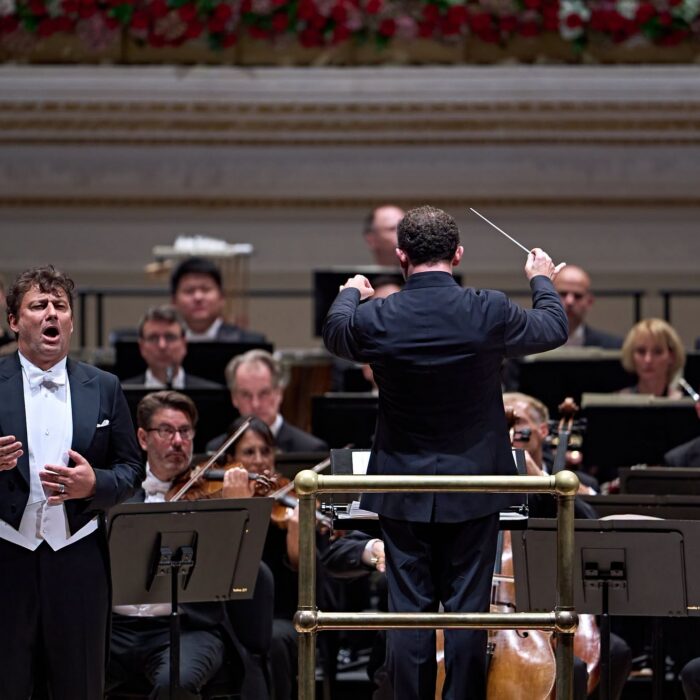
From the first downbeat, Keast made clear that Bernstein’s music would not be treated as heritage repertoire polished to a high gloss, but as something very much in the now. His conducting style is not merely demonstrative; it is corporeal. He seemed to live the rhythmic syntax, translating it into physical impulse — arms slicing, shoulders swaying, feet jumping, fingers snapping as if the beat were being struck into existence. In the wide expanse of the Oslo stage, with the chorus arrayed on risers at the rear, such amplification of gesture was not indulgence but necessity. The result was a rare alignment of visual and sonic rhetoric: one could almost see the syncopations.
The Norwegian National Opera Orchestra responded with a precision that never tipped into rigidity. Bernstein’s orchestration — so often a precarious balance of brilliance and translucence — was handled with notable care and nod to an American sway. The brass and percussion delivered the requisite bite, particularly in the brassy éclat of the “Candide” overture and the propulsive sections of the “Symphonic Dances.” Yet what lingered was the clarity of the inner textures: harp figures glinting through the orchestral weave, strings turning from astringent attack to a kind of bruised lyricism within a single phrase.
In “West Side Story,” Keast leaned into the music’s inherent theatricality. The “Mambo” erupted with calibrated exuberance, its rhythmic cells articulated with near-percussive exactitude, while the “Rumble” confrontation between Jets and Sharks acquired an almost physical immediacy. Here, the conductor briefly crossed the invisible line between pit and stage, joining in the kinetic suggestion of conflict — an intervention that might have felt gimmicky elsewhere but here registered as an extension of Bernstein’s own instinct to collapse boundaries between music and action. The transition to the aftermath — strings voicing a subdued lament as Tony falls — was handled with striking restraint: a sudden withdrawal of energy, leaving a pensive, bitter afterglow that resolved into a quasi-funereal cortege.
After the intermission, “Wonderful Town” unfolded in a semi-staged format that proved well suited to Bernstein’s this jazzy homage to New York and the adventures of two sisters from a small town in search of life, love and adventure. Having Norwegian-speaking Jørgen Backer as moderator bridged the spoken passages with a light touch, providing narrative continuity without impeding momentum. Around him, the chorus moved with a studied casualness, drifting in and out of the action, singing, dancing, and interacting in a manner that suggested the bohemian life of Greenwich Village rather than a choreographed mass.
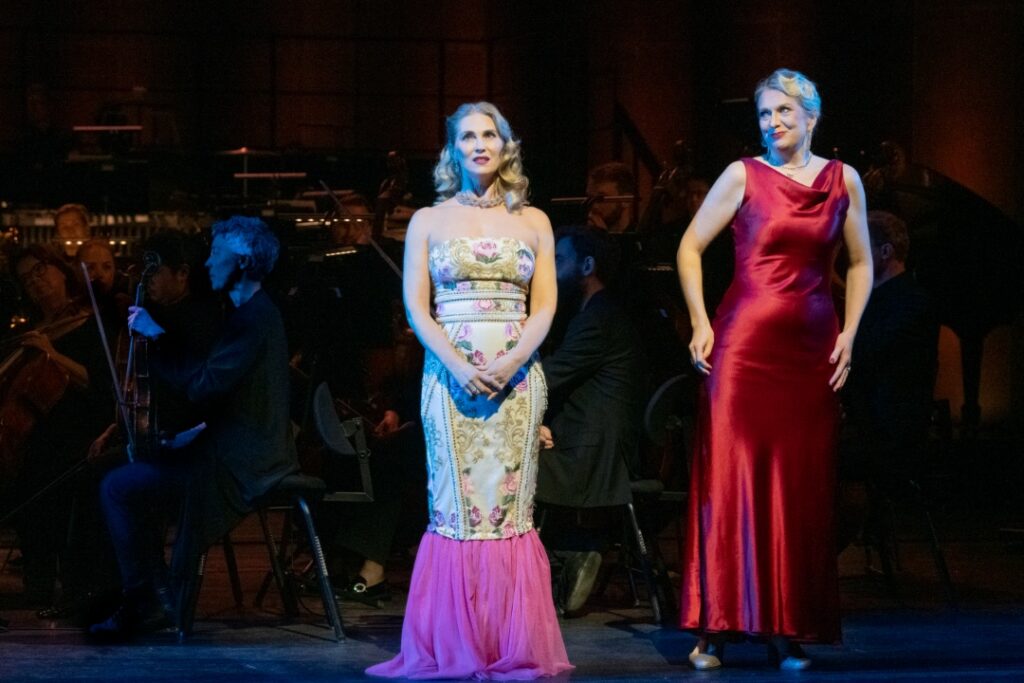
(Photo: Erik Berg)
Illuminating Cast
The sisters at the centre of the work were vividly drawn. Sparkling voiced soprano Eli Kristin Hanssveen as Eileen and melodious mezzo-soprano Tora Augestad as Ruth captured the essential duality of the piece: naïveté edged with dawning self-awareness. Their opening number, with its gently ironic nostalgia for Ohio, was delivered with charm tinged by uncertainty — a recognition, perhaps, that the myth of glamorous New York was already beginning to fray.
Among the supporting roles, baritone Aleksander Nohr made an endearing Wreck, projecting both physical bravado and a touching lack of intellectual sophistication, while tenor Rory Green offered a Robert Baker of lyrical sincerity, his timbre lending warmth to a character often played for diffidence alone.
Keast’s reading of “Wonderful Town” emphasized its stylistic plurality. Already in the overture, he drew out the “Ohio” motif as a kind of gravitational center, a reminder of the provincial origins that haunt the sisters’ metropolitan adventures. Elsewhere, he relished the score’s kaleidoscope of idioms: jazz-inflected rhythms snapping into focus, Latin undercurrents surfacing in ensemble numbers, and Broadway lyricism unfolding with unforced grace.
The culmination came, appropriately, in excess. The encore of “Conga!” erupted into a collective act of abandon. Soloists, chorus, and even conductor joined in the choreography, dissolving the formal barriers of concert presentation. This energy jumped the stage and the entire audience stood, clapped and danced along.
Talk About a Hot House!
The setting itself contributed to the experience. The Oslo Opera House, its exterior famously resembling a marble iceberg rising from the fjord, encloses a warm, wood-paneled auditorium whose acoustics favor both clarity and bloom. It is a space that rewards dynamic extremes, and Keast exploited this to full effect, allowing climaxes to blaze without ever obscuring detail.
In retrospect, what distinguished the evening was not merely its high voltage but its refusal to domesticate Bernstein. Rather than smoothing over the stylistic fractures — the oscillation between jazz and symphonic writing, between irony and sincerity — Keast and the team allowed them to remain audible, even productive. The result was a portrait of Bernstein not as a reconciled figure, but as a composer perpetually in motion, negotiating the fault lines of American musical identity.
Categories
Reviews