Metropolitan Opera 2025-26 Review: Innocence
By David Salazar(Photo: Karen Almond / Met Opera)
Trigger Warning: This review includes discussion of school shootings.
If you walked up to Lincoln Center from Broadway on Monday evening, you might have seen a line of people dressed in white holding up images of people. Underneath the images were their names, who they were, and the senseless event that took their lives. Sandy Hook. Parkland. These are but two such events that carry major significance.
According to K-12 School Shooting database there have already been 48 school shootings since January 2026, almost one every other day. In 2025, there were 235 incidents and 148 victims. In 2023 there were 352 school shootings and 250 victims. And we’re not even factoring mass shootings taking place around the country and the world. According to the Rockefeller Institute of Government, between 2000 and 2022, the United States had 109 public mass shootings; Russia, which had second most, had 21. No other country on record had double digits.
It’s awful to even just frame a traumatic event like this in terms of statistics because the cost is far more than these numbers could ever calculate. Loss of human life. Trauma for those who lose loved ones and those who survived. In a country that often seems callous about these atrocities, throwing around “thoughts and prayers” to get rid of guilt and responsibility, often times there is simply no other way to confront the issue than by forcing the discussion and remembering those who were lost.
That’s what Kaija Saariaho, Sofi Oksanen, and Aleksi Barrière’s “Innocence” does.
Chaos
I can definitely see where some might be repulsed by the idea of art attempting to portray such an abomination for “entertainment” or “escapism,” but that would be to belittle the importance that art serves in society. Art holds a mirror to us. Sometimes that mirror allows us to dream of what we can be. But sometimes, it reminds us of the worst parts of ourselves. Of the worst things people are capable of. To be forced to stare into that latter mirror can be painful, grueling, cruel and unusual punishment. It’s torture. That’s what the experience of “Innocence” often feels like.
The opera goes about this by how it subverts operatic conventions – both musically, dramatically, and perhaps most unexpectedly, the text itself.
The opera’s libretto presents two disparate narrative lines. On one hand, the audience is presented to a wedding between Stela and Tuomas. While the festivities are underway, a waitress Tereza realizes that the Tuomas’ brother was the very man who murdered her daughter Markéta years ago when he opened fire on his fellow students. As Tereza grapples with serving this family, Tuomas’ parents discuss whether Stela should know about their complex history. The opera’s more traditional narrative doesn’t necessarily pull punches, especially as it climaxes into its ultimate revelation (which is ironically very aligned with another recently released work of art that’s making headlines in the mainstream; if you know, you know), but for most of its runtime, some of its characters are allowed to live comfortably behind silence and, considering there’s a priest among the characters preaching for “belief in true love,” thoughts and prayers.
This main “plot” is “intercut” with a more experimental narrative in which victims, both living and dead, of that tragedy express the events as well as the trauma. Some characters speak on how challenging their lives are in the present due to the constant fear of another potential shooting. Others express anxiety for their children. Others detail their guilt over their inaction on the day of the tragedy. This narrative line dominates the first half of the opera, forcing the audience to confront the fallout. The work doesn’t hide its subject matter behind “characters” or “drama” or narrative conventions that give us the illusion of escape. Dramatic structure allows audiences to feel comfortable. It provides them with a goal toward which everything is headed. But when the main plot is only allowed to move incrementally without a clear “climax” or release of tension on the horizon, the audience feels similarly disoriented, creating further anxiety as to where it is headed. “Innocence” manages this tension perfectly.
When you have people singing and talking directly to the audience about tragedy and describing its painful details, you feel confronted. In fact, I couldn’t help but feel that that demonstration outside Lincoln Center prior to the performance was being amplified on the stage. There’s an oppressive quality to the proceedings that forces the audience to sit and listen, to grapple with the collective trauma, to feel our role in it. We get the privilege of that, unlike the people who suffered it. The lack of an intermission also plays into this. Intermissions traditionally allow us a moment to reflect, to think, to converse about the experience. We get to relax if the experience was too intense. Without an intermission, we are essentially forced to live through it unless we want to stand up and walk out, much like politicians in this country often do when confronted with this topic.
Language or the lack of grounding in one furthers this. We don’t get the stability of a single language in the text or music. Characters switch from English to Czech to Finnish to French to German to Spanish, etc. on a seeming whim. The expression of these texts shifts from spoken text to traditional operatic singing to a more folk vocal language. Sometimes it’s amplified, sometimes it isn’t. Sometimes the musical gesture will emphasize some words in ways that feel natural to spoken languages, while in others it might exaggerate certain sounds to express the unease of the word. It doesn’t prescribe to any vocal style, instead seemingly incorporating several to keep the listener on edge.
Saariaho’s music opens with dark colors in the piano, percussion, and brass, with solo instruments interjecting short phrases. It feels like musical chaos trying to hook onto something for direction. Operatic forms like duets or arias or ensembles are largely absent with a ghostly chorus often interjecting itself off-stage.
You feel that as the opera develops, the music, like the text and narrative structure, is searching for some sort of identity, some way to grapple with finding wholeness within itself. It’s searching for the big word that all art seemingly aspires to – “MEANING.” But as with the tragedy of school shootings, there can be no coherence. Why something like this happens is not something art can possibly synthesize. It can aim to explore it, question it, remember it. But to actually explain it or find “meaning” in it is impossible and “Innocence” knows as much. All it can do is force the audience to reckon with it.
It doesn’t all work. The piece takes on narrative paths in its second half that can confound, such as when one character tries to suggest a reasoning for why the shooter made that fateful decision. While I can understand the attempt to explain it from some characters’ perspectives, I wonder if the work needed that. The entire sequence is framed as one character attempting to shift some blame onto Tereza’s daughter for bullying the shooter and thus inciting him to commit the act, but it feels reductive because there’s a moment where the “bullying” is depicted, but nothing is developed thereafter from any perspective. As an audience member, this kind of bullying could lead to the cause, but is this really it? It can’t be. The opera repeatedly notes that the shooting was planned for over a year and that’s where it leaves this conversation. I bring this up because the moment you attempt to bring up a “possible reason” for this to happen, a can of worms gets opened up. You can’t just leave it there. Not to humanize or justify the actor, but to discuss the conditions that lead to this tragedy. To simply have one character throw out an idea and have no one question it leaves the wrong kind of tension in the air.
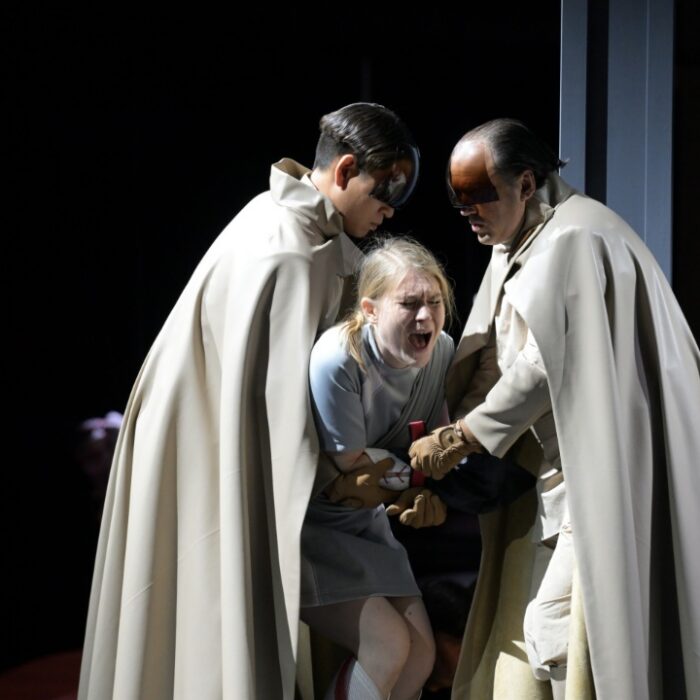
Simon Stone’s production is dizzying in all the right ways. The set on a turntable, a Peter Gelb-era staple, is used to powerful effect. Designed by Chloe Lamford, the multi-level cube-like production, with each side representing a different set that is constantly evolving (one side features a long space on the lower level a wedding salon turns into a school cafeteria and later an empty white room), rotates constantly never allowing you any sure footing in any circumstance. The sense of instability and chaos is latent in Stone’s directorial choices as well. There’s naturalistic physicality in the more traditional narrative, but in contrast to this, the other performers contort their bodies, move in slow motion, shift, and shuffle in ways that are more expressive of their anxiety, fear, and pain. It adds to the difficulty of the experience in all the right ways.
Brilliant Cast
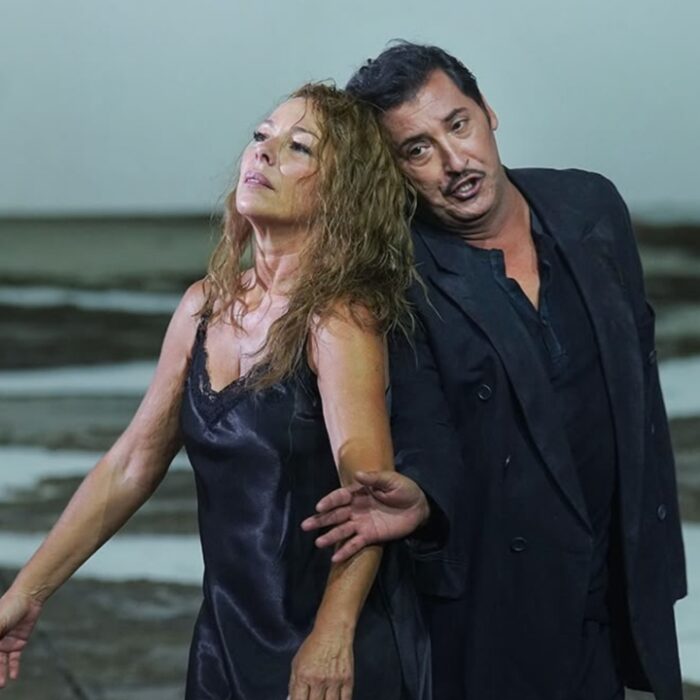
Joyce DiDonato headlines the cast as Tereza, delivering a heart-rendering rendition as she grapples with the loss of her daughter Markéta and the anger she feels at having to serve the very family that killed her. She gets a brief solo in the first half where DiDonato’s glorious mezzo provides the opera with one of its few moments of lyrical respite. But it’s in the second half, where she lets her fury loose, that DiDonato made her strongest impact. The first of these moments was her confrontation with the father in the kitchen, even shoving him off when he attempts to “comfort” her. But her “final” scene, in which she makes the shocking revelation to the bride, was the crowning moment. She unleashed all of her vocal potency here, grabbed the wedding cake and flung it around. Even when Kathleen Kim, as the mother, fired back at her, blaming Markéta for bullying her son, DiDonato didn’t back down.
As Markéta, Vilma Jää was spotless. Her role required a constant shift in vocal styles, amplifying Jää’s own versatility across opera, pop, and folk music. During the flashback scene in the cafeteria where she bullies the shooter with the “Frog song,” her singing had vibrancy and pointedness to suggest the joy of cruelty of the moment. In other scenes, when she related her mother’s suffering or her own pain at the moments of death, her singing had a more pared down quality, the vibrato delicate.
Rod Gilfry and Kathleen Kennedy were solid complements as the father and mother. Gilfry exuded calm throughout the opera. At times, when he tries to be comforting, the vocal writing places him in extreme upper range, forcing the singer to use falsetto. Gilfry managed to express how overwrought and false these attempts with pristine vocalism. Meanwhile, Kim’s character is full of anxiety, the writing constantly shifting up and down the register. The soprano was at her technical best throughout but as her character unraveled in the latter stages, the beauty gave way to a more jagged quality.
Myles Mykkanen shifted from a firm tenor in the early going to more explosive in the opera’s second half. As he made his big revelation, you could feel the tenor’s voice building in its intensity. Jacquelyn Stucker was fantastic as Stela, especially in her second-half solo moment where she comes to the realization that Tuomas saw her a new beginning. Here the vocal writing shifts into the upper register repeatedly and the soprano’s high notes were potent and precise in these moments.
Stephen Milling was solid as the priest. His first scene is written very low and the bass managed the lines with clarity even if the tessitura sounded uncomfortable to listen to. However, this musical choice fit in with the narrative, emphasizing the hollowness of the priest’s words. The thoughts and prayers were useless here.
Lucy Shelton was stunning as the Teacher, a role written in the Sprechstimme style. She shifted flawlessly between declaimed text and hauntingly musical gestures at the extremes of her voice to express the horror of her experience
Camilo Delgado Díaz delivered spine-chilling anxiety as Jerónimo, as did Simon Kluth as Anton, Marina Dumont Anatassiadou as Alexia and Beate Mordal as Lily.
Julie Helga played Iris, the shooter’s friend and accomplice whose conscience prevents her from going through with the plan. Her entire role is in declamatory French, which Helga delivered with a bitter bent throughout as she snaked about the stage. When she confronts Tuomas about his role in the tragedy, her emphasis on his betrayal had a haunting sharp-edge.
The opera also featured the work of such actors as Jairus Abts, Oksana Barrios, Sam Hannum, Niara Hardister, Jalen Justice, Minga Prather, Brian Soutner, and Brant Zheng. The entire ensemble worked together seamlessly to create an experience that I won’t soon forget.
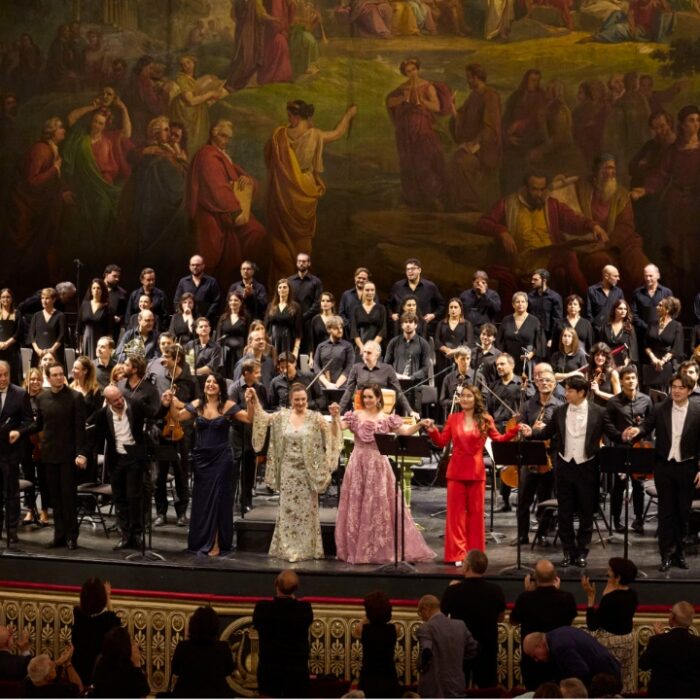
The same goes for the Met Opera Orchestra under Susanna Mälkki, who managed a delicate balance between stage and pit. I was particularly locked into the tonal shifts and balances across the ensemble with every piece feeling part of the larger fabric and yet disconnected from it in different moments.
“Innocence” is a piece that everyone should witness and it was inspiring to see the program list this production as a collaboration with the Festival d’Aix-en-Provence, Dutch National Opera, Royal Opera, Finnish National Opera, and San Francisco Opera. It’s not a work you will “enjoy” or possibly even “like” but that’s not the point. It will confront you, question you, force you into looking in the mirror and then asking about the role we all play in this epidemic of senseless violence. But most importantly, it will help you remember the innocent victims of these tragedies. This is how we can begin to heal as a society.