Magdeburg Telemann Festival 2026 Review: Festmusik & Otto
Gold, Shadows, and the European Bridge: A Tale of Two Telemanns at the Magdeburg Festival
By Mengguang Huang(Photo: Viktoria Kühne)
The 2026 biennial Magdeburg Telemann Festival reached its zenith this week, offering a rewarding musical marathon that spanned centuries of political and musical history. Over the course of a single day, the festival presented two contrasting faces of Georg Philipp Telemann: the celebratory architect of Habsburg dynastic splendor and the pragmatic, experimental operatic bridge-builder. From the daylight echoes of the Johanniskirche, to the stark, psychological shadows of Theater Magdeburg’s “Otto,” the day provided a comprehensive portrait of a composer whose genius lay in his unparalleled ability to adapt to any venue, patronage, or stylistic demand.
Golden Auras and Stormy Seas: A Sonic Banquet for Telemann in Magdeburg
Michael Alexander Willens was awarded the Telemann Prize this year. To honor the occasion, Willens and his Kölner Akademie presented a sprawling, two-part festive program that served as both a musical banquet and a historical reimagining.
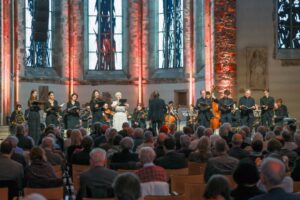
The auditory experience was nothing short of a revelation. The Kölner Akademie played with a remarkable sense of relaxation, projecting a sound that felt entirely effortless yet possessed a vivid, three-dimensional spatiality. Though the venue shifted from the original outdoor setting of Frankfurt’s Römerberg in 1716 celebration to the resonant interior of Johanniskirche Magdeburg, the ensemble maintained a grand sense of “outdoor place.” The trumpet and oboe section, in particular, was the evening’s crowning glory, bathing the score in a golden aura. While instrumental highlights were numerous to count, the absolute peak of the orchestra’s prowess arrived in the aria “Die tobenden Wellen der stürmischen See.” The ensemble achieved an unparalleled three-dimensional effect, navigating the typical Baroque storm tropes with a precision that moved from a whisper to a roar, creating a sense of distance and proximity that felt physically tangible.
The day’s vocal journey was divided between the sacred and the political. The morning’s Church Music, “Auf Christenheit! begeh ein Freudenfest,” was stripped of its original liturgical sermon to focus purely on the theological significance of the Archduke’s birth. The interpretation was appropriately square and dignified, emphasizing the religious gratitude of the era. This sacred half of the program was characterized by Telemann’s high proportion of accompanied recitatives, which Willens directed with a meticulous attention—from sustained chords to independent motivic insertions. This reached a spiritual climax in the magnificent aria “Großer Kaiser, Zier der Erden”, where a solo trumpet was introduced to color the heroic affect of the ruler.
Sopranos Hanna Herfurtner and Elena Harsányi navigated the intricate melismatic passages with crystalline purity, particularly in the arias that frame the central message of divine favor. The voices of Johannes Hill and Thomas Bonni grounded the performance in the biblical dicta, particularly in the passage where jubilant trumpet and timpani ensembles soared above the vocal lines to herald the “Prince who is born.” The morning session concluded with a masterful return to the opening fugue, effectively spanning a grand arch over the entire sacred composition.
The interval featured a stroke of curatorial creativity: to mirror the original 1716 functional requirements of a Habsburg dynastic celebration, a rich buffet was arranged, allowing the audience to physically partake in the communal feasting that historically accompanied such extraordinarily sumptuous occasions.
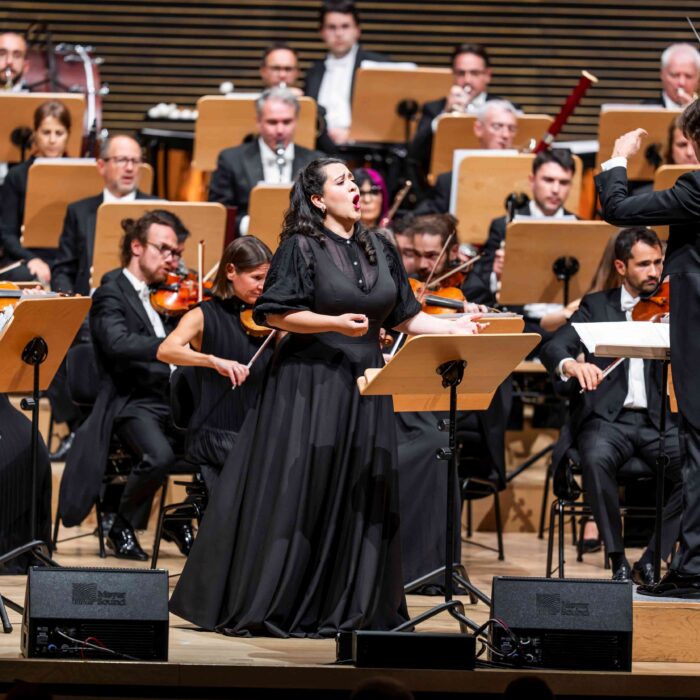
The afternoon Serenata, “Deutschland grünt und blüht im Friede,” leaned into the political and social dimensions of the event. This second half possessed a distinctly more operatic breath, with complex vocal lines reflecting the psychological shifts of a populace emerging from a century of war. The recitatives throughout the day were masterclasses in characterization, with Thomas Bonni and Hanna Herfurtner providing a compelling contrast between strength and grace that drove the narrative forward. In the aforementioned “storm” aria, Elena Harsányi as Irene delivered a performance where her voice seemed to hang suspended above the orchestral waves, imbued with a sense of transcendence.
Herfurtner once again demonstrated her bright, agile soprano in the demanding “Auf, auf! und erwachet, heroische Sinnen,” engaging in a brilliant duel with the solo trumpet. While her projection occasionally felt slightly understated in a few isolated passages, her reaffirmation of the human voice’s allure against the heroic brass remained undeniable. The dramatic tension was heightened by Thomas Bonni’s portrayal of Mars, who arrived with an air of boastful pride. This was balanced by Raimonds Spogis as the personified City of Frankfurt. Though Spogis’s portrayal initially bordered on the slightly affected, he quickly settled into the role, allowing the audience to feel the distinctiveness of his character’s anxiety and doubt.
By balancing the monumental display of the brass & winds with the tendresse of the vocalists, the Kölner Akademie captured the duality of an era caught between the trauma of the past and the desperate hope for a stable future. As the final notes of the Serenata rang out, it was clear that the Telemann Prize had found a most deserving recipient in Michael Alexander Willens.
(Photo: Viktoria Kühne)
A European Bridge Over a Darkened Stage: Handel/Telemann’s “Otto” at Theater Magdeburg
While the morning in Johanniskirche celebrated Telemann’s ceremonial grandeur, the late afternoon at Theater Magdeburg revealed his modernist edge. This production of “Otto, re di Germania”—an European bridge fusing Handel’s 1723 London score with Telemann’s 1726 Hamburg adaptation—reconciled Handel’s deep psychological portraiture with Telemann’s gritty, experimental pragmatism. Shifting from daylight diplomacy to interior psychological “darkness,” the performance served as a stark reminder that Telemann’s legacy extends far beyond festive trumpets into the realm of profound dramatic deconstruction.
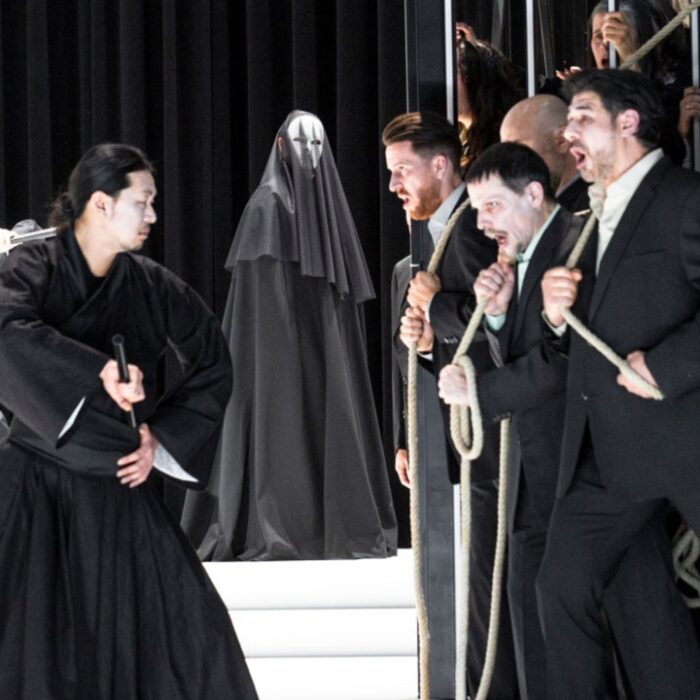
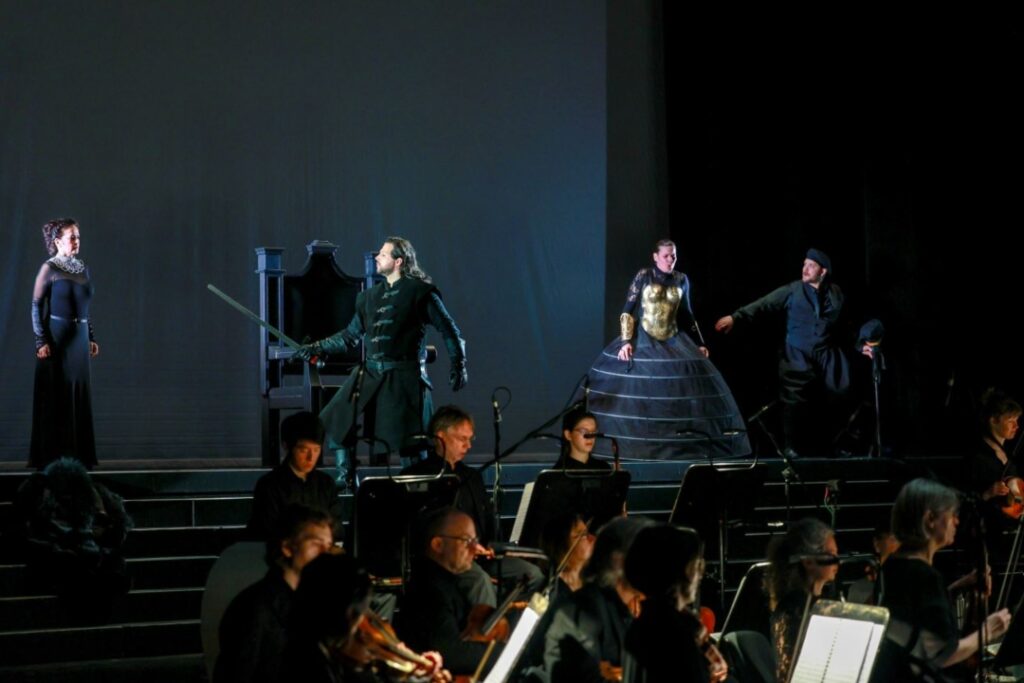
The production utilized a semi-staged minimalism approach that leaned heavily on digital projection. Aside from a single physical throne, the world of the opera was constructed through digital projections of hand-drawn imagery representing ships, forests, palaces, and battle scenes. Unfortunately, these visuals functioned merely as basic atmospheric cues; the transitions were as clunky as early-century slideshows, lacking the fluid sophistication. Furthermore, the entire stage remained shrouded in a persistent, unchanging darkness for three and a half hours, creating an oppressive atmosphere that tested the audience’s endurance.
Meanwhile, this starkness placed a tremendous burden on the singers’ three-dimensional body gestures and vocal projection. In this vacuum of scenery, the narrative developed with a tight, direct intensity, forcing the drama to live entirely through the performers’ physicality and sound.
Despite pre-show announcements that a few singers were battling colds, the vocal quality remained virtually uncompromised. Roberta Mameli, as Theophane, was the undisputed lighthouse of the night. Clad in golden armor with a brilliant, piercing voice, she commanded the dark stage with an unwavering sense of royal nobility. While Telemann’s adaptation stripped away some of the iconic arias Handel originally gave Theophane—such as the heartfelt simplicity of “Falsa immagine”—the newly added arias were arguably equally radiant. Mameli navigated the character’s emotional arc—from the sting of deception to self-doubt born of misunderstanding and finally to reconciliation—with exquisite precision. Crucially, she portrayed a princess who was never merely a pawn of political intrigue, but a firm and dignified noblewoman.
Matthias Winckhler as Otto was equally compelling. He balanced the character’s firm political resolve and confident defiance of enemies with a genuine, palpable tenderness toward his lover. This dual humanity made the German King feel authentic rather than a two-dimensional archetype. The only slight detraction from his performance was purely visual: both Otto and his rival were styled in a similar “German barbarian” aesthetic. Against the backdrop of an already dark stage, the visual differentiation was frustratingly weak.
The antagonists were portrayed with a rare depth that avoided the cardboard villain cliché. Simona Šaturová as Gismonda was chilling in her ambition but deeply moving in her raw, maternal concern for her son’s fate. This blood-bond realism added a layer of tragic weight to her scheming. Likewise, Florian Götz as Adelbert avoided the trap of being a weak-willed pawn. He faced the brutal fluctuations of the political struggle with a resilience that commanded respect despite his character’s duplicity.
Mathilde Ortscheidt as Matilda added a crucial layer of vengeful determination, reflecting her complex struggle between her love for Adelbert and her loyalty to Otto. While her performance was dramatically potent, one noticed that her vocal production possessed an unusual, slightly “fluid” quality—as if water held within the mouth—which momentarily affected her usual clarity. The inclusion of Ludwig Obst as Isaurus provided the specific comic relief that Telemann and Glauche felt was necessary for their Hamburg audience. Finally, Pau Armengol as the pirate Emirenus (the disguised Byzantine prince) delivered the character’s roaring nautical themes with the requisite storm-like energy.
The Akademie für Alte Musik Berlin delivered a performance of typical high completion, marked by an extraordinary sensitivity to the text. The basso continuo group was particularly astonishing; the double bass was dynamic and youthful, providing a vibrant pulse that complemented the warmer, neutralized tones of the string section. Francesco Corti’s harpsichord playing was, as expected, brimming with imagination.
What set this ensemble apart was their high degree of stylistic recognition. They masterfully captured the subtle shift in compositional style between the two composers: Handel’s original sections focused on deeper psychological exploration, while Telemann’s additions—much like other early German operas in Hamburg Gansemarkt Oper —were more direct, experimental, and even “grittier” in their texture.
Conclusion: A Triumph of Musical Substance
Ultimately, the visual presentation of this “Otto” remained the production’s most polarizing element. The combination of unrelenting darkness and a lack of dynamic 3D dialogue or physical interaction between the singers made the theatrical setting feel largely superfluous—a missed opportunity for spatial storytelling.
While hosting a production dominated by Handel’s musical DNA at a festival dedicated to Telemann might have initially suggested a sense of stylistic discordance, the result was a revelatory success. For the Telemann connoisseur and the Baroque enthusiast alike, the evening transcended its visual gloom to become a performance of immense documentary and musicological significance.