Latvian National Opera 2025-26 Review: Salome
By Federico Ginzburg Natalucci(Photo: A Zeltina)
“Salome” undoubtedly stands as one of the most significant works in the history of German opera. The elements Wagner outlined in his works reached Strauss as a direct torrent of influence, and it is precisely in “Salome” where Strauss finally finds—after “Guntram” and “Feuersnot”—a personal, absolute, and unmistakably original musical language. I have always perceived in “Salome” a spirit closely akin to the exoticism that characterized Fellini’s cinema, particularly when thinking of “Satyricon:” those scenes imbued with a strange, unsettling atmosphere, accompanied by their peculiar music, seem almost like a cinematic counterpart—within Italian film—to what “Salome” represents in German opera. One need only think of the eclectic musical idea behind the “Dance of the Seven Veils” and compare it with the early scenes of that ancient metropolis in the first days of the Roman Empire.
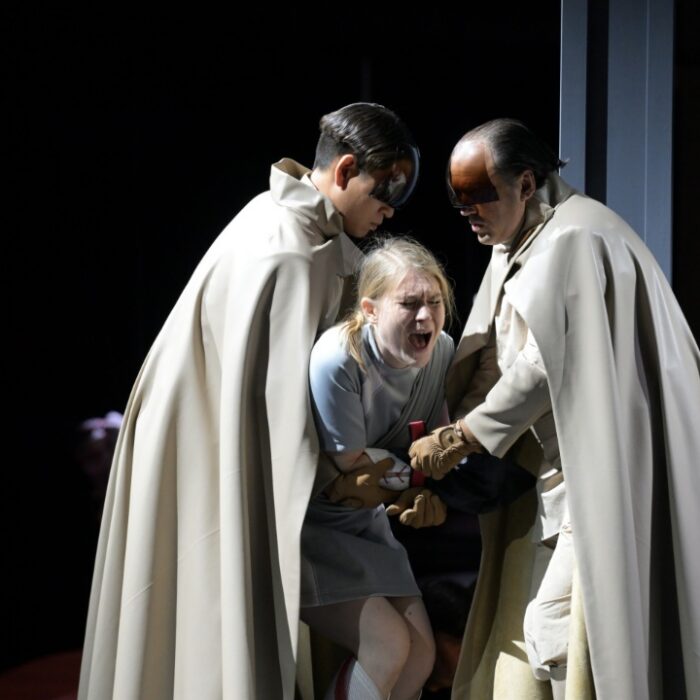
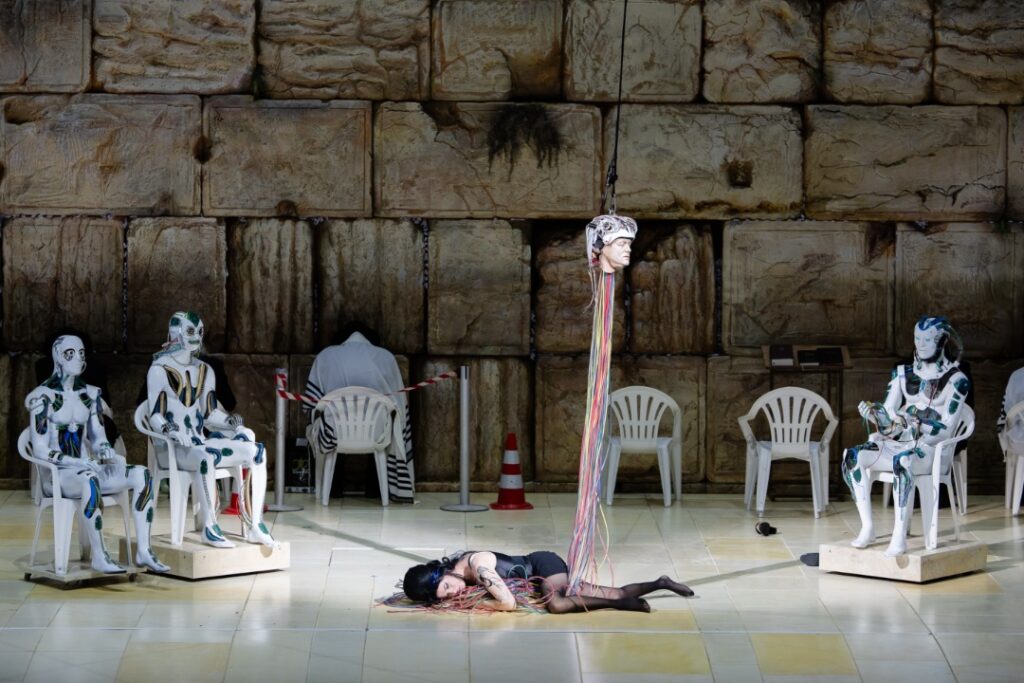
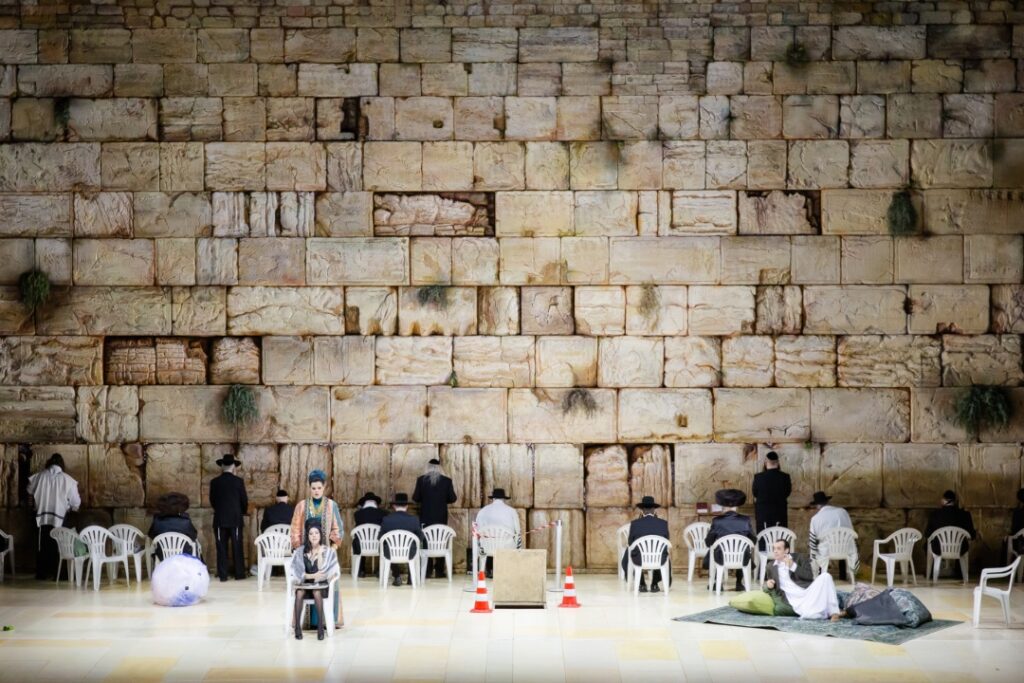
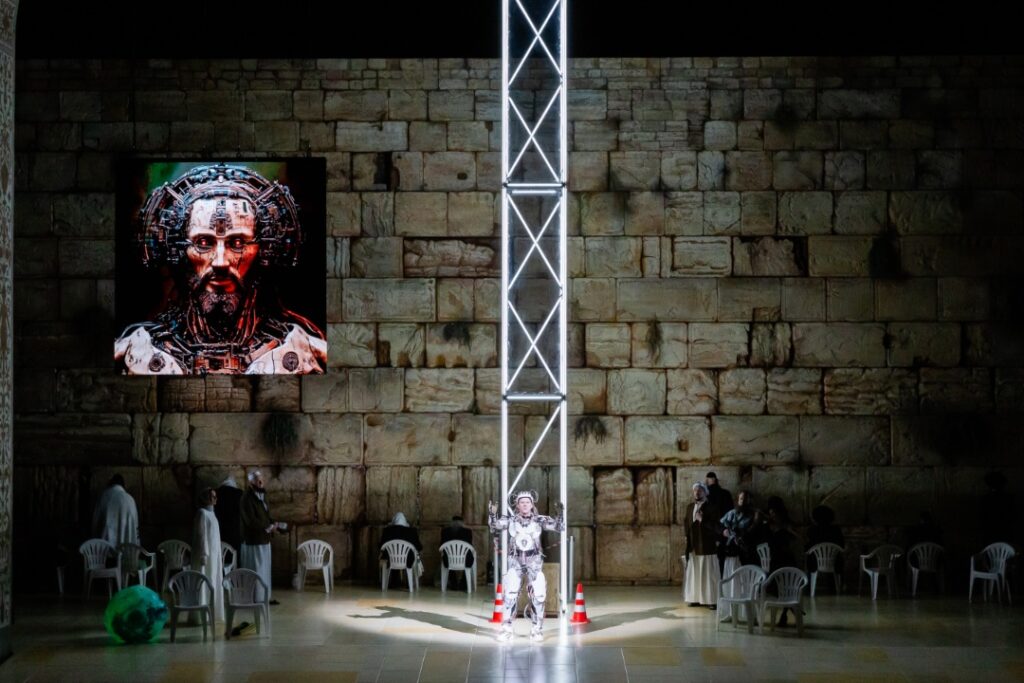
Returning to the Latvian National Opera, “Salome” appears as a rare gem within an intense opera and ballet schedule, largely focused on Italian opera and the great French and Russian ballet titles. In operatic terms, Verdi—and above all Puccini—are the most frequently performed composers. German opera, by contrast, is seldom represented, with “Salome” being a notable exception. Premiered in February 2025, Alvis Hermanis’s production combines a dystopian future shaped by religion and artificial intelligence. Set in the year 2030, the fixed scenic image is the “Wailing Wall,” already visible before the opera begins, with the curtain raised and supernumeraries dressed as Orthodox Jews praying. In this dystopian future, the State of Israel no longer exists; the territory is under Muslim control, replacing the Romans of the original libretto. Herod, Herodias, and the principal guards are portrayed as Muslims. Jochanaan, however, is conceived as a humanoid created by artificial intelligence. The messianic context is thus attributed to a race of superhumans connected to artificial intelligence; both Jochanaan and the prophet Jesus are represented in this way.
Strengths and Weaknesses of an Ambitious Staging
The principal achievement of the production lies in its overwhelming sense of organic coherence: the narrative unfolds without significant gaps or abrupt disruptions between the visual storytelling and Hermanis’s conceptual framework. This stands in contrast to many contemporary European productions in which the audience must reconstruct the original plot from fragmented scenic elements. The Jewish–Muslim dichotomy used to represent Roman-ruled Palestine works remarkably well, and the humanoid conception of Jochanaan fits convincingly with the prophet’s mysterious figure that so deeply fascinates Herod’s daughter. Finally, the character of Salome is visually modeled on the image of the British singer Amy Winehouse.
(Photo: A Zeltina)
Undoubtedly, the greatest triumph of the production is the brilliant realization of the “Dance of the Seven Veils,” a climactic moment that has posed a longstanding challenge since the opera’s premiere due to it’s erotic demands on the soprano. From the outset, a group of seven women in burqas wander in front of the Wailing Wall, seemingly inconspicuous and indistinguishable from the rest of the extras. When Herod finally persuades Salome to dance for him, these seven women surround the princess and begin to dance. The choreography explores arabesque movements in response to Strauss’s seductive music, while Salome sits and dismantles a kind of fruit in her hands—an analogy for the seven veils she metaphorically removes. At center stage, the seven women gradually remove their burqas, revealing traditional bedlah costumes, offering a formidable solution that remains entirely faithful to the Straussian aesthetic of this dance.
It is worth noting that during the “Dance of the Seven Veils”—and at several other moments of the opera, particularly those connected to Jochanaan and the “AI prophecies”—a suspended screen displays AI-generated erotic imagery. This visual device, however, adds little of real substance to the scene and proves largely superfluous.
Another notable success of the staging occurs at the beheading of Jochanaan: Herod’s slave presents Salome with the prophet’s head, still attached to a two-meter-long system of cables torn from the subterranean dungeon beneath the stage. In her final delirium, rather than smearing herself with Jochanaan’s blood, Salome entangles herself in the descending cables, as if they were creeping vines or lianas, creating a visually striking effect.
Despite these compelling elements, the production commits a serious misstep at the opera’s conclusion. After the horrified Herod witnesses Salome’s grotesque interaction with the prophet’s head and orders her execution, the staging fails to depict her death. Instead, the scene ends abruptly with a blackout—without a curtain—and with the suspended screen still illuminated. This pseudo-blackout, combined with residual lighting that left some extras visible onstage, created a misleading sense of continuity. The audience, uncertain whether the opera had truly ended, began to applaud hesitantly. Unfortunately, much of the dramatic tension accumulated throughout the opera toward Salome’s death dissipated at that moment, undermining part of the powerful scenic impact achieved until then.
(Photo: A Zeltina)
Musical Performance
Maestro Ozoliņš offered an interpretation of the score at the highest level. The textural complexity of “Salome” was conducted with exceptional balance, and even in the most intense climactic moments, the orchestra responded with clarity, avoiding any overlap between sections. The ensemble delivered everything one expects from this Richard Strauss title: the long Straussian phrases, which consistently pose considerable technical challenges, were masterfully sustained. The seductive quality imposed by the composer in the “Dance of the Seven Veils” was executed outstandingly by the string section. The orchestra demonstrated cohesion, solidity, and a robust sound—the very qualities one expects in this repertoire. The brass section, for its part, never overwhelmed the rest of the orchestra; as noted earlier, even at peak points, the ensemble functioned as a single organism within Straussian heterogeneity.
Communication between stage and pit could not have been better. Strauss famously conceived opera not as an orchestra accompanying the singers, but rather the reverse—the singing accompanying the orchestra. This concept is particularly evident in “Salome,” where the vocal lines emerge from the orchestral mass, merge with it, and at times collide. Nevertheless, the balance between stage and pit—by no means an easy task—was maintained with remarkable equilibrium.
Cast Details
The cast on February 17 featured a special lineup with several international artists. Overall, the cast proved uniformly brilliant, both vocally and dramatically—qualities essential to this biblical tragedy.
In the role of Narraboth, Raimonds Bramanis portrayed a magnificent guard, utterly captivated by Salome’s beauty. The scenic tension between the princess and the guard grew steadily until his suicide. The vocal challenges of the role were met with security, never distracting the tenor from his dramatic portrayal of an Arab soldier who resorts to prayer in an attempt to withstand the princess’s temptation.
Herod enters the scene following Narraboth’s suicide, and his imposing presence revealed, in the German tenor Marco Jentzsch, a masterful command of acting. Specifically, once seduced by Salome’s dance and pressured by both mother and daughter to order the decapitation of Jochanaan, Jentzsch—at the height of Herod’s downfall—collapsed upon his “throne” with such organic realism that he entirely commanded the dramatic focus of the moment. His dramatic versatility as Herod was exceptional. Vocally, his performance proved equally compelling: endowed with a deep, full-bodied vocal color, he navigated the role’s complexities with remarkable naturalness. His projection above the orchestral mass was impeccable, achieved through complete and organic command of the voice.
Marina Prudenskaya as Herodias delivered a forceful interpretation closely aligned with the queen’s hysteria. The German mezzo-soprano maintained a generally homogeneous vocal color throughout her range. The characteristic Straussian melodic jolts associated with Herodias’s personality were handled effectively, with some high notes slightly sharp-edged yet never compromising solid vocal emission. Her middle register displayed a pleasing, rounder color.
(Photo: A Zeltina)
Jochanaan proved another major surprise of the evening, portrayed by Rihards Mačanovskis. From his emergence from the subterranean dungeon, the bass-baritone astonished the audience with commanding vocal presence and profound color, achieving an excellent balance between timbral darkness and clarity. His extensive physical work adapting to the robotic costume also deserves special mention, as he maintained naturalness within his mechanized movements. While the character functioned effectively within the staging concept, one might have wished for greater interaction between Salome and the prophet during the princess’s declaration of desire. Nevertheless, Mačanovskis’s vocal and dramatic authority remained unmatched.
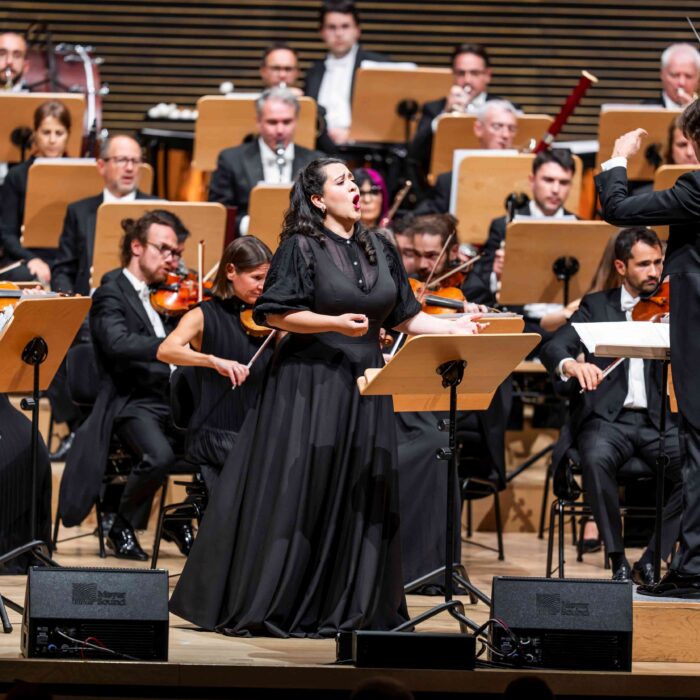
We reserve for last the undisputed star of the evening, who received a long and well-deserved ovation from the audience. Vida Miknevičiūtė offered a perfect embodiment of Salome, demonstrating extraordinary vocal command. Her brilliant timbre and consistently soaring projection rose effortlessly above the orchestral texture. This vocal authority was further enhanced by a well-controlled vibrato throughout her homogeneous range, as could be observed in her scene of erotic delirium toward Jochanaan, which was without doubt a compelling synthesis of all her artistic virtues. Faithful to the character, she dominated the stage at every moment, revealing not only impeccable vocal technique but also a remarkable naturalness in her stage presence, fully embracing the histrionic essence that defines Salome.
Without a doubt, the Latvian National Opera presented one of its finest productions of the season with this title, offering—through its permanent ensembles and an international cast—a magnificent display of collective excellence. One can only hope to encounter Straussian productions of this caliber more frequently.