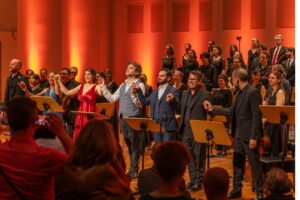
Klangvokal Music Festival Dortmund 2026 Review: Les Boréades
By Mengguang Huang(Photo: Oliver Hitzegrad)
A volatile world of sonic storms, earthquakes, and lightning flashes (forces of nature tightly bound to dangerous political subversion) was completely locked away when Jean-Philippe Rameau’s last opera, “Les Boréades,” was abruptly shelved in 1763. Paranoid of the libretto’s Masonic undercurrents, French royal censorship chose to suppress an extraordinary amount of musical energy. The score’s modern resurrection had to wait until the late 20th century, when John Eliot Gardiner finally unleashed this trapped fury. Far from being the dried-up scribblings of an exhausted octogenarian, the music is a deeply progressive, symphonically unchained masterpiece of the late tragédie lyrique—one that stood defiantly against the rising tide of the lighter Italianate galant styles of its day.
Psychological Saturation and Rhetorical Weight
Rameau’s late-period vocal writing demands a flawless command of French theatrical rhetoric while requiring a dramatic heft capable of cutting through a full orchestra power. In casting Gwendoline Blondeel as Queen Alphise, this Klangvokal Musikfestival concert format production secured a soprano of spectacular psychological nuance. Blondeel possesses an extraordinarily penetrative high register balanced by a rich, grounded lower range, allowing her to navigate Rameau’s circuitous melodic lines with ease. At the conclusion of Act one, her extended monologue showcased not only a flawless command of high-difficulty coloratura but also a profound capacity for interior conflict. She laid bare the acute uncertainty of a monarch torn between her authentic love for Abaris and the severe royal expectation dictating her vows. Yet, once fully captivated by Amour, Blondeel’s portrayal shifted into unreserved defiance. Willing to forfeit her crown and face the wrath of the North Wind, her explicit contempt and fury toward the tyrannical Boréades carried a blistering, authentic weight.
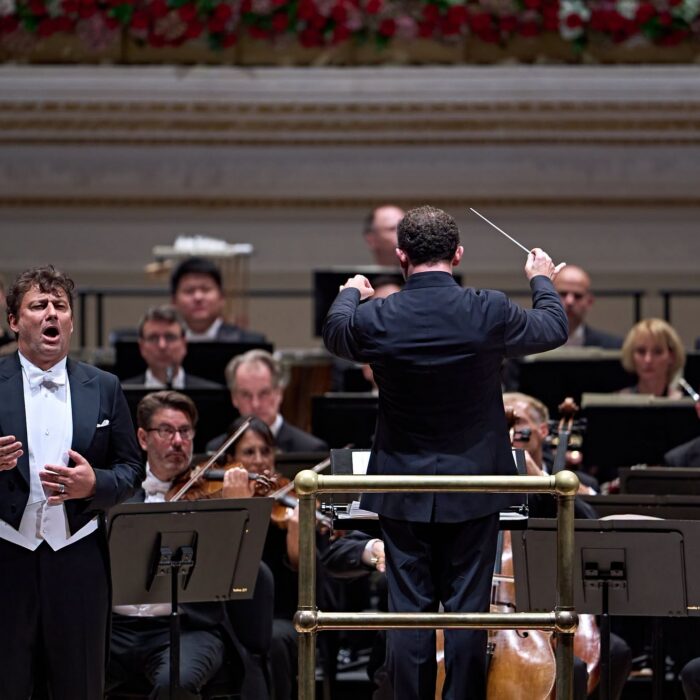
Opposite her, Reinoud Van Mechelen took on the demanding role of Abaris. Arguably the finest haute-contre of his generation, Van Mechelen delivered a performance of immense dramatic tension. His voice rang with a brilliant, metallic masculine luster that filled the hall during grand scale scenes while retained an affecting intimacy during interior monologues. The opening of Act two featured an unforgettable confrontation between the two lovers. Bound by the constraints of birth and duty, their shared hesitation was rendered palpable through sincere body language. Van Mechelen beautifully captured Abaris’s evolution: from his vulnerable hesitation before Adamas regarding his seemingly “mortal” lineage, to the sudden accumulation of courage as he seizes the magic arrow to rescue his love. Crucially, Van Mechelen achieved this while taking double duty as the evening’s conductor. Guiding the entire production with fluent physical gestures, his dual leadership was nearly seamless, marred only by a few fleeting moments where the libretto’s explicit stage directives could have been more sharply underscored.
Antagonist Forces and Enlightenment Foils
The opposing forces—the terrifying Boreads intent on forcing Alphise into political submission through marriage—were anchored by a lineup that completely rejected courtly affectation. No pampered, decorative royals here. Instead, baritone Philippe Estèphe (Borilée) and tenor Robert Getchell (Calisis) brought a cold, elitist arrogance to the stage, routinely and brutally cutting off Abaris’s desperate pleas. Their performance carried a genuine, haughty superiority. When Alphise finally rejected them, their shift from aggressive, entitled courtship to pure vindictive rage was psychologically razor-sharp. One could feel the exact moment their wounded pride turned into mental tyranny.
Tomáš Král, pulling double duty as Apollo and the high priest Adamas, sang with a dignified, authoritative poise. His stage presence carried immense persuasive power, establishing a steadying guidance for Abaris before descending to resolve the cosmic deadlock in the finale—his only minor flaw being a slight inconsistency in orienting his physical direction according to the libretto staging cues. Conversely, Lisandro Abadie’s Boreas remained an unseen shadow for the first few acts, only to make a majestic, terrifying entrance in Act four. Abadie offered no mercy to Alphise, maintaining an unyielding rigidity until Apollo’s sudden intervention revealed Abaris’s divine lineage, prompting a swift, dramatically satisfying capitulation. Providing a tender consolation to this violence, the soprano Lore Binon portraying queen’s companion Sémire (as well as Amour) sang with an exquisite, fluid agility. She infused her warnings regarding the social divide with a warm, vernal affection that felt like a benevolent breath of spring amid the chilling winter.
Ensemble and Chorus: The Protagonists of the Storm
“Les Boréades” contains some of the most thrilling purely instrumental and choral narrative writing in Baroque history. The collective backbone of this performance was the Chœur de Chambre de Namur. Delivering a lush, multi-layered acoustic blend that completely saturated the Orchesterzentrum, the choir was entirely convincing, serving as a dynamic echo to the protagonists. Their transitions from active participants to traumatized citizens fleeing catastrophes felt completely organic.
The heaviest burden of the evening fell squarely on the shoulders of a nocte temporis. Playing on period instruments, they transformed Rameau’s revolutionary 1763 orchestration—complete with its pioneering clarinet lines and exposed bassoon parts—into a vivid, highly cinematic canvas. The colors were astonishing. There was a supple, elastic string section, mercurial woodwinds, and brass that packed a raw, visceral punch, all driven forward by a tirelessly inventive basso continuo. Their vivid tone-painting extended to a brilliant array of percussion and wind-machine effects. The numerous atmospheric court dances and the sublime “Entrée de Polymnie” in Act four were executed with breathtaking sensitivity. If there is any room to nitpick, it was at the very end of Act three. During the iconic storm sequence, a few minor pauses temporarily diffused the kinetic tension. The result was a triumph of high-resolution technical execution and saturated emotional urgency. Even in a concert format, the sheer power of Rameau’s final swan song successfully projected its complex theatrical architecture directly into the imagination of the audience.