Internationale Händel-Festspiele Karlsruhe 2026 Review: ‘Tamerlano’ & ‘Atalanta’
Handelian Diptych Illuminates Tyranny, Tears & Triumphant Youth
By Mengguang Huang(Photo: Felix Grünschloß)
This year, Karlsruhe curated a true weekend feast for Baroque enthusiasts: staging two Handel operas in a single day! The organizers even meticulously accounted for the expected performance durations of “Tamerlano” by pushing back the evening performance of “Atalanta.” It was not merely a schedule; it was a curated emotional arc that tested the endurance of the soul and the radiance of the voice.
The Age of Digital Reproduction: René Jacobs and the New Cinematic “Tamerlano”
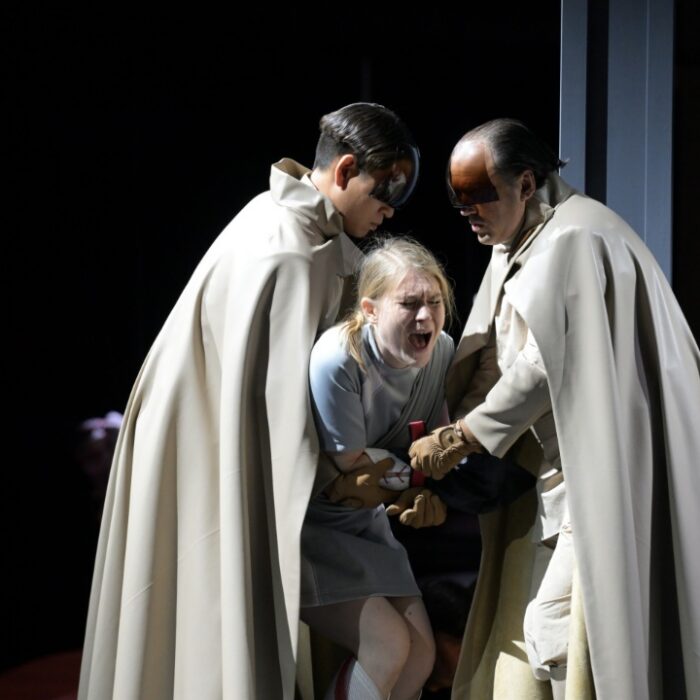
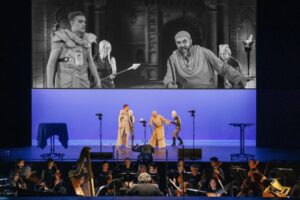
The 2025 touring production of “Tamerlano,” featuring René Jacobs and the Freiburger Barockorchester, arrived with a significantly revised cast and a bold, innovative staging concept from Kobie van Rensburg. By merging live video projection with CGI (Computer-generated) backgrounds, the production reveals a visually arresting cinema-opera aesthetic that experimentally merges traditional performance and modern digital storytelling. The most striking element is the split-horizon staging: while live singers move within a minimalist, almost clinical lower space, the massive monochromatic projections above provide a magnifying glass effect. This broadcasting of intense close-ups captures every flicker of raw emotion—a snarl of rage or a look of quiet despair—that might be hardly recognizable in a large hall.
This dual-layer approach is a daring experiment in multimedia integration. While the digital backdrop initially evokes a Microsoft Teams virtual background, the execution operates on a superior technical plane. Unlike the blurred edges of consumer software, the singers’ silhouettes taken from live cameras remain razor-sharp and flawlessly integrated, without any bleeding. The backdrop, built on an archaeological documentary aesthetic, reconstructs Ottoman, Central Asian, and Mughal cityscapes with historical precision, yet maintains a playful wit—peaking in moments of visual fantasy, such as Irene soaring over ancient domes on a flying magic carpet. Within these spaces, costumes range from intricate saris to futuristic armor, a stylistic collision punctuated by projections evoking 1920s German Expressionism. These facial landscapes recall Carl Theodor Dreyer’s “The Passion of Joan of Arc” (1928), turning every twitch of a lip into a monumental structural event.
Furthermore, by coupling text with symbolic imagery from the libretto—tigers, sextants, and ships—the production manifests metaphors usually left to the imagination. While this ensures no poetic nuance is ignored, it forces the viewer into a relentless pace of visual consumption. Ultimately, the camera-dictated perspective prioritizes 2D intensity over 3D stage relationships, echoing the face-on urgency of short-form video content. While this demands far more screen-ready precision from the singers, it arguably flattens the operatic experience, compromises the theater’s expansive spatial geometry for a singular, curated digital ideal dictated by camera angles, and trades heavy physical sets for digital ingenuity and cinematic flair.
Musically, René Jacobs masterfully recalibrates the opera’s tonal center, softening its inherent sadism and oppressive darkness to foreground a raw, relatable humanism. He explores the complex intersections of shifting affections, the crushing weight of defeat, and the friction between aristocratic pride and filial duty. The Freiburger Barockorchester deviates from the hyper-aggressive articulation and dynamic contrasts favored by some contemporary period ensembles. Instead, Jacobs delivers a performance defined by its chiselled precision, focusing on a deep excavation of the libretto’s inner landscape rather than surface-level virtuosity. While his tempi from time to time may initially seem sluggish—particularly in the signature arias by Bajazet and Andronico—this pacing allows for the psychological weight of every syllable to be fully realized. From a practical standpoint, with the audience’s eyes constantly darting between the dual stage layers, a steadier musical pace could provide the necessary cognitive space to process such a high-frequency digital landscape.
Stellar Cast
The vocal delivery and stage presence of the cast transcend the traditional definition of singer-actors; their performances in front of the camera function as a surgical psychological dissection of the human soul. Christophe Dumaux as Tamerlano delivers a masterclass in stage magnetism, akin to an award-winning cinematic turn. He embodies the tyrant not just as a one-dimensional villain, but as a man defined by a supreme, almost playful self-confidence—a ruler whose every move is calculated to maintain absolute control. This is most chillingly evident in his interactions with Andronico, whom he treats with a condescending, predatory ease, keeping him firmly under his thumb as if playing a high-stakes game of psychological chess.
Thomas Walker’s portrayal of the defeated Bajazet successfully captures the agonizing contradictions of a fallen ruler with startling clarity. He masterfully portrays a bone-deep disdain for his captor while simultaneously revealing a fatherly love that is both fiercely patriarchal and deeply tender. Perhaps his most remarkable feat is the pacing of Bajazet’s slow demise: the broken, accompanied recitatives feel agonizingly natural and cruelly real. This performance anchors the production’s emotional core, bridging the gap between historical tragedy and personal grief.
Alexander Chance as Andronico vividly exposes the inner turmoil of a man caught in an impossible position. He brilliantly portrays the friction of being forced into submission under Tamerlano while privately harboring the embers of rebellion and romantic longing. His performance is a subtle study of suppressed energy waiting for the right moment to ignite. Mari Eriksmoen as Asteria charmingly balances the archetype of the loyal daughter with a multifaceted, almost dangerous allure. She moves seamlessly between the image of a devoted child and a woman using her charms to manipulate a tyrant. Her portrayal adds a necessary layer of political and personal complexity to the drama.
Kristina Hammarström portrays Irene as a political veteran whose rock-solid stability remains intact even in the face of betrayal. Her composure acts as a fascinating counterpoint to the more volatile emotions on stage, showing a character who processes Tamerlano’s treachery with the steady hand of a seasoned diplomat. Finally, Matthias Winckhler accurately conveys the temperament of a poised mediator as Leone. His performance provides a necessary anchor to the surrounding emotional storms, effectively delivering the perspective of a character who must navigate the treacherous waters between these warring personalities.
Ultimately, “Tamerlano” is an inherently intense work, a quality matched by René Jacobs’ musical approach which surgically excavates the libretto’s inner landscape. By employing a camera-dictated perspective, the production forces the audience into a high-intensity mode of spectatorship, intended to be a rigorous challenge to the audience’s intellectual and physical endurance, demanding to be chewed upon and revisited long afterwards. Nevertheless, it serves as a valuable blueprint for cost-effective, low-carbon opera production in an era of tightening arts budgets. More artistically speaking, one imagines that if Walter Benjamin were alive today, he might find in this production the perfect subject for a sequel to his seminal work—an examination of Art in the Age of CGI Reproduction.
(Photo: Felix Grünschloß)
A Golden Arcadian Radiance: “Atalanta” at the Christuskirche
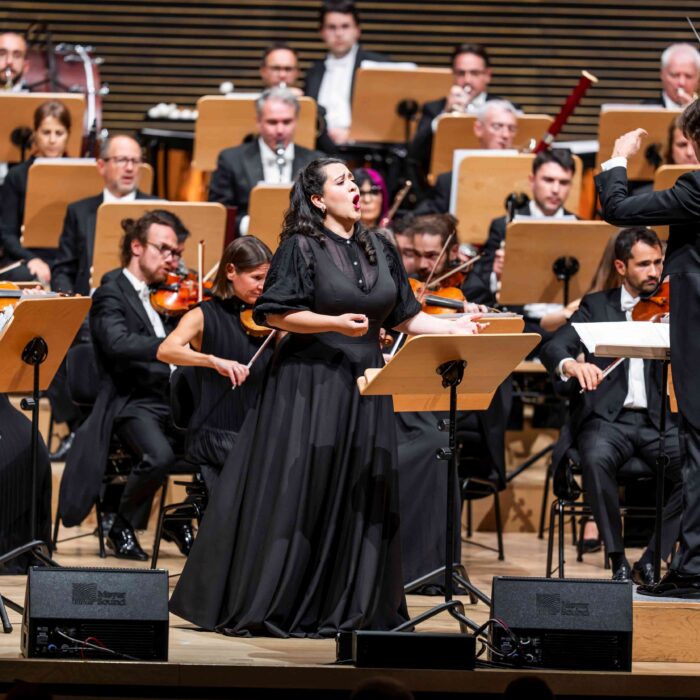
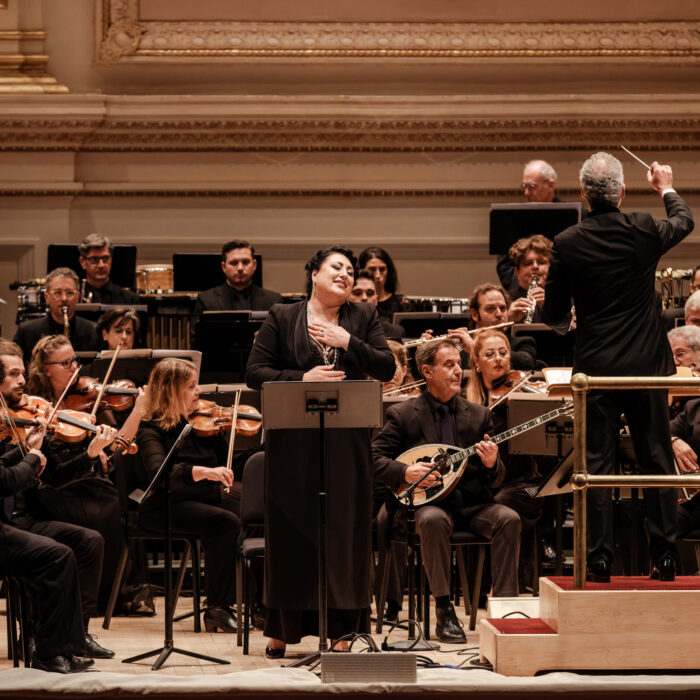
If the afternoon “Tamerlano”—with its dense web of middle-aged political machinations and intensive four hour emotional trajectory—was an exercise in high-stakes exhaustion, the two hour evening performance of Handel’s “Atalanta,” offered as a perfect sensory palate cleanser, a listening feast defined by an irrepressible youthful energy.
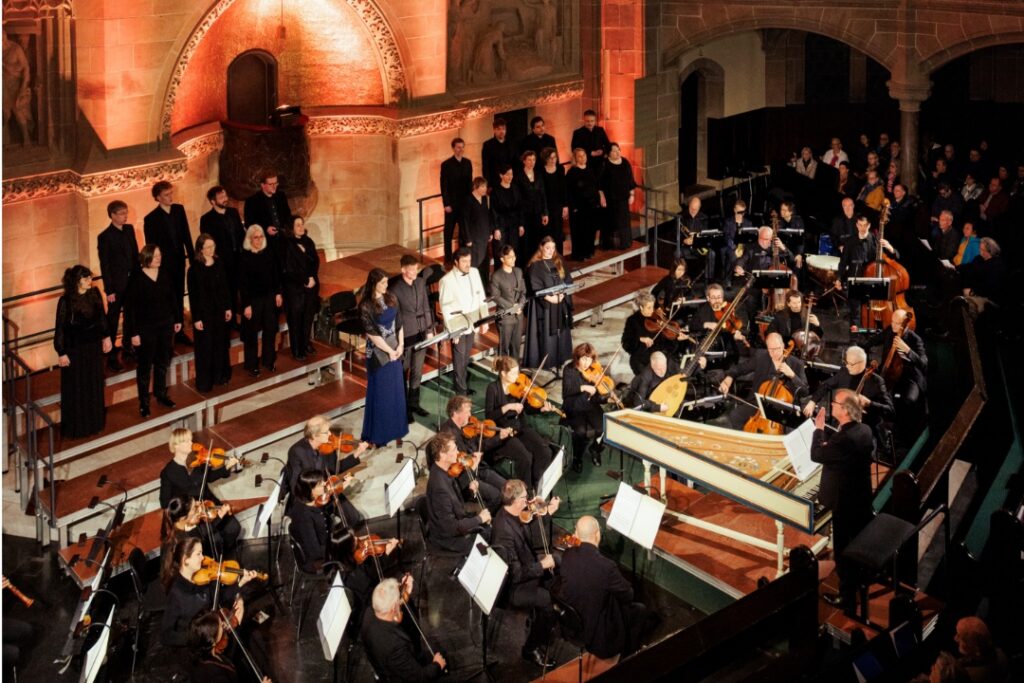
The choice of venue, the Christuskirche am Mühlburger Tor, proved to be an inspired masterstroke. Bathed in a warm, amber light that radiates from the soaring Neo-Gothic arches, the space feels like a gilded vessel for sound. On this night, every singer’s voice seemed bathed in a golden glow, an acoustic halo that amplified the natural bloom of the vocals.
Directing from the harpsichord, Lars Ulrik Mortensen was the embodiment of vitality, warmth, and a quintessentially Handelian sense of humor. His continuo playing was a living, breathing pulse—vibrant, witty, and constantly conversational. Creating a palpable sense of security for the young cast, the Deutsche Händel-Solisten delivered a performance that can only be described as textbook-perfect. The transition between the storm arias—characterized by crisp, percussive bow strokes—and the moments of tender, pastoral intimacy was handled with breathtaking fluidity.
The performances of the two protagonists were undoubtedly the beating heart of the evening. Caterina Sala as Atalanta appeared with a relatively late entrance, but her voice possessed a remarkable penetrating power throughout the performance. She navigated the character’s emotional arc with extraordinary naturalism—from the playful “cat-and-mouse” games of the initial pursuit to the exuberant burst of joy in the final reconciliation. This vivid interpretation transformed Atalanta from a distant mythological figure into a vibrant, passionate, and thoroughly young girl.
In contrast, Dennis Orellana as Meleagro, in the first aria caused a few tense moments, perhaps due to opening-night nerves. However, the gifted male soprano—possessing a quasi-supernatural vocal range—quickly regained his footing. In his first duet with Atalanta, his voice intertwined with Sala’s to perfectly mimic the bickering of young lovers. By the time they reached the climactic reconciliation, the atmosphere shifted to one of unadulterated ecstasy—a radiating projection of affection that struck directly at the hearts of the audience.
The secondary couple, Moritz Kallenberg (Aminta) and Noa Beinart (Irene), provided a vivid exploration of Arcadian sincerity. Kallenberg was a revelation, imbuing Aminta with a rugged, masculine strength that avoided the stereotype of the “feeble lover.” His vocal lines exploded with unvarnished power, providing a muscular sonic counterpoint to the velvety stability of Beinart’s Irene.
As the subplot’s intellectual engine, Beinart navigated Irene’s psychological tests with witty sophistication. The dramatic sparks truly flew during the exchange of the ribbon and the arrow, culminating in a pure harmony that served as a breathing testament to the trials of the heart.
Oğulcan Yılmaz significantly reinforced the night’s theme of burgeoning brilliance through his dual roles as Nicandro and Mercurio. Yılmaz commanded the stage with an authoritative presence and exceedingly precise projection, allowing his rich baritone to cut through the resonance with absolute clarity.
Although the Kammerchor der Christuskirche’s appearance was limited, their contribution served as the indispensable crowning glory of the night. Their final chorus, in particular, resonated with an infectious celebratory spirit that seemed to make the very walls of the Christuskirche dance. This “Atalanta” sent the audience out into the Karlsruhe night enveloped in a lingering, golden warmth.