Innsbrucker Festwochen der Alten Musik 2026 Review: Un giro d’Italia
By Mengguang Huang(Photo: Veronika Lercher)
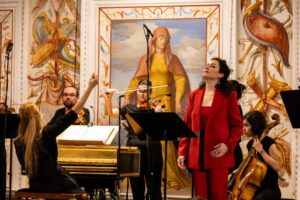
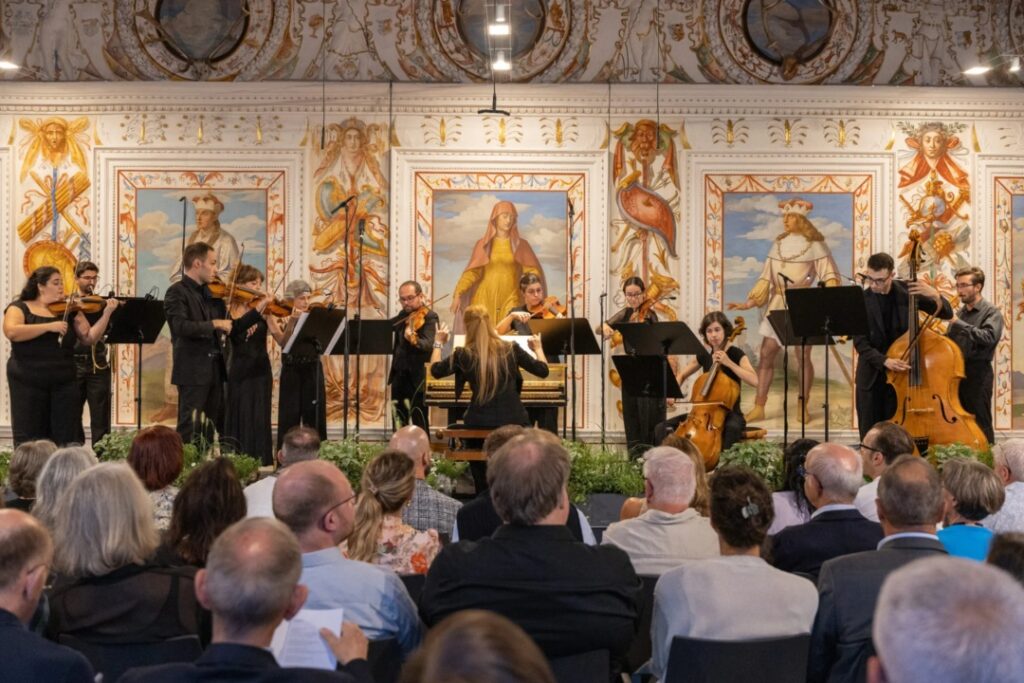
Prior to taking the stage for Antonio Caldara’s oratorio “Gioseffo,” Innsbruck favorite Arianna Vendittelli, alongside period ensemble Academia Montis Regalis, treated audiences to a highly accessible evening concert in the historic Spanish Hall at Schloss Ambras. The program was built around the theme Un giro d’Italia (A Tour of Italy), a concept that has gained considerable popularity across European early music festivals in recent years.
Before the performance began, concertgoers strolled through the castle’s compact, elegant gardens, taking in the dramatic alpine landscape wrapped in pre-sunset summer mist. Inside the Spanish Hall, the small, circular Renaissance windowpanes were thrown wide open. None of the usual stuffy, enclosed air of historical buildings remained; instead, the gentle flow of outdoor temperature, humidity, and faint evening bird calls blended naturally with the hall, injecting a touch of pure poetry into this musical night.
Vocal Nuance
On the vocal side, while the program featured mostly pleasant selections tracing Charles Burney’s historic journey through musical capitals like Venice and Naples, much of the repertoire felt somewhat predictable. The pieces by Giovanni Paisiello and Niccolò Piccinni were almost textbook examples of the era—after hearing the very first phrase, one could easily foresee how the musical ideas would develop. This predictability inevitably limited Vendittelli’s artistic imagination to some extent. Nevertheless, her voice was full, rounded, and steady. Even in Piccinni’s more ordinary vocal lines, she brought artistic flair through subtle shifts in vocal shading.
In Niccolò Jommelli’s “Sperai vicino il lido,” her voice floated effortlessly over the orchestra’s velvety sonic cushion, delivering the signature appoggiatura-laden melodies of the era with genuine warmth and a feeling of being completely at home. The contrasting B-section of this da capo aria convincingly introduced a subtly threatening atmosphere.
The “Quante cosette belle al mondo” by Baldassare Galuppi offered more musical complexity. Vendittelli used rhythmic articulation and a flexible high register to paint a witty, comedic character. Again, she hovered over the full ensemble’s texture, creating a taut tension over the low strings and oboes.
The absolute vocal peak of the night came with the two high-caliber Arie by Johann Adolph Hasse. In the first, “Per questo dolce amplesso,” she surprisingly had a brief one-second pause right near the technical end, yet she sang the rest of the piece with noble restraint and beauty, leaving the tiny moment utterly harmless. She redeemed herself completely in the technically brilliant second aria, “Parto, qual pastorella,” effortlessly executing wide vocal leaps and virtuosic passages with absolute control.
(Photo: Veronika Lercher)
Instrumental Drama
The instrumental portion of the evening was marked by sharp focus and spontaneous musical enjoyment, even if the violins occasionally showed minor roughness and uneven cut-offs.
In Gaetano Pugnani’s Symphony in E-flat major, Op. 9 No. 6, the obbligato harpsichord stood out prominently, particularly in the Andante, where its continuous dialogue with the oboe proved captivating. The third movement pared down to a true trio formed by solo violin, viola, and harpsichord. The fast outer movements were driven by energetic ensemble playing, though the horns occasionally sounded a bit over-assertive.
Giovanni Battista Martini’s Harpsichord Concerto placed Chiara Cattani and her instrument firmly at center stage. Featuring an unusual four-movement layout, the piece made its strongest impression in the finale, which closed with a clever, sparkling Balletto spiritoso. In contrast to the bright, spirited fast movements, the Adagio felt strikingly intimate, touched by a softer, grayish tone.
In the second half, Wolfgang Amadeus Mozart’s Divertimento in F major, KV 138 showed the most audible violin roughness. However, Johann Christian Bach’s Symphony in G minor, Op. 6 No. 6 stood out as the undisputed instrumental highlight of the entire night. Its fast movements erupted with explosive tension that kept the audience alert, featuring bold string glissandi and daring horn calls. In the slow movement, the trembling string textures sustained a tightly coiled, unforgettable suspense.
Poetry in the Ambras Air
It was an enjoyable night; on this cool, airy summer evening, the magnificent Spanish Hall felt almost like the private salon of an Italian aristocrat who had invited an opera diva home to entertain Charles Burney on his long journey from England. While the program was clearly crafted with musicological and historical rigor, Burney was, after all, a true connoisseur of the highest order—had the repertoire leaned toward consistently higher artistic quality, the evening would have been all the more captivating.