Shalom-Music.Koeln 2026 Review: Psalmen Davids
By Mengguang Huang(Photo: Kay-Uwe Fischer)
The 2026 edition of SHALOM-MUSIK.KOELN placed the concept of Zuhören (the intentional act of listening) as the motto of its festival program. Through concerts across Cologne, the festival used music to encourage dialogue between different traditions and cultures, with a special focus on Jewish heritages.
The historical framework behind the grand closing concert shed a new light on the music rarely heard on live stage. Salamone Rossi (ca.1570-1630) was a pioneer who moved between Jewish and Italian cultures in early seventeenth-century Italy. Employed by the Catholic Gonzaga court in Mantua, he created courtly instrumental music while simultaneously writing polyphonic choral settings for his local synagogue. Hearing his works alongside those of Heinrich Schütz, a German master equally shaped by Italianate influence, showed how musical ideas traveled across borders and faiths.
Acoustic Challenge & Vocal Performance
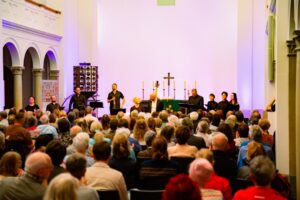
The performance venue was the Trinitatiskirche, which looks from the outside like an impressive structure with its striking portico and basilica layout reminiscent of early Christian architecture in Rome. Spatially the church feels like an ideal home for early music. Practically, its tall stone nave creates an unfocused acoustic that can soften musical edges, especially depending on where musicians stand on stage.
This tricky environment created real challenges for Dame Emma Kirkby. For devoted listeners who have followed her long career, her brief appearances brought a slight touch of disappointment. Performing mere three works, Kirkby’s first two selections, Heinrich Schütz’s “Singet dem Herrn“ and “Herr, unser Herrscher,” struggled to carry through the nave with relatively weak projection. The church’s lack of focus at her standing point swallowed many of her rapid melismatic runs, reducing her iconic pure voice to an almost private whisper.
Fortunately, the instrumentalists were sensitive enough to keep the performance grounded. The baroque ensemble ART HOUSE 17 accompanied her lightly, keeping Kirkby in the foreground. During “Herr, unser Herrscher,” they replaced the viola da gamba with a violone, bringing a refreshing rustic texture to the lower basso lines that made the hall atmosphere lively. Kirkby found a much better balance in the concert’s final piece, Schütz’s “An den Wassern zu Babel.” Singing alongside four young soloists from the WDR Choir Academy, with warm cushion from the deep rumble of organ and violone, she brought her contribution to a satisfying conclusion.
In contrast to Kirkby’s quiet projection, the four WDR singers, baritone Daeyeon Won, tenor Felix Läpple, mezzo-soprano Laura-Maria Püsch and soprano Katharina Hirtz, showed unmistakable command over both early baroque style and vocal technique. The music on the program made demands on careful attention to text and balance, beyond mere dramatic music-making. These pieces were sacred settings of Biblical psalms. They treated the lyrics as their primary guide, uncovering deep emotional weight in lines. Even in Schütz’s multiple chorale-like pieces with steady harmonic development and unhurried music flow, they managed to keep listener’s attention alert. Aside from the tenor, who sounded slightly thin at times due to the acoustics, the SATB quartet sang with a transparent blend. They listened to each other attentively and balanced their voices’ entries and exits with impressive care.
Their skill stood out clearly in Salamone Rossi’s “E’lohim hashivenu.” Switching smoothly between full four-part texture and various duet pairings, their voices shifted like organ stops bringing out different tonal colors. In Schütz’s “Mein Seele soll loben Gott den Herrn,” each singer took the opportunity displaying their individual vocal timbre. Later, during Schütz’s bright triple-meter Cantate Dominum SWV81, the two female singers filled the sanctuary with joyous energy.
Instrumental Brilliance
The instrumentalists of ART HOUSE 17 maintained an admirable cohesive ensemble sound throughout the night. As a creative choice, they included an accordion in their lineup to introduce a subtle Jewish color. The instrument created a glowing background that functioned much like a small chest organ.
Solo violinist Alfia Bakieva led the ensemble with a pure tone and natural phrasing. What struck the audience most was the superb vocal quality of her playing, an approach that demonstrated Salamone Rossi’s violin sonatas exceptionally well. Her dialogue with the second violin and the continuo team showed a deep awareness of the acoustics. They listened for how their notes echoed in the church, letting the acoustic space shape their timing & music phrasing organically. Rossi’s two sonatas built on the famous ground basses Ruggiero and Bergamasca were filled with warm radiance and lively energy.
The peak of instrumental playing arrived with Giovanni Battista Fontana’s Sonata Seconda. Here, Bakieva demonstrated remarkable improvisation skill, weaving fine embellishments into the melodic line. Keyboardist Michael Hell provided imaginative, tasteful support at the harpsichord and organ. Handling multiple roles all evening, he prefaced several pieces with stylistic flourishes reminiscent of Frescobaldi. What’s more, he stepped out to play recorder on two of Rossi’s instrumental works, trading delicate lines with Bakieva’s violin. The only reservation on instrumental performance was on Frescobaldi’s Toccata Settima, in which the organ stop configurations were somewhat muddy due to the instrument characters.
Final Reflections
Despite minor acoustic problems and some undermined vocal moments, this concert awarded the audience with an enlightening experience. It placed Rossi’s legacy within a broader parallel Italian landscape while addressing the festival’s commitment to cross-cultural dialogue.
Categories
Reviews