Innsbrucker Festwochen der Alten Musik 2026 Review: Atalanta
Soprano Sarah Hayashi Delivers a Standout Performance
By Alan Neilson(Photo: Birgit Gufler)
Innsbruck’s Early Music Festival decided on a presentation of Händel’s 1736 opera, “Atalanta,” for its Oper Jung production, a popular event with audiences that gives opportunities to young singers that have impressed in previous editions of its Cesti singing competition the possibility of performing major roles.
The choice of “Atalanta” was not a particularly exciting one, as illustrated by its low profile when placed alongside many of the composer’s other operas, although this is not a reflection of its music, which has been described a ‘festive jewel’ and includes a concert favorite, the aria “Care Selve.”
The problem surrounds its weak plot, which amounts to little more than two couples making life difficult for themselves by deliberately testing each other and finding excuses for why their prospective partner is not acceptable. It is defined as a comic opera, but actual comic episodes rarely materialize and amount to no more than the characters’ use of disguises and a happy ending, which was obvious from the minute they set foot on the stage.
Unfortunately, the name of the librettist is not known, so it is not possible to point the finger of blame, although even if we did have the name, criticizing him might be a bit unfair. The piece was written as a celebratory work for the marriage of Frederick, Prince of Wales, to Princess Augusta of Saxe-Gotha, for which a complex narrative, full of intrigue and tension, was not what was required; rather, this was to be a celebration of love between two committted souls bonded by marriage, against a fabulous backdrop, which in this case consisted of an onstage firework display, and, of course, accompanied by celebratory music that glorified the happy couple. As it turned out, they did not attend the performance!
De Carpentries‘ Excellent Interpretation Overcrowded With Too Many Ideas
Stage director François de Carpentries, and set and costume designer Karine Van Hercke, certainly had their work cut out if they were going to capture the attention of the audience. And, to be fair, they made a decent attempt, although it did require them digging down into the text to find ideas to exploit.
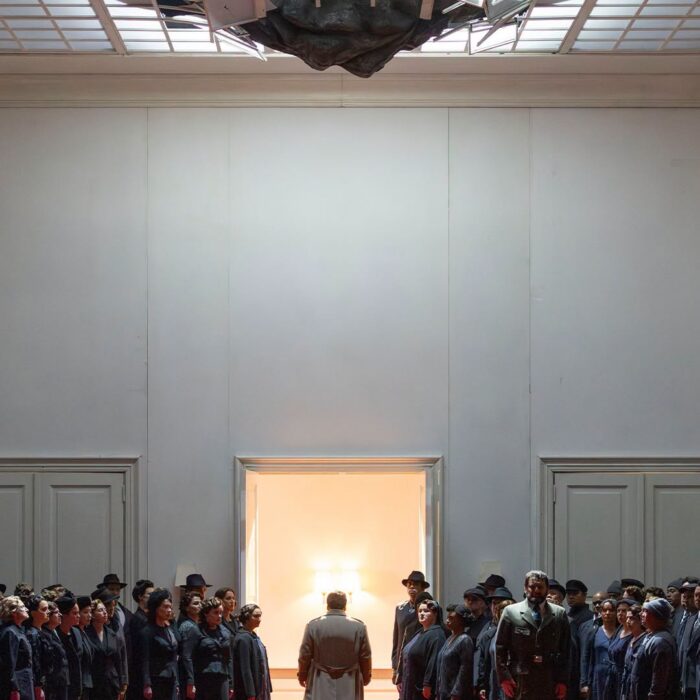
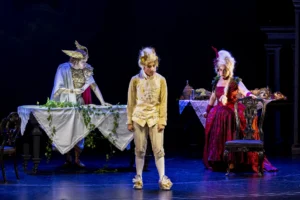
The narrative is set in Arcadia, a pastoral idyll in which humans and nature are at one, the perfect setting for the two couples, Atlanta and Meleagro, and Aminta and Irene, to play out their game of hide and seek with everlasting love as the prize. One may imagine ruined temples set among rolling hills and bubbling brooks, but you would be wrong to do so, for there was a malign presence abroad, and it was prowling around paradise. Its red eyes could be seen shining from the undergrowth, watching with evil intent. The skies were no longer still and blue but swirled angrily and darkly above the stage, occasionally morphing into the face of a wild boar. The forests looked dangerous, certainly not a place for a lazy stroll. It was a presentation that moved well beyond the narrative, in which Atlanta, known for her skills as a great huntress, kills a boar while out hunting at the end of Act one, and turned the opera, at least the first Act, into a gripping piece of theater.
Nor did the mysteries of paradise end there. Disguises lie at the heart of the couples’ difficulties; Atlanta goes under the name of Amarilli, while Meleagro presents himself as the shepherd Tirsi; Irene pretends to have no feelings for Aminta, while he pretends to be in love with Amarilli. Everyone is wearing a false face, so the clouds continue to swirl, this time morphing into masks. Meanwhile, the four lovers’ attempts to establish relationships are frustrated. They fear the deception that appears to be everywhere. It was only when the disguises were dropped that they could finally establish the relationships they all sought. It was a very successful reading and kept the drama moving forward with tension and interest.
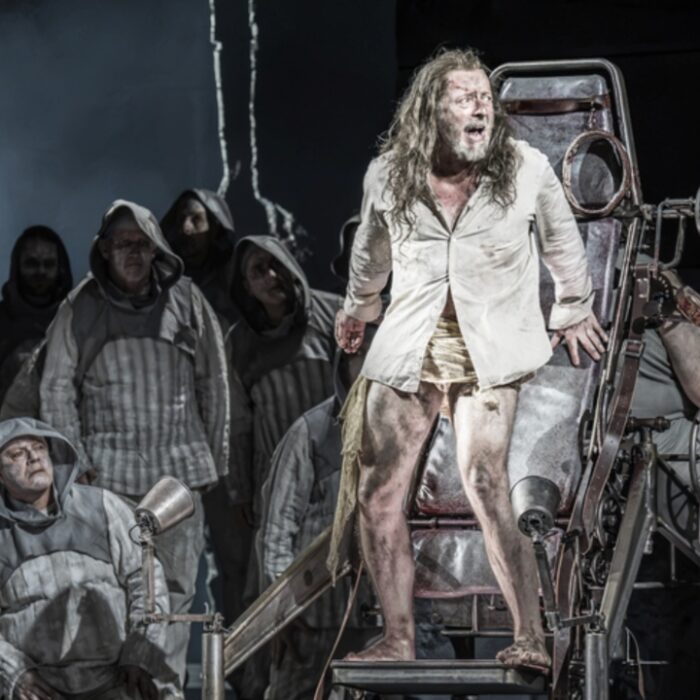
Unfortunately, de Carpentries had not finished. He had more ideas that related to rather abstract concepts, which were less successful, such as an attempt to present Arcadia as a laboratory sealed off from the outside world where the lovers could experiment on how to express their emotions. Luckily, the impact on the staging went unnoticed and did not disrupt the flow. It was only thanks to the program notes that one was even aware of it. However, one of his interventions proved to be very disruptive indeed. At the end of the opera, the god Mercury descends to the stage, carrying blessings from Jupiter for the happy couples. De Carpentries, however, had other ideas for this character!
Rather than restrict the god to a short single appearance, he decided to have him appear as a comic character throughout the performance, moving among the ruins as the couples failed to overcome their self-made problems. He tried to help, but they pursued their own course. He even took up a seated position on the side of the stage to watch the show. It was all terribly distracting and added absolutely nothing to the drama, which was otherwise moving along perfectly well. Even worse, he opened each Act with a spoken monologue that droned on for what appeared forever, completely ruining the connection between the audience and the singers that had been so carefully established.
Basically, de Carpentries had fallen for the all-too-common error of eagerly filling up a production with too many ideas. If he had taken a step further back, he may have seen that what he had created had the fundamentals of an excellent staging. He didn’t, and the production suffered as a result.
Hayashi Leads a Strong Young Cast
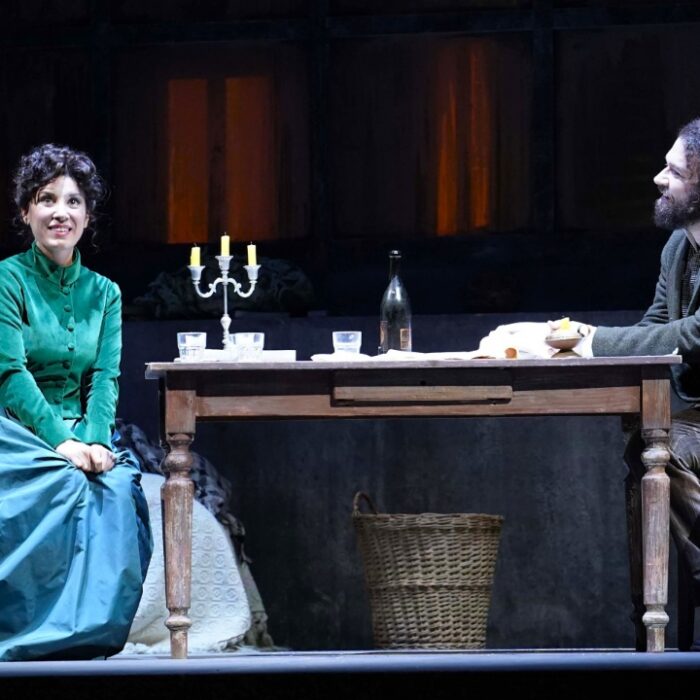
As expected from singers who had performed so successfully at the festival’s Cesti singing competition over recent years, the quality of the performances impressed, no more so than soprano Sarah Hayashi playing the role of Prince Meleagro. It was a performance focused largely on effect. Her singing, in both arias and duets, was confident, secure, and brilliantly crafted to display her vocal artistry, exhibiting audacious leaps, passages of fast complex coloratura, and stunning embellishments. Her top notes shone, and her secure, versatile delivery allowed her to dance nimbly across the line with apparent ease. Yet, her first aria was quite different, consisting of sensitive, elegantly fashioned phrases with delicate adornments that captured the pastoral ambience of the work. It certainly did not reflect the vocal fireworks that were to be unleashed in the arias that followed but was no less beautiful for the fact.
Soprano Silvia Porcellini, cast in the title role of Atlanta, produced a well-measured characterization that brought out her independent spirit, convincingly coupled with a sensitive, romantic side to her nature, which she expertly encapsulated in her opening recitatives and aria, “Riportai gloriosa palma.” Striding on to the stage armed with a crossbow, she slaughtered the boar, then reflected upon her triumph before turning to a new frightening feeling that had awoken within her breast for the shepherd Meleagro. It was an emotionally complex scene of high import, in which she successfully captured her fast-changing emotions using her subtle and versatile means of expression while displaying her ability in adorning the vocal line. Also of note was her Act two aria, “Lassa ch’io t’ho perduta” in which she voiced Atlanta’s pained emotions in an expressively strong rendition, in which she again showed off her ability to furnish the vocal line with beautifully molded embellishments. The enthusiasm with which she engaged in ensembles ensured that her two duets, both with Meleagro were particularly pleasing, especially the famous “Cara, nel tuo bel volto,” in which their voices combined to create a stunningly beautiful moment, replete with delightful ornamentations from both singers.
Contralto Justina Vaitkute proved herself to be a combatitive Irene. One could only feel sympathy for her lover Aminta, whom she seemed to delight in tormenting and testing. She possessed a distinctive, colorful palette that she used with a fine degree of flexibility to craft animated, lively recitatives. Likewise, she coated her arias with an array of appealing dark colors to which she introduced contrasting bright inflections in the upper register, which was illustrated beautifully in her final aria, “Ben’io sento l’ingrata,” in which, fearing that she has lost Aminta, she is overwhelmed with jealousy and allowed her despair to course its way through her rendition topped by passages of coloratura full of pain.
Tenor Salvador Simão, the winner of last year’s Cesti competition, was cast as the shepherd, Aminta, and fell a little short of expectations. Although it would be wrong to suggest that his performance was lacking in any way, it rarely rose above a workman-like response; rather, the word ‘solid’ would be the most appropriate adjective to describe his interpretation. Certainly, he possessed a pleasing tone, sang with clarity and expressivity, and his technique was good; maybe, carrying the mantle of a Cesti winner can have drawbacks. Although his arias were pleasantly delivered, they did not ignite the passions. His relationship with Irene, however, in which he came across as the weaker partner, was convincingly developed with plenty of entertaining squabbling and bickering, while his recitatives were rendered with a lively energy.
Baritone Peter Edge produced a tidy performance as Irene’s father, Nicandro. He presented his recitatives with conviction, characterizing him as a fairly tough-minded figure but with his daughter’s interests at heart. Arias were sensitively rendered to bring out their emotional effects, underpinned by a fine technique, which he displayed with his sensitive dynamic contrasts and neat ornamentations of the vocal line.
By the time bass-baritone Pierre Gennaï appeared towards the end of the final Act to bless the happy couples, in his role as Mercury, he had already managed to irritate and disrupt the flow of the narrative, thanks to de Carpentries’ misplaced interventions. What a refreshing surprise it was, therefore, to discover that Gennaï possessed a fine voice, to the extent that he managed, at least temporarily, to banish the memory of what had come before. His one aria, “Sol prova contenti,” was confidently and authoritatively delivered to exhibit his richly colored palette, alluring vocal depth, and beautifully crafted phrasing, to which he added pleasing embellishments, topped with an impressive passage of staccato coloratura.
The musical direction was in the hands of Andrea Buccarella, who, despite an inconsistent start, in which the sound was a little rough around the edges, produced a lively and energetic reading from the Orchester der Schola Cantorum Basiliensis, which captured the elegance and beauty of Händel’s melodies. The dance music from the Act two prelude in particular was a delight.
Overall, it proved to be an enjoyable, pleasing production that was beautifully presented. It was only a pity that the director’s enthusiasm got the better of him with regard to the role of Mercury.