Innsbrucker Festwochen der Alten Musik 2026 Review: Gioseffo che interpreta i sogni
By Mengguang Huang(Photo: Amir Kaufmann)
As a court composer in 1720s Vienna, Antonio Caldara occupied a unique position in Baroque music. His style—characterized by dense, contrapuntal orchestral textures, intricate imitative writing, and a strict avoidance of cheap theatrical indulgence—gives his operas and oratorios an almost scholarly quality. Much like Alessandro Scarlatti, Caldara was a master of deep psychological portraiture, yet his commitment to gravity and restraint often left his works feeling distanced and reserved. Consequently, his extraordinary output rarely receives the modern stage attention it deserves. Fortunately, listeners in Austria—particularly in Vienna and Innsbruck—still enjoy rare opportunities to experience his music. For the 50th anniversary edition of the Innsbruck Festival of Early Music, former artistic director Alessandro De Marchi returned to conduct Caldara’s “Gioseffo che interpreta i sogni.” Rediscovered and modern-premiered only in recent years (first revived in Turin in 2024), this performance at the sombre Stiftskirche Wilten, recorded for future broadcast by ORF, easily stood as one of the festival’s highlights.
“Gioseffo che interpreta i sogni”
Written originally for the Imperial Court, the work instantly reveals the refined, serious taste of Emperor Charles VI through its richly polyphonic opening Sinfonia. Leading the Consort Maghini, De Marchi apparently rejected superficial brilliance. The string section focused intently on the fluid voice-leading of polyphonic lines and the seamless imitation of musical ideas across sections, while the brass maintained impressive control. The basso continuo was particularly mesmerizing: two harpsichords delicately wove transitional passages, working alongside Caldara’s beloved cello—given a leading role—to evoke the refined elegance of a chamber cantata. This instrumental aura created a psychological suspense, leaving the audience eagerly anticipating every transition.
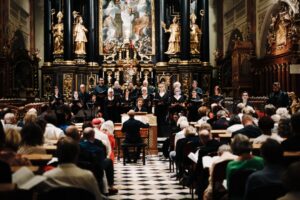
The libretto focuses tightly on Joseph’s rise to power through his interpretation of dreams. Imprisoned in Egypt, Joseph correctly deciphers the troubling visions of Pharaoh’s Cupbearer (Coppiere) and Royal baker (Panatiere). Two years later, summoned to solve the King’s own prophetic nightmares, Joseph predicts seven years of abundance followed by severe famine, earning his release and appointment as prime minister. Not merely pushing the plot forward, the recitatives are packed with dense moral allegories, posing a considerable challenge to the six vocalists. Given the sacred atmosphere of Stift Wilten, surrounded by its solemn black columns on high altar, De Marchi’s interpretive route heavily emphasized the work’s contemplative, reserved, and somewhat didactic nature. However, affected by the abbey’s resonant acoustics, this approach felt almost too restrained. Large portions of the recitatives sounded overly literal and flat, lacking expressive declamation and dramatic urgency. Joseph’s recitatives often bordered on formal sermons, while Pharaoh’s lines failed to convey his underlying doubt and dark suggestions. This flat delivery persisted across much of the cast until Sedecia entered relatively late in the performance.
Illuminating Performances
Fortunately, the arias presented a much stronger, albeit somewhat uneven, musical landscape. Margherita Maria Sala as Joseph delivered a noble and dignified performance. She successfully portrayed a self-aware wise man who maintains firm faith despite lingering self-doubt. In those structurally simple but high-calibre arias assigned to her, Sala overcame surface melancholy, introducing subtle tonal shades in the da capo B-sections. Her extended aria “Libertà cara, e gradita” was a triumph: accompanied by the crystalline tone of a Baroque hammered dulcimer (salterio), the music evoked an ancient, spiritual atmosphere reminiscent of biblical harps while remaining deeply human. Equally touching was her quiet grief in “E quando mai potrò cessar di piangere?,” where the dark, lonely timbre of the Chalumeau —an early single-reed cousin of the modern clarinet—underlined Joseph’s lingering isolation.
Luigi de Donato as Pharaoh projected stately grandeur, though his vocal projection suffered slightly, leaving him overshadowed by the soprano in his trumpet-accompanied duet with the Cupbearer. Conversely, Arianna Vendittelli as Sedecia seized her late arrival with radiant energy. Blessed with probably the most operatic music in the score, she showed off her metallic high register and vocal flexibility in her Part two solo aria, bringing brilliant sparks to her fiery confrontation with Pharaoh.
In the role of Cupbearer, soprano Eleonora Bellocci handled her rapid, streamlined passages with solid technique, though a more chiselled articulation treatment would have brought more variety to her lines. However, her psychological acting shone brightly when introducing Joseph to Pharaoh, convincingly shedding her character’s guilt and achieving redemption. As Royal baker, mezzo-soprano Lorrie Garcia made a profound impact near the end of Part one; supported by a prominent cello line, her aria conveyed a broad rhythm and a vast sense of space that felt noble and sublime. Meanwhile, Mauro Borgioni served as an outstanding Narrator (Testo), delivering heavy commentary while maintaining a detached, lofty neutrality.
Last but not least, the Coro Maghini made their appearances at the end of each part, navigating Caldara’s exquisite fugal writing with clear lines and a highly refined, controlled timbre.
Objectively speaking from the listener’s perspective, tonight’s performance was undeniably an elevated, high-minded affair, executed with refined taste and intellectual rigor. Yet for an oratorio that was only given its modern revival in Turin in 2024, this milestone 50th-anniversary festival celebration could have offered something more. Had the performance ventured slightly beyond Habsburg restraint, this long-dormant masterpiece could have breathed with greater dramatic passion and a genuine thrill of rediscovery.