Händel-Festspiele Halle 2026 Review: Talestri, regina delle Amazzoni (1760)
When Mercy Outshines the Armor: An Enlightened Resurgence of “Talestri” in Halle
By Mengguang Huang(Photo: Anna Kolata)
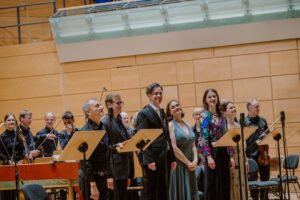
History is not entirely devoid of female composers. Similarly, history books readily note reigning monarchs who successfully wielded the musical quill. Yet, the convergence of the two remains an exceedingly rare phenomenon. Under the baton of Attilio Cremonesi, the Handel Festival Orchestra Halle brought this rarity to vibrant life. Their performance of Maria Antonia Walpurgis’s 1760 opera drammatica, “Talestri, regina delle Amazzoni,” was magnificent. It provided a brilliant, subversive counterpoint to the 2026 festival’s overarching theme: “Masculinities: heroes, rulers, heartbreakers.”
Walpurgis (1724–1780), a Bavarian princess and Electress of Saxony, was a formidable polymath who studied under Baroque titans Nicola Porpora and Johann Adolph Hasse, achieving what few aristocrats of any gender dared: penning both the libretto and the sophisticated score. She reframes the mythic Amazon Queen Talestri as a complex ruler caught in the agonizing, deeply human conflict between state duty—which demands the sacrifice of male intruders—and her forbidden love for the captured Scythian Prince Oronte.
The musical performance went far beyond mere thematic interest. Conducting from the harpsichord, Attilio Cremonesi’s long-standing synergy with the ensemble, plus his personal background as premier vocal coach, ensured the sound remained exquisitely sensitive for the singers. The ensemble’s capacity for emotional delineation and vivid tone-painting was extraordinary, establishing a compelling framework driven by sharp rhythms and rich palette. Throughout the evening, the basso continuo was a marvel of imagination, acting as an active, fluid commentator between scenes.
Illuminating Cast
In the title role of Talestri, Katharina Ruckgaber gave a solid performance of extraordinary emotional range. In Act one, scene two, as she confessed her forbidden love to her sister, Ruckgaber introduced a beautifully soft, sensitive, and appropriately fragile vocal quality to the character’s initial dilemmas. Yet, as the drama unfolded, her portrayal grew immensely. By Act two, scene four, plotting to subvert the council’s execution laws, she navigated intricate thematic lines in the recitative with astonishing agility, paving the way for her spectacular Act two, scene five aria. Here, asserting her royal authority against the high priestess, and framed by a brilliant tutti texture and roaring horns, Ruckgaber unleashed a commanding vocal power filled with metallic strength. This evolution culminated in the final act; following a tense dramatic confrontation over the fate of the prisoners, her scene five mourning aria offered an exquisitely moving, floating alliance with the baroque flutes, showcasing a devastating vulnerability paired with masterful breath control.
Standing at the sovereign’s side, Corinna Scheurle as Antiope offered a resolute vocal and dramatic foil to Talestri. She embodied a sharper metallic edge and an unwavering determination. Emerging in Act one, scene three with an unusually dark & muscular voice, Scheurle immediately injected a fierce passion into her performance, singing of her own willingness to yield to love. Her Act one, scene six aria enhanced by oboe accompaniment, was a lyrical highlight showing her clean & silky aspects of voice. This grounded dignity carried through to the final act, where her crucial moments in scenes six through seven showcased a remarkably solemn and stable vocal production, projecting an unwavering sense of finality.
The character of the high priestess Tomiri was brought to life by veteran Roberta Invernizzi, who infused the role with unquestionable authority. She commanded attention from her very first entrance in Act one. Arriving with her signature large dynamic range, her delivery was filled with immediate dramatic tension. She utilized subtle, highly expressive vocal shifts as she urged the hesitant princess toward the throne. This artistic gravitas deepened in Act two, scene six. Invernizzi utilized a complex, multifaceted voice to embody the chilling legalism of the Amazonian state. Yet, beneath this terrifying political exterior lay her deeply complex emotional entanglement with her son, Learco. Her formidable presence reached its peak in the council scene, where she launched a fierce legal assault against Talestri’s leniency. Delivering an aria of immense command, Invernizzi unleashed a true grand heroine aura backed by the roaring brass of a powerful horn tutti.
More Cast & Musical Details
As Prince Oronte, countertenor Ray Chenez confronted a series of mid-tempo arias that were notably the longest in the score. Their lack of dramatic variety and broad architecture presented the evening’s greatest challenge for a performer. In his major Act two, scene three aria—where he pleads for his friend’s life while reflecting on his former female disguise—Chenez audibly struggled to sustain momentum with his nasal projection. However, by the final act, as Oronte prepares for execution and bids farewell to his mother, Chenez convincingly navigated the music’s long-breathed lines, transforming the moment into a deeply felt portrait of noble resignation.
Federico Fiorio delivered a stellar performance as Learco. His relatively late entrance in the finale of Act one was unforgettable. Captured but unbowed, he emerged directly to spin soft, rich lines over rolling, wave-like string figurations that beautifully evoked the Thermodon river, executing breathtaking high-register piano singing. After his enlightening aria in Act two scene two, Fiorio returned in the final act with an energetic, princely glamour, displaying a wonderfully flexible upper register and beautifully executed small coloratura figures.
The casting for the night’s performance was exceptionally well-considered, creating a natural alignment of vocal color, dramatic temperament, and individual virtuosity. If one would like to point out drawback, it was a noticeable lack of physical onstage interaction between the performers, which occasionally left the audience to navigate the libretto’s complex web of plots with purely musical clues.
Yet, this did not diminish the opera’s profound intellectual residue. By opting for romantic reconciliation over the cold retribution of Amazonian law, Walpurgis’s “Talestri” fundamentally subverts both her period’s—and perhaps our own—anxieties around masculinity. In a festival with a theme on Masculinities, this work quietly poses a question: Does true strength lie in the rigid enforcement of power, or in the courageous abdication of control?