(Credit: Bernd Uhlig / OnP)
The production of “Ercole amante” at the Paris Opera represents both an artistic and a musicological event. The opera was composed in 1707 by Antonia Bembo, never performed during her lifetime and long presumed lost until it resurfaced in 1937 at the Bibliothèque nationale de France. Its rediscovery eventually led to a concert performance in Stuttgart in 2023, followed by a staged production later that year at the ODC Theater in San Francisco. The work now arrives at the Paris Opera thanks to Leonardo García-Alarcón, whose commitment to reviving forgotten works from the pre-Baroque and Baroque repertoire is well established.
Antonia Bembo: A Forgotten Voice
Antonia Bembo, née Padoani, was born into a bourgeois family in Venice around 1640. She studied singing as a soprano with Francesco Cavalli and developed an interest in composition. After an unsuccessful (and probably abusive) marriage with aristocrat Lorenzo Bembo, she made a bold decision: she ran away to Paris in 1677, where King Louis XIV granted her a pension as a composer and lodgings in a semi-cloistered female community. She composed motets, cantatas, and arias, though it is not known whether any of her music was ever performed, either at court or elsewhere. In 1707 she composed her only opera, “Ercole amante,” using the same libretto by Abbé Buti that Cavalli had set forty-five years earlier for his opera of the same title.
A Distinctive Franco-Italian Synthesis
Her style combines Italian melodic richness, rooted in the recitar cantando tradition typical of seventeenth-century Italian opera, with elements of French tragédie lyrique. The French influence is evident in the structure of the overture, the division into five acts, and the inclusion of dance numbers, although these are not modeled on Lully’s court dances. There are no chaconnes or character dances; instead, these atmospheric interludes are highly original and distinctive to Bembo.
The story draws on Sophocles, Ovid, and Seneca. Hercules is in love with Iole, princess of Oechalia, who is herself involved with Hyllo, Hercules’ son by his wife Dejanira. Venus descends from Olympus to secure her favor and ensure his conquest. Juno, who despises Hercules as the product of one of her husband’s affairs with a mortal woman, sides with Iole and Hyllo against Venus. After a series of Baroque shenannigas, Hyllo and Iole are finally united, Hercules dies after being accidentally killed by Dejanira, and ascends to Heaven to be wed to Beauty.
Baroque Fantasy Through a Contemporary Lens
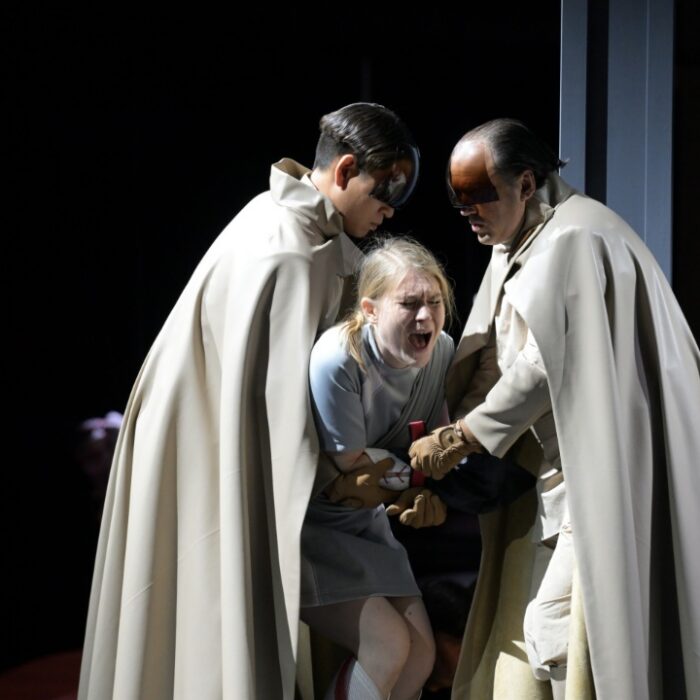
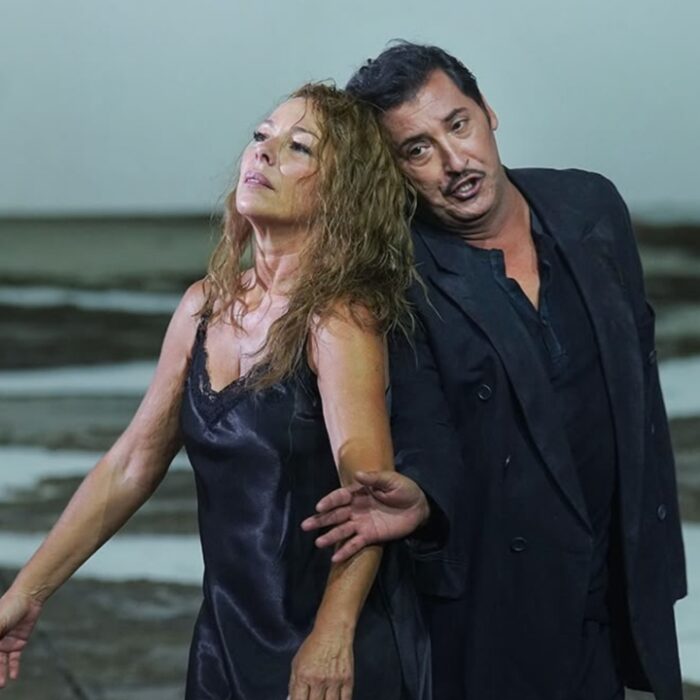
Director Netia Jones’s production offered a modern take on what an eighteenth-century opera might have looked like: extravagant costumes, elaborate special effects, and flamboyant characters. Buti’s libretto is remarkably explicit in its stage directions and imagery; everything is already there, guiding the director. Jones follows this path, illustrating the librettist’s fantastical suggestions without imposing an overly innovative interpretation, with results that are sometimes more successful than others. The first act unfolds in Hercules’ world, depicted as a tacky assemblage of furniture and decorative pieces suggestive of a faded grandeur. Hercules himself is a pot-bellied, middle-aged libertine addicted to Botox, sporting a dreadful yellowish toupee and reduced to a shadow of his former heroic self. Later we move to a formal Italian garden, where classical statues of the youthful Hercules seem to mock the aging slouch as he attempts to seduce Iole, who, under Venus’s spell, suddenly finds him irresistible.
Juno, clad in an elegant evening gown, travels to the realm of Sleep to seek his assistance, and here Jones creates perhaps the finest scene of the evening. The cave of Sleep is represented by a bare scaffold populated by lounging bodies intertwined in a sensual, though not overtly erotic, tableau. Video projections enhance the dreamlike atmosphere, while dancers and chorus move languidly through the space, smoking from a hookah. Jones collaborates with Lightmap Studio to sculpt the stage through video, blurring the boundaries between reality and virtuality and creating striking visual perspectives. The overall impression is one of lavish extravagance, brought off through sheer creativity and audacity.
Splendor and Excess in the Pit
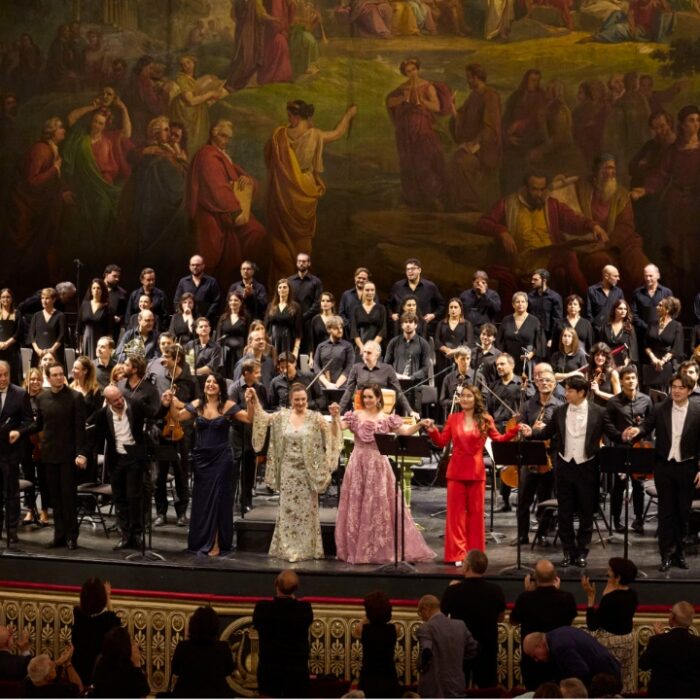
Staging a work of this period at the Opéra Bastille was another extravagant choice, though not one that proved entirely successful. Alarcón approached the score with his customary enthusiasm, placing fifty or sixty musicians in the pit, including oboes, bassoons, recorders, harpsichords, lutes, theorbos, viola da gamba, cello, three sackbuts, bells, and a substantial percussion section. He directed this musical army with expansive gestures, seeking a vast palette of colors and emphasizing the contrast between the French and Italian elements of the score, while also highlighting hints of Spanish dance rhythms—complete with castanets—and supporting choreography inspired by the French court.
The problem was that, in such an enormous space and with so many instruments, the sound occasionally became muddy despite the precision and commitment of the musicians. Alarcón also indulged his familiar tendency toward excess: the percussion was omnipresent and often too loud, while the orchestral colors bled into one another, an issue exacerbated by the vast dimensions of the Bastille.
The Chœur de Chambre de Namur performed with precision and style, clearly relishing the comic business and general exuberance demanded by the production.
A Great Cast of Baroque Specialists
The large cast was consistently excellent and composed almost entirely of specialists in this repertoire. Baroque voices tend not to be particularly large, and against an orchestra of this size the singers occasionally struggled to project; from my seat in the stalls this was already noticeable, and one wonders what audience members in the upper balconies were able to hear.
Andreas Wolf sang Hercules, his elegant bass-baritone generally well projected despite some weakness in the lower register. He offered a committed and convincing portrayal of a powerful demigod unable to accept either old age or a woman’s rejection.
Julie Fuchs was an outstanding Juno, her soprano rich and golden-toned, lending the character considerable charisma. Her stage presence was commanding, and her Act one aria “Su portatemi, o venti” was thrilling, delivered with impressive coloratura.
Sandrine Piau sang Venus, drawing on her profound stylistic knowledge and a light, silvery soprano that remains remarkably fresh and luminous. Her interpretation was charming, knowingly humorous, yet always elegant and worthy of the goddess.
Among the young lovers, Alasdair Kent’s Hyllo won over the audience with his exceptionally high tenor in the haute-contre tradition. His aria “Ahi che pena è gelosia” at the beginning of Act four brought the performance to a standstill and earned prolonged applause.
Ana Vieira Leite sang Iole with a silvery soprano and partnered Kent effectively in their duets. Deepa Johnny brought gravitas to Dejanira with her deep and beautiful mezzo-soprano, while Alex Rosen was authoritative and suitably resonant as both Neptune and the shade of King Eutyro. Marcel Beekman as Dejanira’s servant Licco, provided comic relief with his trumpet-like tenor, though his Italian vowel pronunciation occasionally sounded peculiar. All the remaining singers contributed significantly to the success of the evening.