Théâtre des Champs-Elysées 2025-26 Review: Ariodante
By Andréas Rey
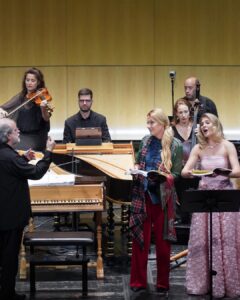
Following a very disappointing production of Mozart’s “Die Entführung aus dem Serail” the day before, the Théâtre des Champs-Elysées presented a one-night-only concert version of Handel’s “Ariodante” on June 7, conducted by Andrea Marcon.
To begin with, it must be acknowledged that the La Cetra Barockorchester Basel performed Handel’s highly melodious, harmonious, and expressive score very well. A sense of joy in performing this work even seemed to emerge at times, when the orchestra played the arias. However, a lack of musical continuity—certainly intentional for the genre but deviating from the customary approach of conductors such as those in the Baroque tradition and Marc Minkowski—left the musical score feeling very fragmented here.
Illuminating Cast
The quality of the vocal ensemble also kept the audience spellbound, particularly when tenor Emiliano Gonzalez Toro, in the role of Polinesso, gave free rein to his comic flair through both vocal ornamentation in their arias and physical acting, both in solo moments and with soprano Shira Patchornik’s Dalinda, conveying all the perverse malice of this precursor to Don Giovanni, Iago, and all of the Scarpia-like characters. The same goes for Christophe Dumaux’s Lurcanio, who portrayed his role’s character—raging after his brother’s death, and the clumsiness of his love for Dalinda.
Soprano Shira Patchornik’s Dalinda was well-embodied, unlike soprano Erika Baikoff’s Ginevra. In fact, Ginevra is arguably the least physically embodied role of all, but fortunately sung just as well as the others. Shira Patchornik portrayed this young woman, manipulated by the seducer Polinesso, very well, before she realizes his toxicity and turns her love toward the more moral Lurcanio.
But beyond the quality of their performances, one must also commend the singers’ voices, which were consistent, articulate, and effortlessly mastering the technical challenges. One of the hallmarks—if not the very virtues—of this opera is that it gives each performer the opportunity to showcase his or her talents. And the quality of the vocal ensemble held up perfectly from a technical standpoint.
Of course, the audience appreciated the ease with which soprano Magdalena Kožená as Ariodante executed each of her arias. It suffices here to note the mastery of “Con l’ali di costanza” and “Cieca notte, infidi sguardi,” among others, during which, perfectly commanding her athletic vocal cords, knowing her range like the back of her hand, and mastering her breath perfectly. She worked with the composer’s pitfalls as if it were child’s play.
More Cast & Musical Highlights
Emiliano Gonzalez Toro’s light, almost crystalline voice was equally impressive, particularly in his famous aria “Se l’inganno sortisce felice,” during which, like a precursor to Iago, he confesses that he prefers to indulge in vice rather than virtue to get what he wants. In contrast to this dark character, baritone José Antonio López’s King of Scotland, full of nobility in his inner conflict between paternal love and royal duty, conveyed his dignity in his “Al sen ti stringo, e parto.” Lurcanio struck a fine balance between anger and love, as demonstrated in his aria “Il tuo sangue, ed il tuo zelo.”
But above all, the female roles of Erika Baikoff as Ginevra and Shira Patchornik as Dalinda, with their pure tone, fragility, and freshness, beautifully conveyed the anguish and torment of their characters in arias such as “Orrida a gl’occhi miei,” “Sì, morrò; ma l’onor moi,” “Apri le luci, e mira,” and “Neghittosi or voi che fate?” The quality of the duets was no less impressive, and their balance ensured the high standard of this concert. One need only listen to “Dite spera, e son contento,” or “Bramo aver mille vite / cori…” to be convinced.
The greatest strength of this production is undoubtedly its strict adherence to the work, to the point of highlighting the libretto’s awkwardness—a libretto crafted more for arias than to follow a narrative. Despite all these strengths, a lack of enthusiasm, even a sense of routine, pervades this production, including within the orchestra. A nitpicking amateur who hears heightened emotions in this opera—Ariodante throwing himself into the waves after believing his betrothed has betrayed him, Ginevra tearing at her clothes and face after believing her fiancé has committed suicide, for example—sees here no real anxiety or musical tension, but rather the mechanical display of talent with nothing at stake for its performers.