Händel-Festspiele Halle 2026 Review: Judas Maccabeaus
By Mengguang Huang(Credit:Thomas Ziegler )
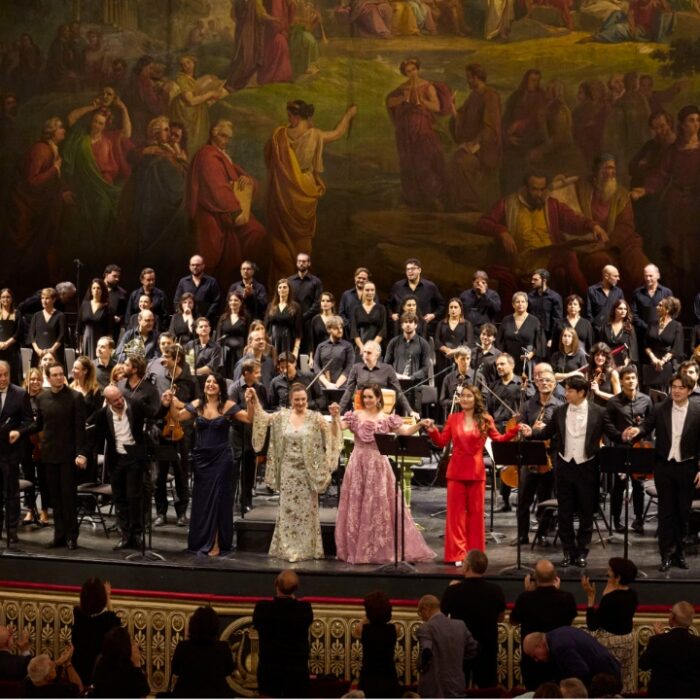
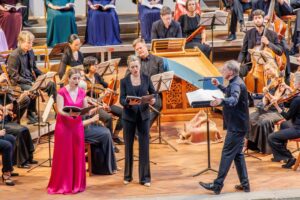
Written in the wake of the Jacobite rising to celebrate the Duke of Cumberland’s victory, the Händel’s oratorio “Judas Maccabaeus” inherently carries a nearly dynastic majesty. In the hands of conductor Holger Speck, the baroque ensemble Les Favorites, and the Vocalensemble Rastatt, avoided the pitfall of simple martial reading, but into a multi-layered human drama. Speck chose an excellent soloist ensemble, weaving the score as a refined, highly structured network.
The Overture was simply incredible, being defined by a particular dynamic control that captured a sense of French grandeur and refined taste. This paved the way for the chorus “Mourn, ye afflicted children,” where the Rastatt ensemble achieved a beautifully balanced, sombre timbre. Olivia Vermeulen’s mezzo rendering of the Israelitish Man in the recitatives were delivered with a melancholic gravity, subtly supported by the intimate texture of a chest organ. This restraint made the subsequent duet with Suzanne Jerosme (Israelitish Woman) remarkably intense: its fierce dotted figures and highly charged momentum collided with a solid bass string section to generate genuine psychological tension.This humanizing impulse peaked in Vermeulen’s aria “Tis liberty, dear liberty alone.” Employing an exceptionally flexible voice in dialogue with the ensemble’s echoes, Vermeulen transformed the movement into a micro-drama, sounding more like a profound call to pastoral nature.
Opposite her, Jerosme’s silky voice found the shinning moments in the most brilliant operatic arias from the oratorio. In “From mighty kings he took the spoil,” Jerosme navigated a melodic line that hinted Händel’s early operatic fragments.The serene elegance of the A-section was shattered in the middle section, creating an intense contrast driven by an energetic basso continuo. Similarly, in “Come, ever-smiling liberty,” the music shifted from an initially sublime, celestial dialogue with a solo cello into a joyful reprise. Backed by the full ensemble, Jerosme unleashed incredible embellishments that elevated the movement into a vibrant episode. The instrumental ensemble excelled in translating Händel’s rhetorical text-painting into vivid theatrical action. In the recitative “O let eternal honours crown his name,” when Jerosme sang of a warrior roaring “like a lion,” the cello unleashed a sudden growl that electrified the hall.
As the title role, Thomas Hobbs provided a robust, heroic anchor, commanding the stage with masculine power. His rapid, articulation-perfect coloratura propelled “Call forth thy pow’rs,” but the momentum peaked in “Sound an alarm!” and “With honour let desert be crown’d.” Pushed by powerful string playing, rich trumpet sounds, and blazing brass, Hobbs unleashed a high-tension performance. His voice, rich in metallic ring, created a dynastic majesty.Conversely, Matthias Winckhler’s Simon offered a magisterial counterweight. His stately accompanied recitative led into an “Arm, arm, ye brave!” that stood out for its dance-like rhythm. It flowed with joyful determination, building an accelerated speed that swept seamlessly into the chorus.
The young countertenor Jaro Kirchgessner impressed the audience in Part three. In the solemn aria “Father of heav’n,” Kirchgessner displayed fine breath control and a nearly princely pleading tone that captured the ultimate expression of devotion. Later, in “Sing unto God,” Kirchgessner stepped forward as the soloist to ignite the chorus, singing a magnificent melisma that soared over the festive brass.
The grand finale demonstrated the Vocalensemble Rastatt’s cumulative choral capacity. The iconic “See, the conqu’ring hero comes!” was meticulously layered: the horn parts, opening the movement, slicing through the high chorus to inject a brilliant sonic radiance, followed by a pristine, high female semi-chorus, before the entry of the full chorus reached a thundering zenith. Following the tranquil, blessed mood of the duet “O lovely peace,” the final chorus, “Rejoice, O Judah,” united the whole group in a grand gesture of magnificent power, as if the music had stepped outside the heavy gates of Jerusalem, and found itself simply human again.