Gran Teatre del Liceu 2025-26 Review: La Gioconda (Cast A)
By Mauricio VillaPonchielli’s masterpiece, “La Gioconda,” was presented at the Gran Teatre del Liceu with a double cast of stellar singers and a beautiful production.
Production Details
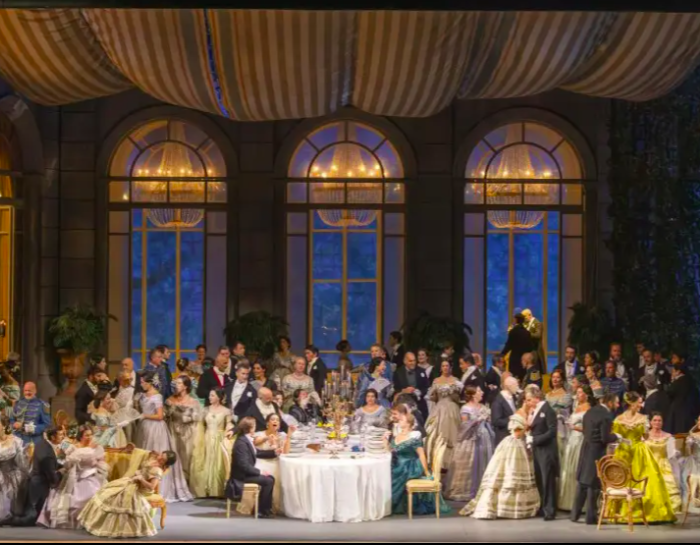
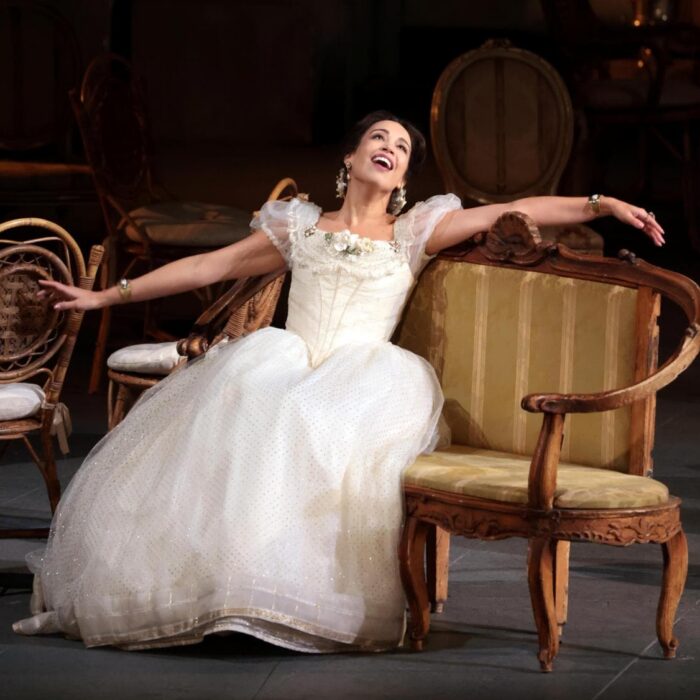
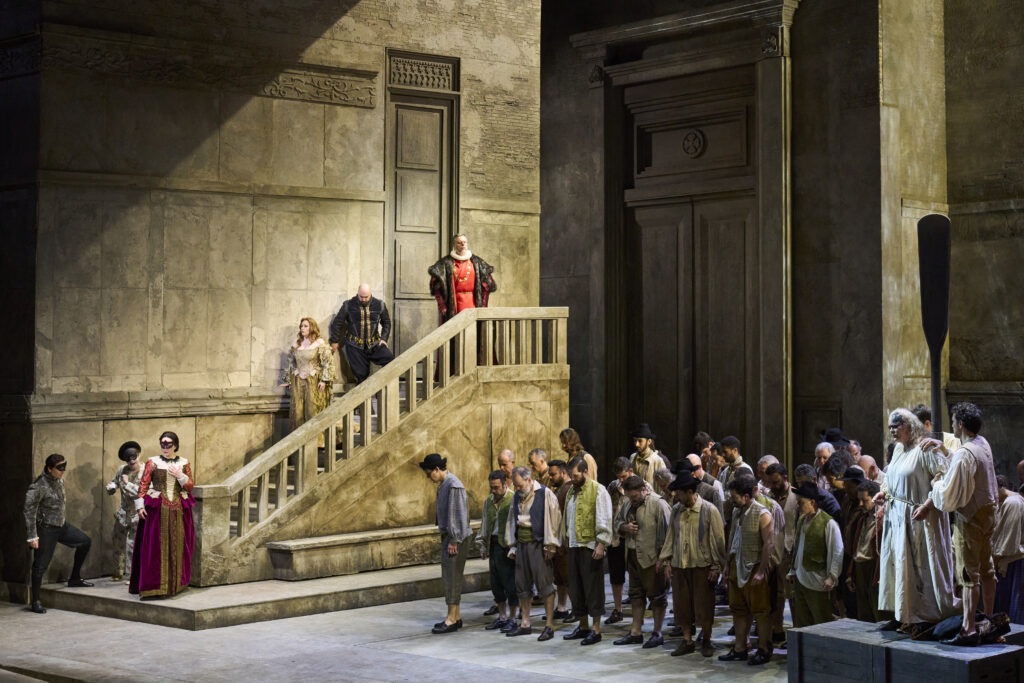
The sets by Étienne Pluss were beautiful and meaningful. The stage was surrounded by walls of stone and wooden beams. There were realistic elements for each scene, including a big marble staircase in the first act, a boat in the second, and chandeliers in the third. It was a very pleasant experience to be able to recognize onstage what the opera was about and where the action was set, instead of spending the whole show wondering what the director was trying to say. Meanwhile, the costumes were rich period pieces from Christian Lacroix. It was a beautiful production to see.
The biggest issue, however, was the lack of stage direction. Romain Gilbert opted for a realistic, natural acting approach. He simply staged what is written in the libretto. Though in itself not an issue, a problem arises from the fact that this libretto is very weak, transforming the staging into a boring performance full of old verismo opera clichés. There are multiple operas in the repertoire (Verdi’s “Il Trovatore,” for example) with very weak plots. This is where a stage director must find a different stage language and show their perspective. One of the tasks of a stage director is to connect the opera with today’s audience. Unfortunately, this production of “La Gioconda,” set in the original Venice in the 17th century, turned out to be old fashioned and boring.
The single surprise was at the end, when Barnaba said to an already dead Gioconda that he killed her mother, and Gilbert opted for making the mother appear and point towards Barnaba (though it was not clear if she was a ghost or if Barnaba had lied and she was still alive).
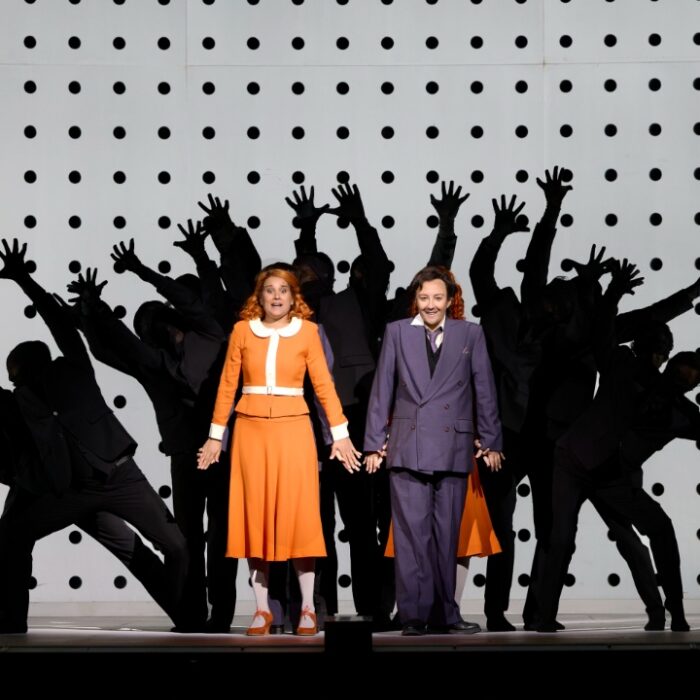
It was a very simple but ultimately ineffective solution to put acrobats and dancers in front of the choir, the latter basically remaining static throughout the multiple big chorus scenes. What is more, the chorus singers did what singers normally do when they do not know what to do: move their hands around and nod at each other. This shows that there was no staging work done with the chorus and it robbed the staging of this title, which under the influence of “Grand Opera” has many memorable chorus interventions.
I found it a poor decision to relegate 80 percent of the ballet music to a pantomime with the commedia dell’arte characters — Arlecchino, Colombina, and Pantalone — when the performance had six wonderful ballet dancer couples. The magnificent corps de ballet appeared only during the final minutes of music, despite this being the “Dance of the Hours.”
Saioa Hernández as Gioconda
Saioa Hernández, one of the most acclaimed Spanish sopranos, sang the titular role. She possessed a truly lirico-spinto voice with a consistent sound throughout her whole register, a mesmerizing low chest register, plus secure and strong high notes. Her low register was astonishing and big, with harmonics and an even timbre with the rest of her voice. The first exquisite example was in “colla tua chitarra!,” where her voluminous chest voice blended perfectly with the rest of her register — something that I consider her most astonishing achievement in this role. She could sing from the highest note (high C) to the lowest (low B flat) and reverse without compromising her voice (it is very easy to load the voice and make it heavy by abusing the use of chest voice, compromising the high register). It was a pity that she did not manage to deliver a true high B flat pianissimo in “Ah! Come t’amo…” and instead remained in a weak mezza voce with a fast vibrato. But she nevertheless accomplished all the demands of this difficult role, which is mostly written in the middle register with strong jumps to high notes (B naturals and high Cs) and low notes under the stave.
The highlight of Hernández’s performance was her famous aria, “Suicidio,” where she showed all of her potential — a strong middle register, top ringing high notes (B natural), and a beautiful and sonorous low chest voice. She delivered two secure ringing high Cs in her trio with Laura and Enzo. Her last scene with Barnaba was performed with a cruel cynicism before she killed herself. She received a strong ovation at the curtain call.
Michael Fabiano as Enzo Grimaldo
Enzo Grimaldo was performed by Michael Fabiano. He entered the stage with a heroic and strong high G in “Assassini…,” making his first intervention aggressive and strong. He was always audible over the soloists, chorus, and orchestra thanks to his expansive projection. He effortlessly sang the difficult tessitura, navigating constantly around high G and high A, offering a strong interpretation of “Enzo Grimaldo…,” his first act duet with Barnaba. Fabiano’s voice grew darker and even more voluminous as the story progressed. His interpretation of this role was a success based on his decision to opt for a bel canto approach. Some expansive and melodic lines, like “O grido di quest’anima,” sounded like Donizetti or Bellini in the tenor’s voice. But the highlight of his performance was his constant use of mezza voce and diminuendo to deliver dynamics and create contrast with the heroic bombastic moments. I have never heard such use of mezza voce in his previous interpretations. It was especially profound and hair raising in “Buona notte!,” moments before his second act aria!
His performance could be summarized in one word: “beautiful.” His famous aria, “Cielo e mar,” was elegant, moving, sweet, and full of long legato lines with the absence of portamenti (something which tenors with a verismo approach usually overuse). He delivered two top ringing and secure high B flats.
It is unnatural and even extraordinary for a voice, as it matures, to becomes darker, bigger, and develop a soaring use of mezza voce. But Fabiano’s interpretation was truly remarkable. The whispering line in his duet with Laura in the second act, “Vedrem fra poco tramontar la luna” in a soaring mezza voce, was yet another of multiple examples from the night. In contrast, he delivered an ardent and exposed secure B flat in “e colle vele al vento.”
His voice was totally present in the third act concertante, which he sang with ardent passion, fury, and emotion. He culminated his performance with a moving, short love duet with Laura. He was warmly received by the audience at the curtain call.
More Illuminating Cast Details
Gabriele Viviani, who played Barnaba, opened the performance (after the first choir intervention), presenting his first intervention with depth and multiple nuances. This defined his character for the whole performance. He was evil, inquisitive, and uncompromising, but at the same time cynical, as he proved in his lines “vaghissima farfalla!” and “La farfalle è scomparsa.” He possessed a metallic timbre with modest volume, correct projection, and with an extreme facility on the upper register, as he proved in his strong and powerful high G at the end of his duet with Enzo, in his aria “Regia e bolgia dogale!” in Act One, and in the final high A flat at the end of the fisher’s song in Act Two.
Mezzo-soprano Ksenia Dudnikova sang the role of Laura. She has a dark and powerful voice that matched and blended perfectly with the soprano and tenor: a good thing as she mostly performed duets and ensemble moments. Her timbre and vibrato were equal throughout her whole register, making her voice pleasant. She usually covered her low register while keeping a high position on the sound, probably because the tessitura of the role is quite high and very similar to the tenor, and eschewed the use of chest voice in most of the low notes. After an ardent and memorable duet with Enzo in Act Two, “Enzo! Mio Enzo!,” where she delivered a strong sustained B flat along with the tenor in their first lines, she sang her short aria, “Stella del marinar,” with emotion and sweetness, easily navigating the long legato lines and coronating the piece with a strong A natural. However, it did surprise me that she did not rise up to a B flat along with the soprano in the subsequent scene, as is traditionally done. She was very moving and lyrical in the “poisoning scene,” which was one of the greatest moments of her interpretation.
Mezzo-soprano and soprano Violeta Urmana was Gioconda’s mother, La Cieca. The memorable Urmana began her career as a mezzo-soprano, then shifted to dramatic soprano for most of her career, and is now portraying this contralto role. Her onstage magnetism is awesome and the portrayal of her character was moving and dramatic. The role is mostly written in the lower part of the voice, inside the stave, with a strong ascension to an A natural. Urmana showcased her vocal potential and support, with her dark velvety sound, even vibrato, and total control of her vocal output throughout the whole register. Her interpretation of “Voce di donna o d’angelo” was lyrical, full of long legato lines and very moving. She performed one of the most beautiful melodies of the opera, the “prayer leitmotif” (“Che le preghiere aduna…!”). It is a luxury to see an artist of such magnitude perform, even in so a short role.
Bass Alexander Köpeczi as the inquisitor Alvise Badoero performed a few lines in ensemble in Act One and an aria, “Si, morir ella de´,” at the beginning of Act Three. This he sang with beautiful fraseo and modest volume which was crowned with a high F at the end. However, his portrayal of the cruel inquisitor who tries to kill his wife, whom he believes unfaithful, during festivities in the palace was weak. This was due to a lack of volume that did not delineate a suspicious and dictatorial character.
Conductor Daniel Oren found the perfect balance between the piece’s lyricism and verismo, offering moments of deep emotion as well as bombastic numbers. The several leitmotifs were always clearly presented — it was fantastic how the strings sounded in tremolo when presenting Barnaba’s leitmotif at the overture in an impressive crescendo. Oren obtained moments of extreme tension and excitement without hiding the singers’ voices. He proved how to create moments of great dramatism without playing the loudest, as it is usually poorly done in the verismo repertoire. The Orquestra Simfònica del Gran Teatre del Liceu, Cor del Gran Teatre del Liceu, and Cor Infantil de l’Orfeó Català showcased the brilliant high standards that they are famous for.
This was a beautiful production of “La Gioconda,” albeit poorly staged. The stellar cast of singers and the magnificent conductor made it unforgettable.