Theater Freiburg 2025 – 26 Review: Doctor Atomic
Friederike Scheunchen’s Powerful Musical Direction Makes A Compelling Case for Adams’ Masterpiece
By Alan Neilson(Photo: Alexandra Polina)
Freiburg Theater’s current production of John Adams’ “Doctor Atomic” is a must-see event! Even opera-goers who find contemporary works difficult or off-putting would struggle to deny the brilliance of this presentation. It succeeds on every level: musically, dramatically, visually and intellectually. And in doing so, confirmed the opera’s reputation as an early 21st century masterpiece.
The opera is set in 1945 in the lead-up to the first test of an atomic bomb, which was overseen by the physicist Robert Oppenheimer, the so-called “father of the atomic bomb.” It is not, however, a bio-opera; rather, it is a work that focuses on a single moment in time, the countdown to the first detonation of a nuclear device. There is little in the way of an active plot; instead the opera is a consideration of the moral, emotional and practical pressures to which the scientists, auxiliaries and their families that worked on the project were subjected. While Robert Oppenheimer is the central figure, other figures, notably his wife Kitty, the scientist Edward Teller, and General Leslie Groves, the senior member of the armed forces responsible for security and ensuring that the project is delivered on time, are also explored. In essence, it is a musical journey that delves into their existential fears, the stresses to which they are exposed, and the effects on their behavior and relationships.
The libretto, created by Peter Sellars, is a compilation of quotations from the actual people involved along with poetry by John Donne, Baudelaire, Muriel Rukeyser; texts from the Bhagavad Gita; and a song from the Native American Tewa tribe, which he used successfully to construct scenes in which the stresses, anxieties and fears, along with the different perspectives of the protagonists, are starkly revealed.
Štorman‘s Layered Reading Captures the Complexities of the Human Condition when Confronted with Existential Decisions
As well as coaxing compelling acting performances that successfully ensured each character’s anxieties were fully developed, the director, Marco Štorman, underpinned the performance with an imaginative reading, in which he highlighted the inseparable connection between security and annihilation in a world with atomic weapons; Oppenheimer’s motivation to preserve his existence and way of life through the development of the bomb carried with it the threat of extinguishing human life itself and thus forced the scientists and, indeed, the world to confront questions relating to its existence.
Štorman, who was aided by set designer Frauke Löffel, created a staging dominated by the framework of a two-story wooden house, which aimed to symbolize not just Oppenheimer’s efforts at creating a secure home, but also the mental constructs that we develop to provide a foundation for our existence. Its flimsy and semi-finished state drew attention to its inadequacy in confronting the dangers and existential concerns of moving into the atomic age. On a more practical level, it also referenced the buildings in which the scientists and workers lived and worked during the run-up to the detonation. In Act two, the wooden framework transformed into the tower upon which the bomb was supported – although the bomb itself was never physically presented.
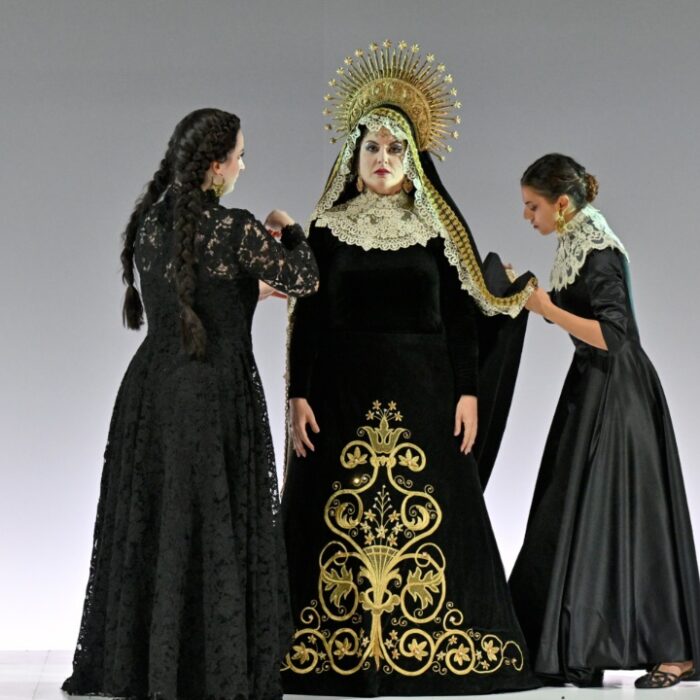
The staging was very dark, even oppressive, to which Stefan Maria Schmidt’s lighting designs and Axel Aust’s 1940s costumes added little in the way of color and intensified the heavy atmosphere that pervaded the drama. There was nothing to lighten the scenes; even when an occasional opportunity presented itself, such as with a reference to indigenous tribal traditions or philosophy, the scenes remained heavy and gloomy. Štorman’s decision to introduce a barbecue with a few cans of beer to depict the continuance of life’s trivial concerns while the life-changing events played out, neatly contrasted the extremes in which the protagonists operated. The overriding sense of anxiety, however, was relentless; the hot dog and beer changed nothing.
Timothy Connor’s Standout Performance as Doctor Atomic
Baritone Timothy Connor presented Robert Oppenheimer as an isolated individual, unable to connect with the other characters on the stage. He often appeared as vacant, and hollowed-out, overwhelmed by the moral, political and scientific questions that weighed heavily on his whole being. The responsibility for taking decisions with potentially existential consequences was clearly psychologically damaging, and in Act two, he descended into a delusional state, in which he adopted Christ-like poses in front of his flock, with the chorus on their knees. His vocal portrayal was sensitively layered to meet the depths of his psychological and emotional struggles to reveal his sense of dislocation and pain; the weighting of his words, the emotional coloring of the voice, and keenly placed accents were all brilliantly crafted. There was much to admire, not least his moving rendition of John Donne’s poem, “Better my heart three person’d God,” which brought the first act to an end.
It was a compelling, if not sympathetic portrait, which captured the depths of his anxieties and the effects of the pressures under which he worked. In the final scene, he was a broken man, sitting at the front of the stage, pouring the crushed bones of the dead over a model of a house, the house he had sought to protect by developing the bomb.
The scientist Edward Teller was given a clearly defined, confident interpretation by bass Jin Seok Lee. Equally as aware of the moral and existential consequences of their work as Oppenheimer, he did not suffer the same degree of anxiety and was able to take an emotionally more detached approach, even indulging occasionally in sardonic comments. Lee possesses a firm, resonant voice with an attractive, rich timbre, which he used intelligently to craft an expressively compelling vocal portrait.
Tenor Roberto Gionfriddo produced an excitable, emotionally volatile portrait of the scientist Robert Wilson, whose anxieties led him to focus on the negative aspects of the project, in which he often allowed his emotions to get the better of him. However, it was the sweet lyricism of his voice that really captured the attention.
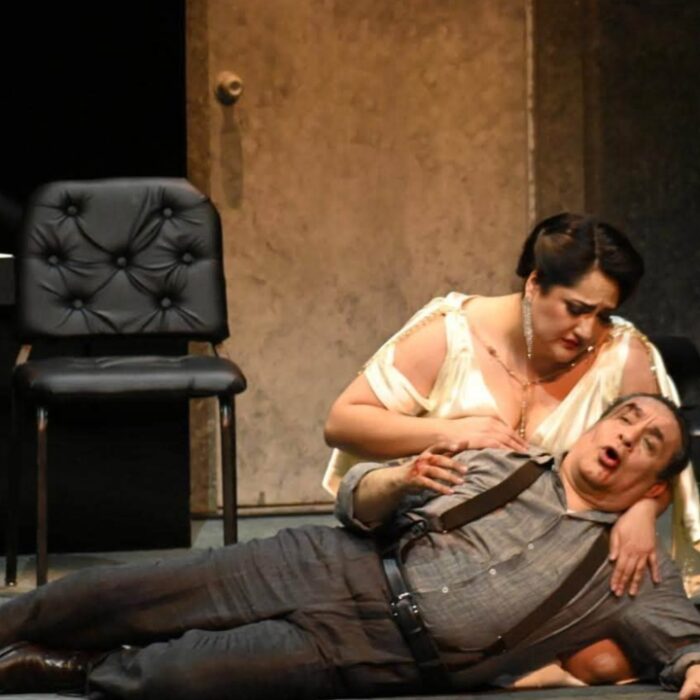
The two women introduced very different perspectives to the male-dominated world of Los Alamos with its regimented and practical scientific approach underpinned by strict chains of authority and its commitment to developing the bomb. Oppenheimer’s wife, Kitty, was given a sympathetic reading by soprano Inga Schäfer, portraying her as superficially calmer and more reflective than her husband, from whom she has become emotionally detached. In Act one, she appeared on the upstairs balcony of the house while her husband was situated on the ground floor, rather than lying in bed with him as described in the libretto. They never touch each other. They are isolated, trapped in worlds made up of their own fears and anxieties. Schäfer sang with a confident, appealing flexibility, exhibiting a beautiful sultry tone, which she used with an expressive sensitivity to capture Kitty’s varying emotions as she ponders what the future holds, while her nuanced phrasing was neatly tailored to capture her worries and shifting feelings about her complex relationship with Oppenheimer.
Contralto Anja Jung was cast as the Native American maid Pasqualita, and although visually there was nothing to suggest this was her background, her distinct outlook, which viewed man’s position within the natural world from a different perspective, managed to add a spiritual calmness that was absent in the other characters. Jung impressed with a fine, controlled singing performance, in which the allure of her dark-colored tones promoted her sense of connection to an eternal spirit.
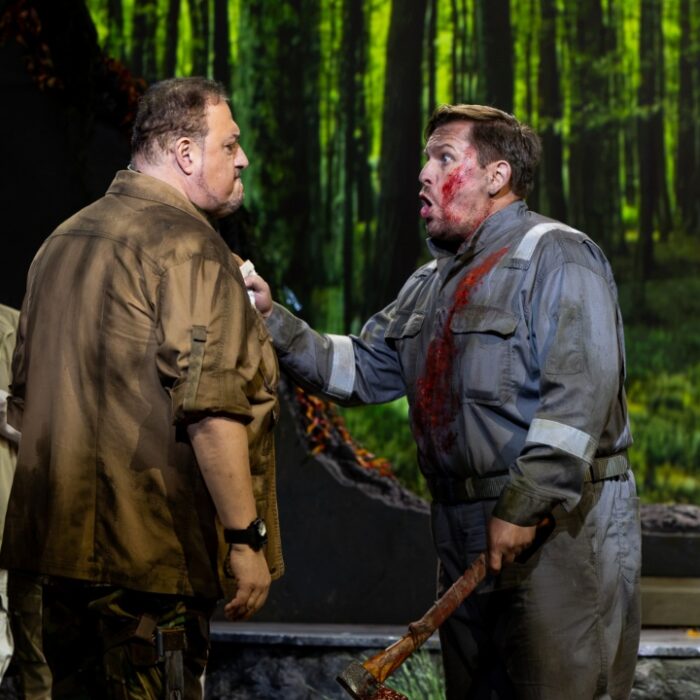
Baritone David Severin created a convincing portrait of the single-minded General Leslie Groves, whose commitment to ensuring a successful test was paramount, paying little attention to any secondary concerns, be they technical or moral. Severin swaggered around the stage with an authoritarian and aggressive air, bullying anyone who threatened his agenda, yet allowed the stresses and anxieties that inevitably oppressed him to permeate his singing, and successfully created a layered interpretation.
Baritone Jakob Kunath essayed the role of Jack Hubbard, whose principal responsibility was to forecast and monitor the weather. He was the target of much of Groves’ bullying behavior, who refused to accept his weather predictions, as they would delay the test. Kunath’s characterization was that of a responsible, nervous man who was intimidated by Groves whilst still managing to hold his position. He possesses a voice with a pleasing timbre that he imbued with Hubbard’s sense of unease and, at times, fear.
Tenor Juyoung Mun produced a tidy performance as Captain James Nolan, impressing with his attractive lyricism.
The Chor des Theater Freiburg was in fine voice and successfully helped create the sense of claustrophobia that weighed heavily upon the complex in which the scientists lived and worked.
Adams‘ Brilliant Score Brilliantly Captures the Inner Drama
What really makes this such a powerful work, however, is Adam’s wonderfully detailed, busy and atmospheric score that mixes tonal and atonal music with a confident ease that unsettles yet, at the same time, draws in the audience and prevents the listener from being able to detach and thus step back from the anxieties it seeks to capture; the moral and existential questions remain fixed in the mind throughout the performance; even the rare periods of musical calm were unable to diminish them.
Friederike Scheunchen, conducting the Philharmonisches Orchester Freiburg, elicited a brilliant performance, one that captured the scale and emotional depths of the score. It was a reading that promoted textural detail and revealed Adams’ imaginative orchestral colors. The sound was often tense, energetic and moody with plenty of rhythmic contrasts, and the pace was carefully managed; in Act one the music sped along with a sense of urgency and conflict, while in the latter part of Act two everything slowed, allowing the tensions during the countdown to the detonation to build. Scheunchen’s presentations of the orchestral interludes were beautifully fashioned, allowing their gripping melodies to bloom; the storm music, in particular, was wonderfully evocative of the menace and danger that was developing.
Overall, this was a first-class presentation from the Theater Freiburg, one that did justice to Adams’ thought-provoking, insightful and emotionally draining work. The layered presentation not only brilliantly captured the nuance of the psychological and emotional pressures along with the moral dilemmas to which the protagonists were subject, but the sensitivity and strength of Štorman’s staging and Scheunchen’s excellent musical direction, together with the fabulous cast, ensured that it was a fabulous piece of theater.