Florida Grand Opera 2025-26 Review: Turandot
Aleksandra Kurzak & Yulan Piao Shine as FGO Celebrates 100th Anniversary of Puccini’s Final Opera
By David Salazar(Credit: Lewis Valdes)
To commemorate the 100th anniversary of the world premiere of Puccini’s “Turandot,” the Florida Grand Opera revived the iconic work for the first time since 2010. For the occasion, the company’s CEO Maria Todaro took the stage to give the audience a brief intro to the evening and its significance for the community, while also previewing what is to come in 2026-27.
The moment felt particularly potent, given the whirlwind that the opera world (and ballet world) has experienced over the past week. Because what was made immediately apparent by Todaro’s speech, and which isn’t always something we notice as we focus on the curtains rising and being lost in our individual experiences of a work, was the sense of community. The palpable excitement and laughter elicited by her words. That same energy was visible throughout the performance with audience members exploding into applause when some artists delivered breathtaking displays. Even when one artist experienced a major setback (more later), the audience exploded with support when that artist got a chance later at redemption. It’s almost as if the people comprising the near-capacity crowd actually cared.
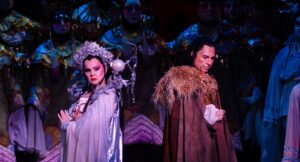
The production, directed by Jeffrey Marc Buchman, features sets and costumes designed by Allen Charles Klein with the aesthetic emphasizing a traditional approach to the opera. A dragon sculpture dominates stage right with a descending staircase bisecting it. Stage left is a more open space with platforms that are utilized freely and amply throughout the performance. The backdrop features projections by Keith Lissner, with imagery shifting as the scene demands. During Ping, Pong, and Pang’s musings at the top of Act two, we see a lush, green garden while the Riddle scene features a darker, wooden interior with the riddle answers displayed in Mandarin on the screen as Calaf comes to his realizations. In outdoor scenes, images of clouds dominate with Liù’s death punctuated with a subtle appearance of Puccini himself amidst the clouds (in her pre-performance talk, Todaro hinted that some of the kind would happen in commemoration of the opera’s first-ever performance whereupon conductor Arturo Toscanini put his baton down and stopped the performance to remember the recently deceased composer).
All of the projections are complemented by expressive lighting design by Robert M. Wierzel. Perhaps the standout moment is the climactic duet between Calaf and Turandot. After a dense blue lighting dominates following Liù’s death, the tone slightly shifts as we approach the sunrise, the lighting growing warmer, the projections shifting accordingly. The final images of the opera are bathed in radiance, emphasizing the happy ending.
Ballet is utilized throughout the performance (more than I’ve seen in any other production of the opera I’ve personally experienced first-hand) with a particular standout happening at the beginning of the opera. As the people comment on the fate awaiting any prince that fails the riddles, we see one of the executioners twirling a sword around. The solo dance was aggressive but potent and contrasted with more graceful appearances from the female corps, who get multiple appearances in anticipation of Turandot’s arrivals on the scene. While preponderant, the use of dance heightened the staging, providing ample counterpoint to the otherwise static blocking of the performers.
This is perhaps the one major critique of the production. The costumes certainly help establish the world and give it character, but how the characters entered or left the stage at times (and when) undermined the dramatic tension and energy of certain scenes. The end of Act one, where Calaf hits the gong and calls out for Turandot, is a moment of epic proportions with the two arias evolving into a massive ensemble. But for this scene, there were only six players on the stage with the chorus off-stage. It made the moment feel a bit hollow. More troublesome from an aesthetic perspective, was the seeming lack of order and coordination of all the characters entering the palace in the second scene of Act two. Everyone seemed to be coming from all parts of the stage and the general lack of order made the scene feel chaotic. Given that this is a ceremony full of protocol, the blocking didn’t quite work.
The title role is one of the most demanding roles in all of opera. The teenage girl is meant to be performed by a dramatic soprano with sufficient weight and power to explode over a titanic orchestra and chorus in this very act. On paper, soprano Aleksandra Kurzak doesn’t seem like a fit for this role. The soprano is a great Tosca and Cio-Cio San, but the dramatic repertory is not something she’s flirted with before. At a post-performance event, the soprano herself admitted that when she got the call from the company, she expected to sing Liù. But given the 100th anniversary of the opera, she decided to give it a shot. Who knows what the future holds, but on this occasion she delivered a very solid turn. Given the extremes of range, she clearly darkened her sound for the heftier low sections and definitely tested her limits throughout “In questa reggia,” but what resulted was often thrilling in its execution. She never sounded taxed or overwhelmed, the legato lines as fluid as any bel canto singing the soprano has done. In her most renowned interpretations her emotional intensity is always matched by a similarly peerless technical precision and it was clear that she employed this latter characteristic to great artistic effect. Not only did she manage the moments where Turandot is expected to sing over the orchestra, never pushing or forcing, her sound never overpowered in anyway, but this exactitude made her Turandot feel more calculated and rigid. The riddle scene was notable in its rhythmic precision, the soprano’s bite all the more palpable. When she begged her father to not throw her away, the soprano indulged the gentle lines, allowing her expansive legato space to mold and build before the epic conclusion to the passage. With the orchestra and the chorus delivering tidal waves of the sound, the soprano rose to the occasion quite well.
While her singing retained that similar aggression throughout the opening of the final duet “Principessa di Morte!” the second half, following the kiss, allowed Kurzak ample breadth to sing with the full expansiveness of her lyric soprano and it was here where you heard her deliver colors that most sopranos, because of the weight of their sounds, simply don’t have the same access to. If Turandot was rigid and violent for most of the opera, here you felt the softening, the gentleness, the tenderness, that often eludes performances of this work. In a similar vein, Kurzak’s imposing theatrical presence shifted from firm and even angular for most of the opera, to looser and more relaxed in the second half of the duet.
People will surely have their opinions on whether this is the “right fit” for Kurzak’s voice. But what makes her such an exciting artist is that she’s not afraid to take risks and experiment. Ultimately, no one knows what is best for Kurzak better than the soprano herself.
The other major draw of this performance was tenor Roberto Alagna in the role of Calaf, one of his signatures. The tenor’s last appearance in the role took place at the Royal Opera in London with Alagna leaving the performance prior to its conclusion, resulting in a late cast change, the omission of “Nessun Dorma” and booing from the audience. While there was reported speculation about why he left in this fashion, OperaWire’s own investigation into the matter did not result in concrete confirmation from The Royal Opera.
This night was undoubtedly an essential one for Alagna and Kurzak. As such, it was quite notable that the tenor took a long time to settle in and even when he did, there were shaky moments throughout. His voice has ample resonance and the tenor is explosive in his intensity, but there was a sloppiness in many passages.”Non piangere Liù,” while full of tenderness, was exceedingly slow and tentative. It didn’t seem like Alagna and conductor Jonathan Brandani were fully on the same page throughout this particular passage and it never quite took off to its emotional heights. At the height of the riddle scene, after Turandot begs her father to protect her, Calaf declares “No, no, Principessa altera! ti voglio ardente d’amor!” Some brave tenors throw in a high C to add to the passion of the “ardente,” but it is not written in the score. Alagna opted for the interpolation. His voice cracked. It was an unfortunate moment in a performance that was already far from the tenor’s greatest. Moreover, it came after a solid showing during the riddle scene, Alagna’s fiery responses playing off nicely against Kurzak’s controlled demeanor.
“Nessun Dorma” felt primed to be a moment of redemption, but the tenor’s intonation was uncharacteristically flat with the exception of the high notes. The climactic high B was solid and potent and the audience rewarded Alagna’s effort with the most effusive applause of the evening, almost as if trying to rally him to greater heights. The tenor responded by delivering his finest singing of the night during “Principessa di Morte!” It’s almost as if something clicked for the tenor that hadn’t to this point. He was firm and in control, both dramatically and vocally. The chemistry with Kurzak was palpable, the two pushing each other to greater heights. It reminded me of a performance of “Tosca” the two did a few seasons ago where their chemistry overcame suspect conducting. On this occasion, together with Brandani and the orchestra, the singers delivered palpable drama, allowing the opera to conclude on the highest of notes. Alagna’s singing here was so strong that it felt like a major redemption for many of the struggles prior.
Yulan Piao also delivered a strong turn as Liù. While her high notes in “Signore, ascolta!” had a roughness to them, the soprano slowly warmed up into the role and was quite noticeable in the climax of the first act. But where she really shone was during her big scene in the final act. From her opening “Principessa, l’amore,” there was a tenderness that had not been present from anyone else to this moment in the performance. Her legato lines were fluid throughout this first aria and as she built toward the “A! Come offerta suprema del mio amore,” she accelerated, the lines more accented until all time stopped on the A and B flat of this climactic line, the soprano delivering an arresting piannissimo. “Tu che di gel sei cinta” was even more potent, with Piao’s singing imbued with a sense of urgency. She held the high A fermata on “di questa ancora,” crescendoing gloriously into the final “aurora.” At that moment, she grabbed the sword from the executioner and stabbed herself viciously, collapsing with similar potency to the ground. After such heart-wrenching singing, her physicality in this moment was the perfect emotional punctuation. The audience gave her a tremendous ovation right before the final duet. The response to her during the curtain hall was similarly effusive.
As Timur, Adam Lau was rock solid and deeply affectionate in his interactions with Piao’s Liu. He was forceful in his protests toward Alagna’s Calaf throughout Act one, but made his biggest mark in the final moments after Liù’s death, a calm in his sound as he pleaded for her to get up. There was an innocence in the approach, which allowed for the strong contrast when he realizes the truth and curses everyone for her death. Here, as he cursed them, his voice took on a more jagged edge and the bass held his final note, further emphasizing the haunting nature of his proclamation. The chorus turtled physically in response, furthering the effect.
Raymond Diaz, James Mancuso, and Levi Adkins were solid as the trio of Ping, Pong, and Pang, particularly in their big Act two scene, though the ensemble did feel unsteady at times and balance was noticeably off in Act one. Ray Gonzalez’s Emperor was forceful and it was particularly refreshing to hear a rising desperation creep into his voice as he pleaded with Alagna’s Calaf to let go of his goal to win over Turandot. Alagna’s relaxed “Figlio del cielo, io chiedo d’affrontar la prova!” was a perfect counterpoint to Gonzalez’s increased desperation. It also emphasized the danger presented and the fact that the Emperor was not callous to the situation. Given this, you could actually believe he might be swayed by his pleading daughter, but it was his “È sacro il giuramento” that felt unfeeling. It furthered the understanding of Turandot’s anger; her father was desperate to save a stranger but quick to give her away.
In the pit, Brandani led a solid performance overall. There was some trepidation in the opening Act and you could feel some of the creaks that come with an opening performance, but there was greater cohesion in the final two acts. The orchestra’s sound tended to favor the brass, which added a more muscular texture to the overall feel of the piece. However, strings, except in solo sections, felt muted in their presence. As for balance with pit and stage, the conductor ensured a good mix with the singers coming through clear whether thundering over fortissimo ensembles, or singing the gentlest of piano sounds.
A few seasons ago, Florida Grand Opera was on the brink of extinction, marred by poor financial choices. But there were those who cared enough to turn it around and this “Turandot” seems like a statement of intent for where the company is heading. While the sopranos stole the show, it was undeniably an engaging evening on the whole.