Latvian National Opera 2025-26 Review: Cavalleria Rusticana & Pagliacci
Premiere of New Production Highlights Mārtiņš Ozoliņš’ Musical Direction & Aik Karapetian’s Stage Vision
By Federico Ginzburg Natalucci
On February 17, the Latvian National Opera premiered its new production of “Cavalleria rusticana” and “Pagliacci.” The evening stood as a demonstration of the highest artistic level, expressed in every dimension that only opera can so powerfully unite. Two fundamental pillars sustained the success of the enterprise: the formidable musical direction of Mārtiņš Ozoliņš and the extraordinary stage vision of Aik Karapetian.
All Eyes on “Cavalleria rusticana”
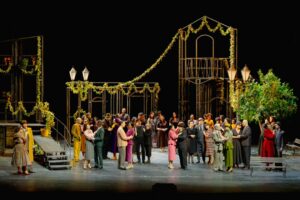
Of the two traditionally paired titles, it was “Cavalleria rusticana” that received its premiere staging. Drawing, as the stage director noted, on the aesthetics of Italian neorealist cinema, the production sought, through costume and set design, to evoke the immortalized Italy of Michelangelo Antonioni, Pier Paolo Pasolini, Vittorio De Sica, and Federico Fellini. Yet, most compellingly, this Mediterranean imagery was interwoven with a distinctly Baltic or Nordic inflection, including subtle allusions to the floral symbolism of midsummer rituals.
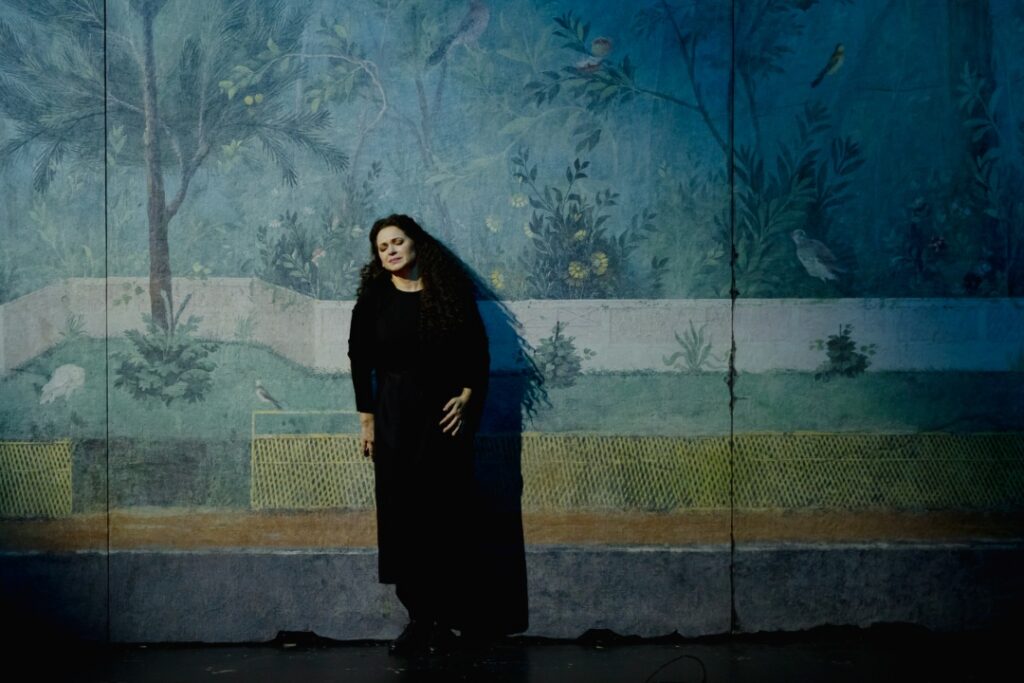
As the curtain rose during the overture, the staging offered fleeting memories of Turiddu’s past with Lola before his departure to war, and of the moment he first encounters Santuzza. As the aria “O Lola, ch’ai di latti cammisa” begins, the staging shifts, revealing a long and vividly colored fresco, like an extended mural along a narrow alley where Santuzza listens to Turiddu’s song. The visual richness of this image deserves special mention. It subtly captures the spirit of the Roman frescoes preserved in the Palazzo Massimo in Rome. Its naturalistic detail and restrained tonal palette captivated the eye, binding the action to one of the most enduring artistic legacies of Italian history.
(Photo: Agnese Zeltiņa)
Two moments achieved particular visual sublimity through masterful lighting and design: the Romanesque fresco itself, and, during the “Regina Coeli,” the appearance of a luminous rose window rising from the rear of the stage. Without altering the village setting, a transformation in lighting alone produced a breathtaking effect—the stained glass radiating hues reminiscent of 1970s cinema, austere yet robust in beauty. The scenographic team of the Latvian National Opera deserves the highest praise for such meticulous craftsmanship.
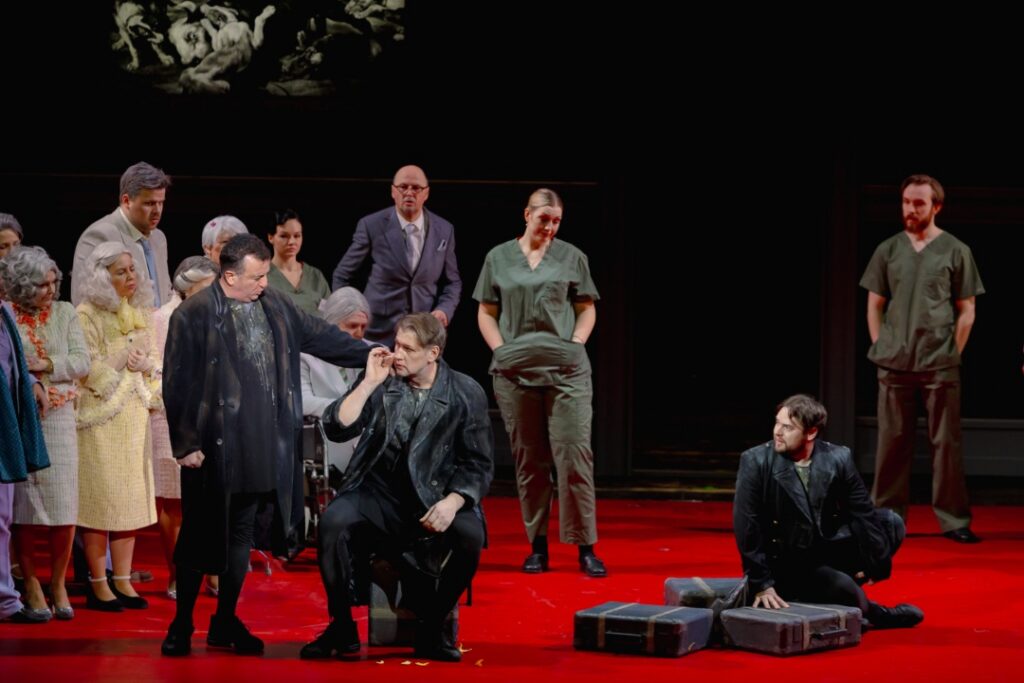
Dramatically, the production revolved around a central axis: transmutation. If one were to distill Karapetian’s concept into a single word, it would be transformation—the psychological and emotional passage from one state to another as shaped by the unfolding tragedy. This extended well beyond Santuzza; nearly every character underwent a profound internal shift within the opera’s brief span. For instance, Mamma Lucia, portrayed by Ilona Bagele, initially appeared as a devout, rigidly moral figure who regards Santuzza with disdain due to her excommunication, withholding the maternal compassion suggested in Mascagni’s conception. Yet upon learning of the fatal outcome of the duel between Alfio and her son, her psychological structure collapses entirely. Don Alfio, by contrast, emerged as a cinematic celebrity, a showman surrounded by villagers seeking autographs, until news of Lola’s betrayal fractures his inflated identity. Turiddu, though less radically altered, remained in the image of a reckless villager given to habitual drunkenness, an interpretative choice that diverges somewhat from the original libretto. Santuzza, however, embodied the culmination of metamorphosis, a transformation to which we shall return.

(Photo: Agnese Zeltiņa)
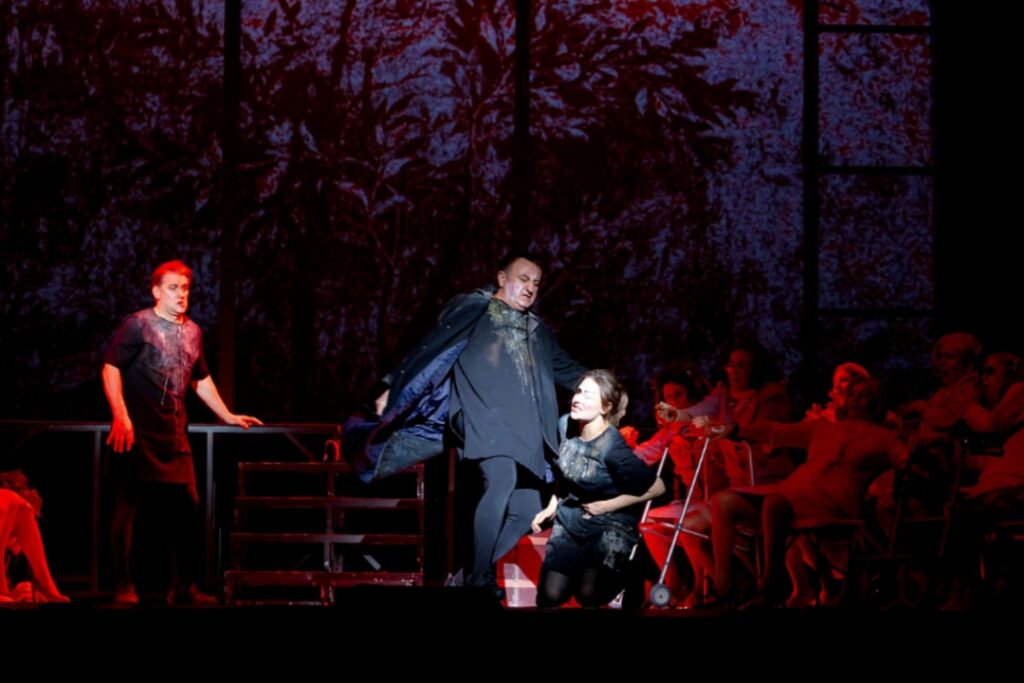
In Karapetian’s staging, Alfio hires men to execute Turiddu by hanging, a chilling final image. Mamma Lucia herself cries out to the audience, “Hanno ammazzato Turiddu,” as the silhouette of a hanged man appears before the illuminated rose window. Santuzza’s scream of horror completes a tableau of devastating power. From visual conception to dramatic structure, the production proved a continuous triumph—eschewing empty innovation in favor of psychological depth and artistic integrity.
Musical Direction
Under the baton of Mārtiņš Ozoliņš, the musical direction proved equally impressive as staging. Communication between pit and stage was exemplary. The orchestra displayed remarkable sonic flexibility, delivering ferocious fortissimi and exquisitely controlled pianissimi with equal authority. The “Regina Coeli” stood as a masterclass in balance between chorus and orchestra, from its opening “Inneggiamo” to the apotheotic finale.
Ozoliņš conducted with finesse and assurance, granting singers expressive latitude while shaping a coherent interpretative vision. The Italianate fervor—marked by incisive string passages and expansive crescendi—revealed both the conductor’s and orchestra’s versatility across demanding repertoire. Special mention goes to the principal cello for his full-bodied sound projection and expressive phrasing.
(Photo: Agnese Zeltiņa)
A Cast of Remarkable Distinction
The premiere featured a cast of formidable caliber. Latvian tenor Raimonds Bramanis as Turiddu, convincingly embodied the director’s portrayal of the reckless Sicilian antihero, particularly in his confrontation with Alfio before the duel. His vocal projection was secure, with notable strength in both the lower register and upper register, though occasional strain appeared in the middle range. His duet with Santuzza was especially commendable.
Mamma Lucia, sung by Ilona Bagele, impressed with luminous Italian diction and a richly colored mezzo timbre. Dramatically attuned to the staging’s demands, she displayed a homogeneous instrument marked by rounded emission and excellent vocal presence.
Irma Pavāre as Lola crafted a dramatically astute portrayal of a provocateur who thrives on discord. Vocally appealing in color, she demonstrated refined breath control and particularly well-rounded high notes.
Don Alfio was interpreted by baritone Jānis Apeinis, who would later assume Tonio in “Pagliacci.” Electrifying in stage presence, he fully realized the camera-conscious showman. His dark yet focused tone, impeccable diction, and evenness across the range affirmed his reputation for consistency and authority.
Santuzza—“Beata tra tutte le donne,” as the prayer invokes—found an extraordinary exponent in dramatic soprano Tatiana Trenogina. Those present at the premiere can attest to the magnitude of her achievement. Vocally, she deployed an impressive technical arsenal, revealing new facets aligned with each dramatic turn. Her diction was pristine; her tone rounded and free of harshness, yet capable of acquiring a cutting edge when required.
During the “Regina Coeli,” as the village rejects her, she offered an intimate, inward interpretation, her expressive face serving as the primary vessel of the drama. Tatiana Trenogina surrendered herself entirely to Santuzza’s fate. After imploring Turiddu in desperation, she reaches the apex of emotional purity—only to curse him in a moment of wounded pride. In that instant, innocence yields to corrosive bitterness, a transformation vividly etched across her features. Her mastery lay in charting this essential metamorphosis: from near-virginal vulnerability, to shadowed avenger, and finally to a figure shattered by terror at the sight of her husband’s hanging body. Voice and body alike responded with total commitment, surpassing the interpretative norm of contemporary operatic performance.
Brava.
(Photo: Agnese Zeltiņa)
“Pagliacci”
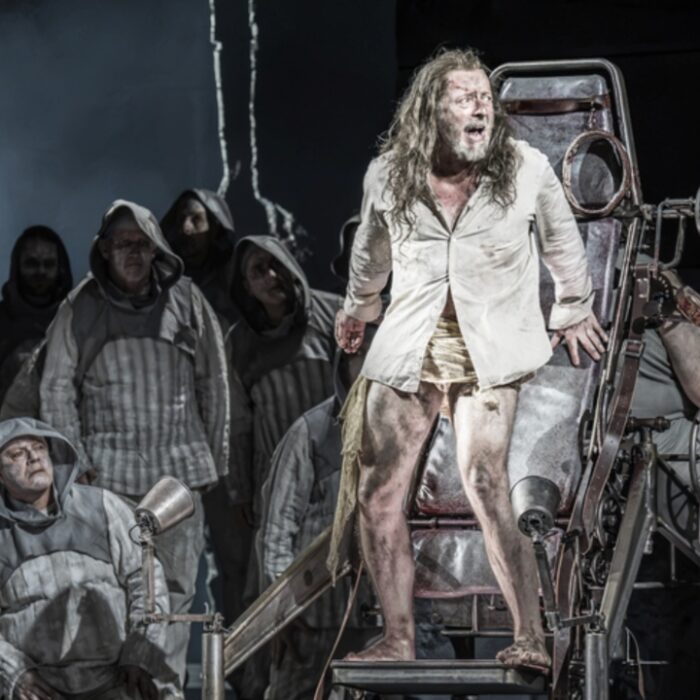
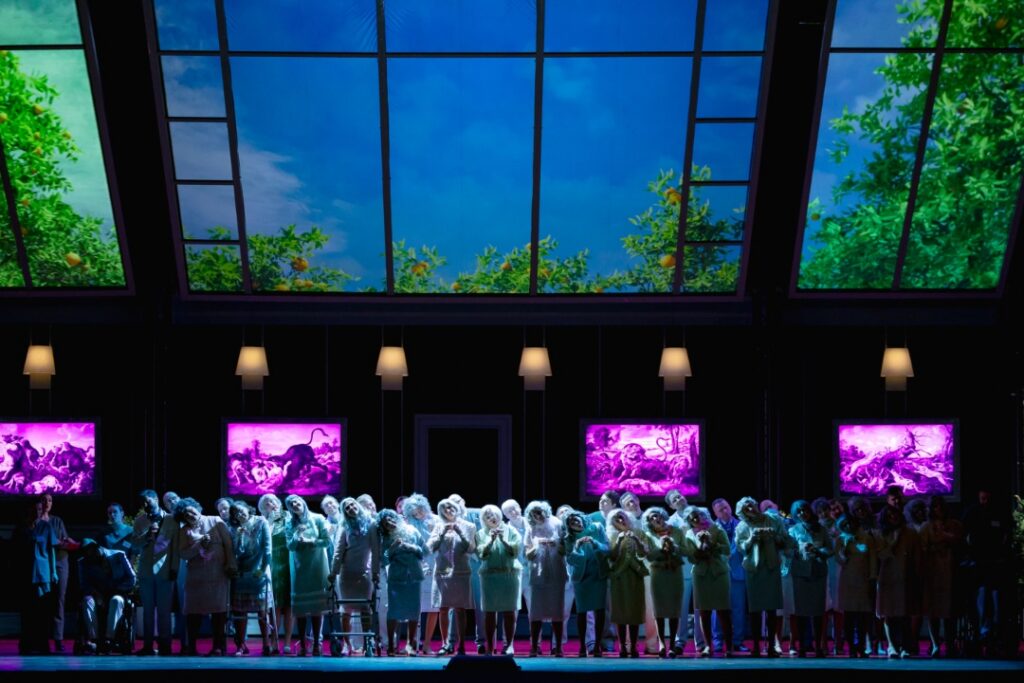
On this occasion, Leoncavallo’s title was presented as a revival of the 2019 production. In its renewed context, the dramatic concept unfolds as a kind of future projection of the dolce vita depicted in “Cavalleria rusticana:” the inhabitants of that Sicilian village, now advanced in age, find themselves residing in a nursing home. The staging once again proved a remarkable success. The tension generated between the elderly residents and the traveling circus troupe provided a layer of dark humor that offered an unexpected yet perfectly calibrated counterweight to Leoncavallo’s tragedy. The chorus assumed a carefully structured and perceptive prominence: the crowd of senior residents clustered among the performers, elderly gentlemen attempting to touch Nedda, elderly ladies reaching for Beppe. The nursing home staff medicated them as the plot unfolded, and during the circus performance many of them drifted into sleep—only to awaken, bewildered, when Canio’s violent outburst toward Nedda shattered the atmosphere. When tragedy finally bared its teeth, chaos and uncertainty engulfed the stage.
One of the most striking aspects of the production was the clear divide between the residents of the nursing home and the circus troupe. Before the famous “venti tre ore,” there was barely any meaningful interaction. Tonio appeared openly arrogant, even annoyed by the presence of the spectators. A large part of the staging’s impact came from its realism. It takes the essence of verismo and places it convincingly in a contemporary setting. In a world where art is increasingly marginalized and economic pressures suffocate performers, Aik Karapetian’s “Pagliacci” presents circus artists who appear exhausted and spiritually depleted. Canio, their leader, mistreats his wife in front of the audience with unsettling indifference—“after all… they are only old people.” Tonio’s contempt is just as evident. Nedda appears more sincerely connected to her artistic calling, yet her true sense of freedom—true to the libretto—emerges through her love affair with Silvio. Only Beppe shows a genuine warmth toward the elderly audience, engaging with them in a way that feels natural and unforced.
The pervasive feeling that this is merely another routine show for the troupe becomes crucial. Unlike the traditional tension in which Canio feels humiliated before an engaged audience, here the spectators are almost irrelevant—just another passive presence. This is underscored when, at the beginning of the confrontation between Canio and Nedda, the elderly residents are asleep, an effect that focuses our full attention on the marital conflict. The earlier tension between troupe and spectators dissolves entirely, allowing us to become immersed in the dispute that will culminate in catastrophe. The production stands as a clear triumph—comic, raw, violent, and contemporary in the best sense—drawing exceptional dramatic work from both soloists and chorus.
The orchestra, for its part, carried the soul of the drama with absolute refinement, fully aligned with the dramatic essence described above. In passages associated with Canio, Leoncavallo’s score recalls that remarkable theatrical phenomenon in which truth is masked on stage yet revealed through music—the emotional weight embedded within the melodic discourse. This was interpreted with particular distinction in the cello solo that follows “Vesti la giubba.” The burden of Canio’s dishonor translated into the weight of the bow in that cathartic solo: phrasing, breath, and dynamic shading were shaped with rigor under the baton of Maestro Mārtiņš Ozoliņš and the orchestra’s principal cellist, whose commitment was unmistakable.
This passage is of immense importance. While in concert performances the aria often concludes with the tenor’s final note, in the opera Leoncavallo demands that Canio’s emotional trajectory continue, further elaborating the tension after the climactic “Ridi, Pagliaccio” rather than releasing it. It is the essential turning point between grief and the birth of vengeance. As noted, the orchestra gave its fullest measure to convey the brutality of these passages and of the finale, while equally shaping the free, almost springlike lyricism of Nedda’s aria, with special mention to the woodwinds for their evocative rendering of birdsong. Once again, one must emphasize the excellence of an orchestra capable of adapting to diverse repertoires within a demanding schedule while maintaining the highest interpretative level.
(Photo: Agnese Zeltiņa)
Stellar Cast
Beginning with Beppe, tenor Dainis Kalnačs offered an absolute gem of the evening in the aria “O Colombina.” Vocally assured, equipped with impeccable technique and a clear, rounded emission, he delighted both audiences—the fictional nursing home residents and the real spectators in the theatre. Beyond its vocal polish, the aria was theatrically memorable: Kalnačs sustained a delightful pantomime continually disrupted by the mischievous elderly ladies onstage. His wholehearted embrace of the clown’s eccentricity was crowned by flawless singing.
Silvio, dressed as a contemporary stage technician, was portrayed by tenor Rinalds Kandalincevs, who shone alongside Nedda in the love duet. Possessing a vocal instrument of appealing warmth and supported by solid technique, he impressed with passionate outbursts, carefully shaped phrasing, and generous projection.
Tonio deserves special mention. Baritone Jānis Apeinis demonstrated striking dramatic versatility, moving from the charismatic film-star showman of Cavalleria Rusticana to a menacing Tonio clad in a leather coat—an authentic societal outsider. His portrayal conveyed disdain toward the nursing home audience, subtle manipulation, and at first an almost disarmingly sincere affection for Nedda, which soon devolved into cruelty. (One cannot fail to note his astonishing onstage consumption of mandarins—so numerous that their scent seemed to reach the stalls— a comic detail that at the same time demonstrated his full commitment to shaping the character.) Vocally, Apeinis was impeccable: a notably darker timbre, firm emission, precise diction, and commanding projection over the orchestral texture.
Nedda was embodied by Latvian soprano Inna Klochko, presenting a character of dual nature: repressed beneath Canio’s authority yet liberated in her aria. Leoncavallo’s long, romantic melodic lines unfold most expansively when she is alone, and Klochko delivered the aria with extraordinary delicacy. Her homogeneous register and luminous timbre allowed her coloratura to shine with precision while never sacrificing emotional intensity. Another highlight was the Colombina–Pagliaccio duet, in which she physically manifested the mounting tension that would lead to tragedy.
Tenor George Oniani as Canio was without question the central figure of the evening. His performance embodied what we hope to experience in opera: a natural, outstanding vocal technique combined with complete dramatic conviction. His “Vesti la giubba” stood out as one of the highlights of the night. In the recitative “Recitar!… mentre preso dal delirio…,” he conveyed genuine emotional anguish, carefully building the tension that leads to the heartbreaking “Tu sei Pagliaccio!” At that moment, his body seemed to give way, his posture collapsing as his gaze remained fixed and distant before the Arioso Adagio began. By the time the aria unfolded, the sense of despair was already fully present in his physical expression. He sustained each phrase with clear, focused tone and a well-controlled vibrato, allowing the pain of the character to emerge naturally and directly.
The weight he placed on certain notes, along with subtle touches of rubato, allowed Canio’s despair to unfold with clarity and intensity, leading to a deeply moving “Ridi, Pagliaccio” at the height of the aria’s tension. Under the attentive direction of Maestro Mārtiņš Ozoliņš, the orchestra followed the tenor with remarkable sensitivity. There was a palpable sense of spontaneity—one of those rare moments in live performance when everything feels immediate and alive, as if the music were being discovered anew beyond what had been rehearsed. Ozoliņš maintained precise control throughout, then seamlessly guided the expressive cello solo that brings the aria to its close. With this performance, George Oniani offered a powerful display of passion and artistic dedication, raising an already strong production to an even higher level.
The premiere concluded with a heartfelt and thoroughly deserved ovation for what stands among the finest productions presented in this theatre in recent months.
Bravo.