Festival Alte Musik Knechtsteden 2026-27 Review: Hoffmann & Mozart
By Mengguang Huang(Photo: Michael Rathmann)
Kloster Knechtsteden is an ideal spot for early music. You do not just get an unaltered Romanesque church, but also the whole surrounding abbey ecosystem. There is a college, a library, guest lodgings, and a Kulturhof with an art gallery. The moment you turn off the main road, that noble porch stands there to welcome you. Inside, the Basilica’s vaulted roof immediately hits that mental image of what medieval architecture should feel like.
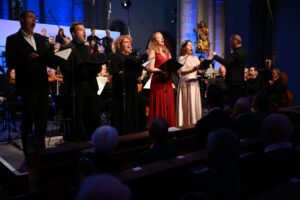
This year, the Festival Alte Musik Knechtsteden celebrates the 250th anniversary of E. T. A. Hoffmann’s birth. Known mostly as a literary figure, he was truly versatile, and this festival gives his musical output a systematic spotlight. Opening the festival by presenting his “Miserere in B-flat minor” with music by his idol, Wolfgang Amadeus Mozart (Hoffmann even adopted the middle name “Amadeus” after him) felt thoughtful. Having Concerto Köln on the stage made the match even more promising.
The solo vocal quartet featured Anna Nesyba (soprano), Alice Lackner (mezzo-soprano), Johannes Gaubitz (tenor), and Konstantin Paganetti (bass). Right from the start, their SATB blend was warm and balanced. What impressed most was how well they listened to one another. Their collaboration felt natural, and their rapport with the orchestra was attentive. In a piece like Hoffmann’s “Miserere,” which relies heavily on dense contrapuntal imitation, that kind of mutual awareness is essential. One could hear it clearly in the second section, “Ecce enim in iniquitatibus,” where the vocal lines weave around each other in a style that owes a heavy debt to Mozart.
Meanwhile, the modestly sized Rheinische Kantorei shifted easily between full homophonic textures and complex fugal lines. For example, in the sixth section, “Averte faciem tuam,” they delivered a captivating pianissimo over dark string accompaniment. Later on, in the ninth and eleventh sections, they threw themselves into grand fugues with a momentum that felt like an unstoppable force.
The opening “Miserere mei” set up a captivating contrast between quartet and choir: a gentle blend from the soloists set against firmer declarations from the brighter chorus. In the third section, “Ecce enim veritatem dilexisti,” the choir sang over an energetic, pulsing bassline from Concerto Köln’s low strings, building a sensible spatial effect.
For the fourth section, “Asperges me hyssopo,” mezzo-soprano Anne Bierwirth stepped out from the choir to join the soloists. The three female singers produced a clean, simple sound that meshed beautifully with the orchestral strings, while the choir responded with sincerity.
Naturally each soloist had moments to shine. In “Sacrificium Deo,” Nesyba sang with a golden radiance over comforting string figures. Her voice showed remarkable flexibility, holding long lines with fine breath control, and her lower register sounded grounded and rich. In “Auditui meo dabis,” Gaubitz navigated his lines alongside bassoons, using a warm expression, while Paganetti also demonstrated his flexible timbre in section eight.
Under the direction of Edzard Burchards, Hoffmann’s score sounded polished and well-informed. The composer clearly knew his way around the sacred music of Haydn, Mozart and beyond. While considerable passages instantly remind us of Mozart’s Requiem, Hoffmann’s Miserere holds its own as a deeply sincere work.
After the intermission, this paring program turned to familiar territory with Mozart’s Cantata “Davide Penitente,” KV 469. The work is a vivid example of Mozart’s practical nature. Probably written for a Viennese benefit concert, he recycled his unfinished “Mass in C minor,” KV 427, swapping out the Latin liturgical text for Italian words.
The transition from the deep C-minor weight of the opening Kyrie (now “Alzai le flebili voci”) to the operatic additions was handled with real nuance. Supported by relaxed but majestic string playing from Concerto Köln, Nesyba unleashed her full vocal power.
Lackner took center stage in “Lungi le cure ingrate,” navigating its operatic lines with confidence. Her back-and-forth with the orchestra felt natural, marked by subtle tempo shifts. One could also witness the flashes of energy, and considerable theatrical daring in her singing. Even if her lowest notes occasionally lacked a bit of weight, her vocal chemistry with Nesyba was undeniable. When the two joined for “Sorgi, o Signore,” their voices projected with impressive power, challenging each other in color without ever clashing.
The eighth section, “Tra l’oscure ombre funeste,” is one of the two entirely new arias Mozart composed for this largely recycled work. It turned out to be a real triumph for the soprano. Nesyba first shaped broad melodic contours in the air effortlessly. When the music moved into demanding coloratura passages and the shining cadenza, she sang with technical assurance and a sense of operatic flair.
In the second new aria, “A te, fra tanti affanni,” Gaubitz handled the lyrical lines with a human touch, framed by fine woodwind passages in the introduction and recap. During the trio “Tutte le mie speranze,” the three singers again showed that listening-first ensemble work that made the first half so engaging.
While the Rheinische Kantorei has a smaller role in “Davide Penitente,” they delivered solid work throughout: whether in the brief phrases of plead in “Sii pur sempre benigno” or in the massive closing fugue. In the seventh “Se vuoi, puniscimi,” the choir explored wide dynamic contrasts against decisive accents in the strings.
Intriguingly, Mozart’s own music written for the “Mass in C minor” also looks back to earlier masters like Bach and Handel. Side-by-side programming like this feels much like hanging two interrelated paintings together in a gallery. To be sure, it is not a grand blockbuster exhibition, but it offers a deeply insightful experience for inquisitive listeners. In our era of increasingly tight cultural budgets, it stands as a welcomed approach to music curation with real depth.