Escena Escorial Festival 2026-27 Review: Carmen – The Reel Story
Bárbara Lluch’s Searing Production Turns Bizet’s Beloved Opera Into a Mirror Held up to the Present
By Galina Altman(Photo:
“Carmen” is the most performed opera in the world by number of productions, and its heroine dies in every generation for the same reason: for the right to rule her own life. Now let’s ask ourselves how many of those productions were, and still are, staged through the male gaze.
Taking a Closer Look
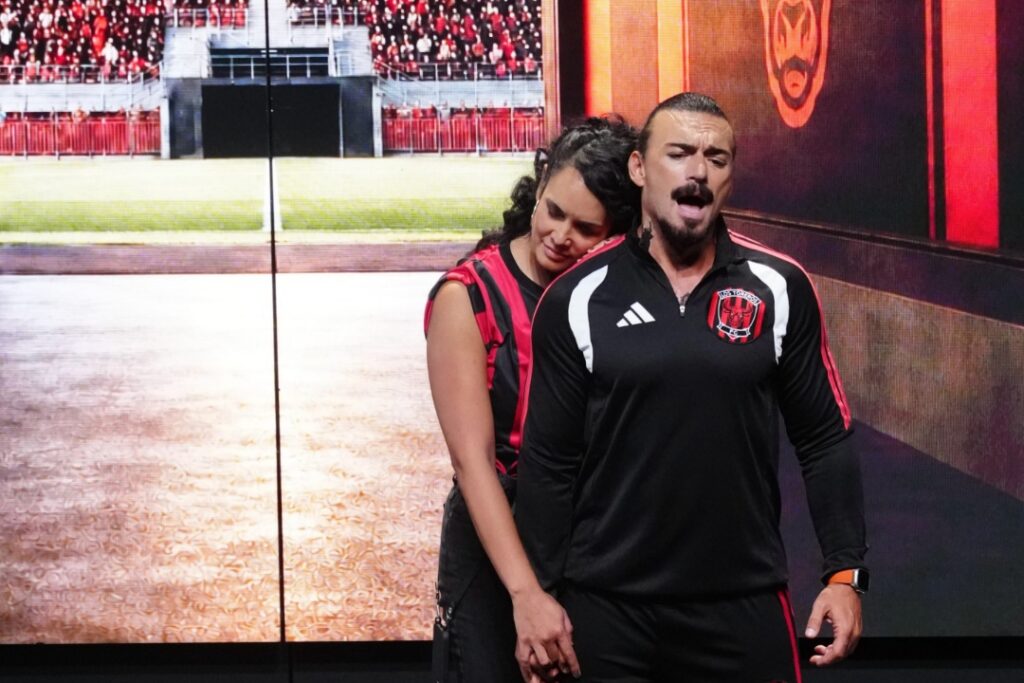
Bárbara Lluch‘s new production of “Carmen,” which had its world premiere at the PAAX GNP Festival in Mexico before making its Spanish debut at the inaugural Escena Escorial Festival in San Lorenzo de El Escorial, opens with femicide statistics flashing across a screen under the sound of Bizet’s overture. Numbers from different countries, mixed with quotes from well-known male politicians on women’s place in society, appear before a single note of music has been sung. It is an immediate, disorienting, and entirely deliberate rupture with everything audiences expect when they take their seats for this opera.
The quotes from “great” contemporary politicians on women’s place in society paired how many women die every year, how many acts of violence happen every hour, what well-known male politicians say or have said and how they treat women now and broadcast that attitude to the world through an enormous media network, reaches literally every one of us. Every one of her.
This text hit me emotionally from the first seconds, even me, someone already well acquainted with the subject, before a single note of music. It immediately pulled us away from the lens we usually watch “Carmen” through: Spanish decorativeness, castanets, gypsy skirts and heels clicking on the street. Let’s be honest, in the 21st century that is already pseudo-decorativeness. We don’t live like that, even if we happily watch traditional processions and costumes on holidays. But theater is exactly about our life, no matter what century the staging pretends to be in.
(Photo: © Carmen: The Reel Story)
Calling Out Systemic Cycles
Femicide, of course, is not only about Spain, just as “Carmen” is not about being a victim. The movements around MeToo, the Gisèle Pelicot case, “Epstein’s island,” keep reproducing themselves in our world over and over.
Why does this keep happening?
Not a single male director has stopped to ask why. And that is astonishing.
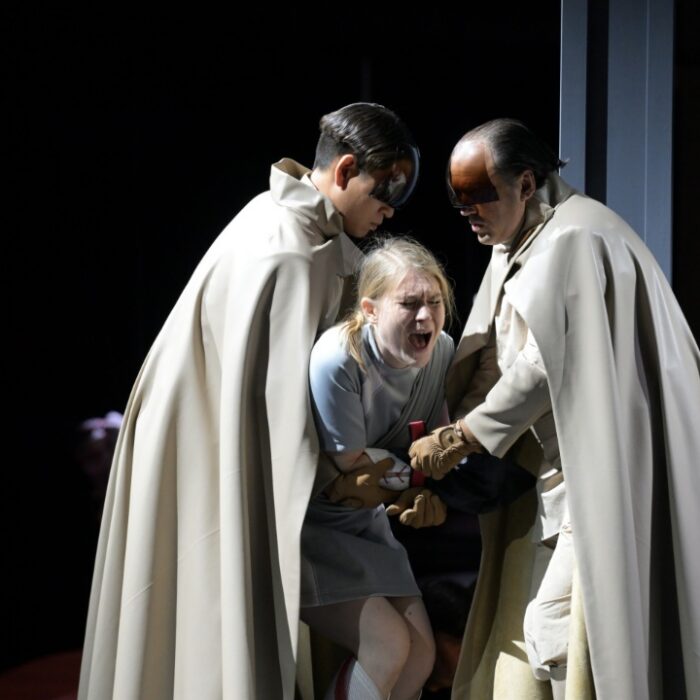
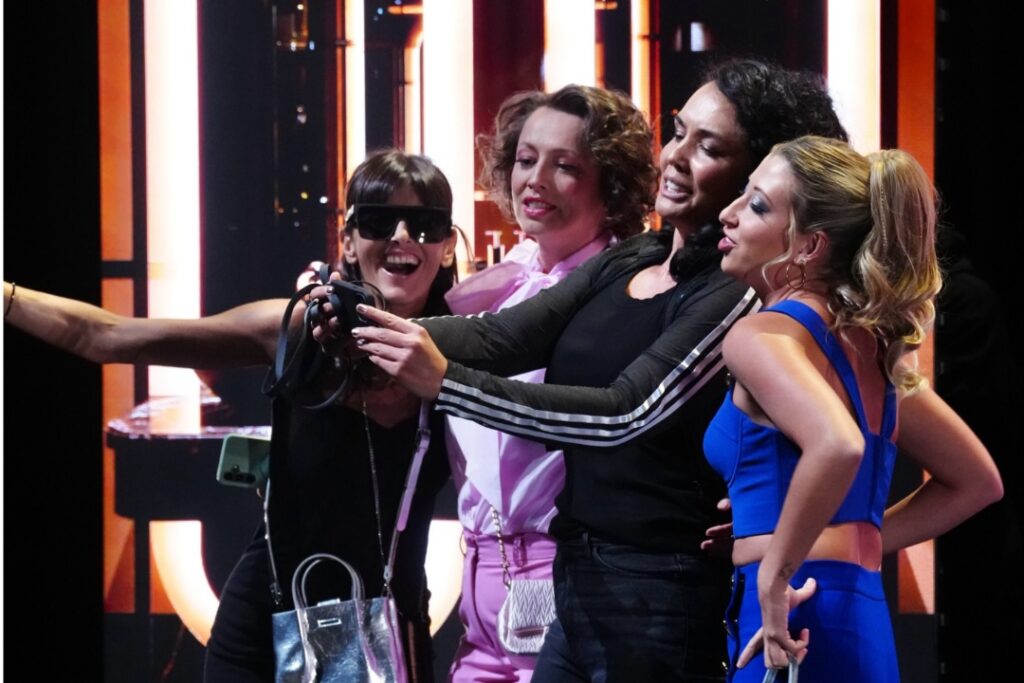
Lluch’s production uses every current trend and the social reality we all live in: screens and chats running alongside live conversation, dating apps, girlfriends’ clubs, relationships, with men too, of course. All of it is done remarkably well, dramaturgically, symphonically, and emotionally. Both theaters are effectively working on that stage at once, the dramatic and the musical, reinforcing and completing each other. The singers’ acting can safely be called brilliant, clearly built on the best traditions of British theater training, combining deep classical text, powerful vocal grounding, and mandatory physical expressiveness from the performers. The stage design can be called minimalist, but it cannot be called dull or uninteresting—everything is subordinate to the director’s intent and masterfully holds the viewer’s attention.
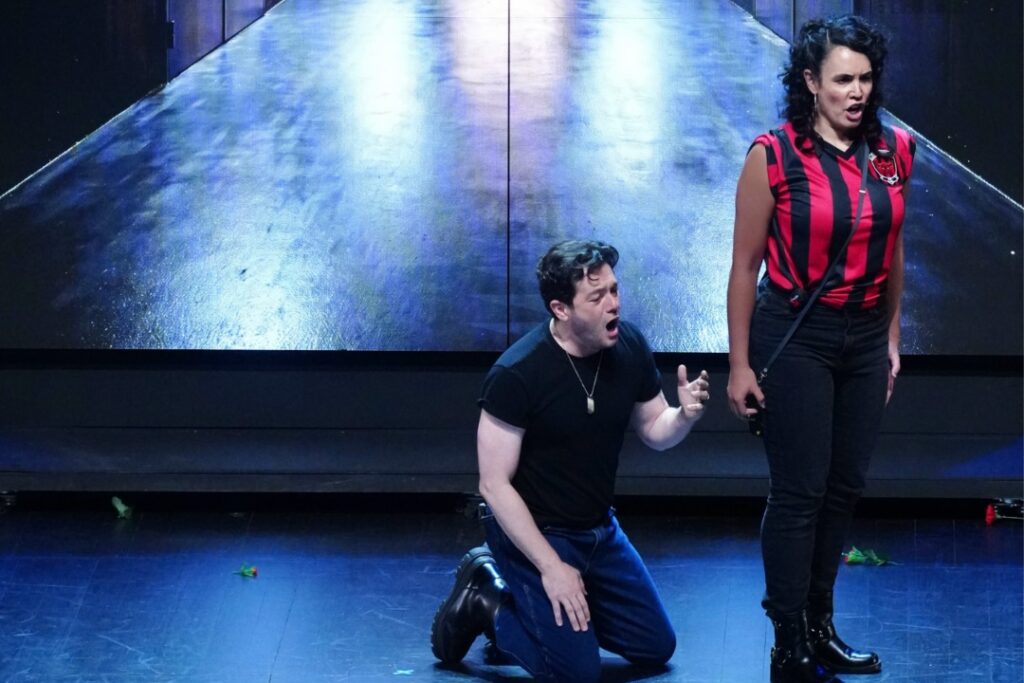
The scenes with children are magnificent in their meaning: mass “programming” through TikTok, cartoons with political and other subtext, are woven into the production incredibly well, as is their gender divided upbringing. Boys and men strive to look tougher among their own kind, they bulk up, watch football, compete through sports and gadgets, while girls and women keep improving themselves from a completely different angle. Supposedly of their own free will, by their own choice. Meanwhile the crowd’s idol throws roses to both sides, and both crowds, male and female, grab them with the same fanaticism.
(Photo: © Carmen: The Reel Story)
Rethinking the Archetypes in Role-Play
The characters, too, are rethought through contemporary psychology, not the openly wild passions of the 19th century. Don José is not a macho man, but rather someone who looks nice on the surface yet is pathetic and not particularly interesting. He is a security guard at an office building, you know the type, wearing a uniform, but it’s unclear whether he could actually guard anything or stop any real disorder. As the action unfolds, “wounded” by Carmen’s attention to Escamillo—here a football star instead of a bullfighter—he joins chats where men discuss their girlfriends and other women, a direct reference to the Gisèle Pelicot case. The temperature of that discussion gradually gives him “permission to kill.” Carmen doesn’t fall in love with him, she rather settles for this relationship, and when she finds out about the chat, she leaves Escamillo for good.
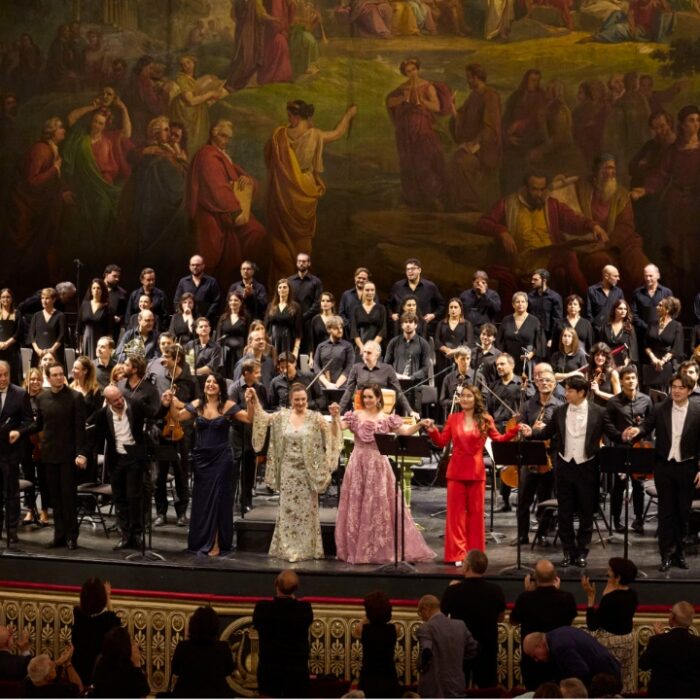
Artificial intelligence is also used simply and brilliantly here. In recent festival productions, the AI experiment onstage looked silly, soulless, and out of place, with all due respect to creative experimentation. Here the AI visual effects are used in a very fitting way, witty and, next to live people, even frightening. This way, in an hour and a half instead of Bizet’s three hours, the director, together with the singers, the chorus, and the orchestra, tells us a story you rarely find even in the best examples of contemporary cinema sitting in a movie theater.
(Photo: © Carmen: The Reel Story)
Vocal Performance Highlights
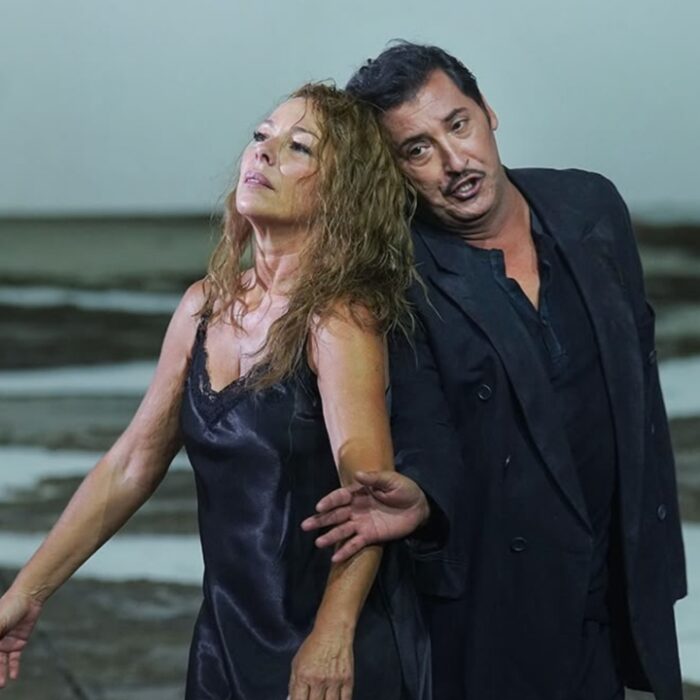
Mezzo-soprano Gaëlle Arquez as Carmen outplayed plenty of showbiz stars on that stage, with voice, with dance, and physicality. Nothing could pull attention away from her and her part, not the chorus, not the bright screens onstage, nothing and no one. She was magical. She has one of the most beautiful voices of her generation: flexible, elegant, silky, and, at the same time, fresh and seductive. There was a “French” elegance in it—a soft, noble sound that grabbed you from the first second. Plus incredible shades of piano and phrasing. She sounded deep and beautiful, without a single questionable note.
Tenor Arturo Chacón-Cruz gave a genuinely wonderful vocal performance as Don José, a Mexican American tenor with a beautiful velvety lyric timbre that suits his character very well – someone who is at heart more of a romantic than someone with a hero complex. He carries his voice remarkably: a rich, full middle register, a timbre without any flat harshness, sounding very manly and weighty while blending perfectly with the orchestra, creating an excellent ensemble with it.
Italian bass-baritone Gianluca Margheri as Escamillo performed with rich, dark vocal colors, without being the killer of the story: he showed just how masterfully he could thicken the vocal palette, giving his voice drama, authority, or even the sinister and dangerous shades the plot required. He was the kind that fit the leader of any aggressive male group, in this case a popular football team and its fans. At the same time his voice was perfectly focused and easily cut through the dense orchestral texture, reaching the farthest rows of the Auditorio El Escorial without visible effort.
(Photo: © Carmen: The Reel Story)
Building a Living Dialogue
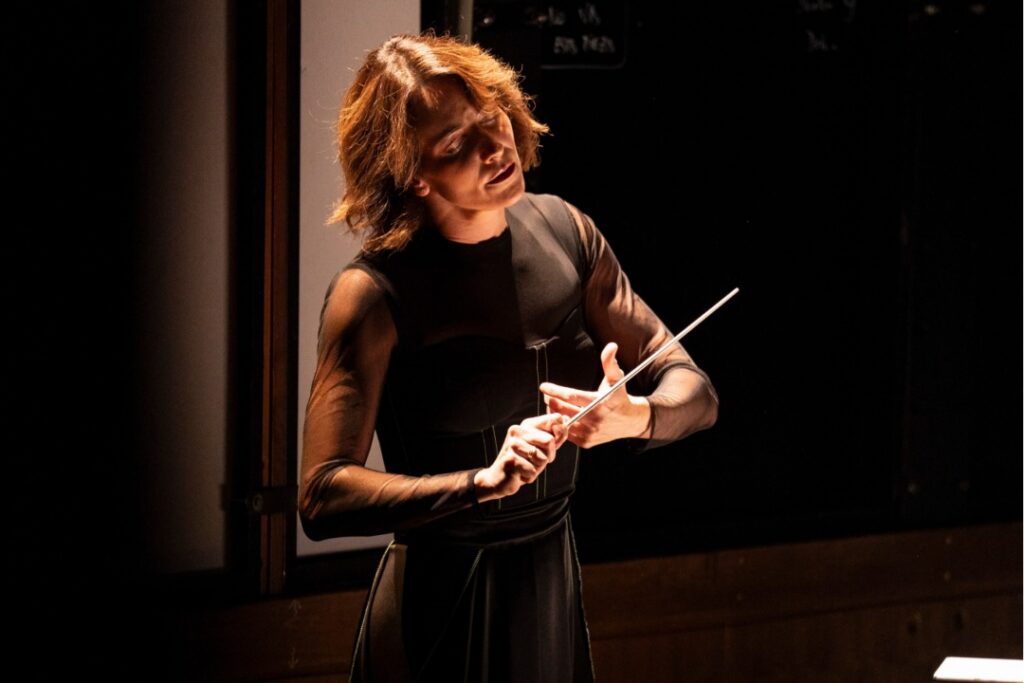
Of course, it’s impossible not to talk about the music director and conductor of this production, Alondra de la Parra. An expressive and finely balanced sound, rhythmic precision and elegance, new details in music we’ve all heard countless times, made the ORCAM orchestra feel like our own personal player. It was like a well-balanced set of speakers, the instrument through which any modern listener hears and takes in music. The volume was set perfectly: after all, we don’t shout at the top of our lungs on the street when we talk to each other now, and we don’t push our voices to extreme levels in ordinary communication the way “Carmen” used to be delivered as a musical backdrop by orchestras under “traditional” conductors, deafening the audience with blaring brass and percussion until they were half fainting.
Alondra de la Parra is also rightly called part of a new wave of conductors who break the “maestro dictator” stereotype and build a living dialogue with both the orchestra and the audience. She always gives wonderful, thoughtful introductions before her performances and concerts, drawing the audience in not just for pure aesthetic enjoyment of musical masterpieces, but for thinking with them through, during, and after the show.
It’s worth mentioning separately that this new “Carmen” from Barbara Lluch became the first opera of the brand new Escena Escorial Festival in San Lorenzo de El Escorial, whose artistic director and creator is Alondra de la Parra herself. This is a completely new level for the cultural life of the Spanish capital. Alondra said it plainly at the presentation: she wants to turn San Lorenzo de El Escorial into a world-class summer cultural capital, something like a Spanish Salzburg. More than 250 artists from 11 countries have already taken the festival stage in 2026, among them Daniel Barenboim, along with leading local ensembles. The program opened on Aug. 29 with a concert by French pianist Thomas Enhco.
Given the scale of the ambition, the lineup, and the resounding success of the opera “Carmen: The Reel Story” of this first season, Escena Escorial looks like a bid for a new permanent fixture on Spain’s and Europe’s cultural map.