Carnegie Hall 2026-27 Review: Tosca
Superstars Dudamel, Kaufmann & Rebeka Deliever Greatness
By Chris RuelConcert presentations of operas are tricky to pull off because nothing “guards” the singers (or orchestra): no lighting, sets, or costumes, and the musicians are tucked into a pit. Except for the hidden instrumentalists, the other three aspects of a staged production can distract. Music, unfortunately, can take a back seat to the other, flashier parts of a staging. This was not the case for the November 16th, 2026, presentation at Carnegie Hall.
“Tosca” productions are numerous and varied, and my experience with those I’ve seen has, of course, spanned the quality spectrum, especially in the emotional payoff of two heavy scenes: the Scarpia/Tosca fight and the final betrayal. Carnegie Hall’s concert presentation of “Tosca” lacked that. This isn’t a bad thing, nor was the lack dire. Instead, the music and narrative took center stage in Puccini’s “shabby little opera,” and new insights emerged.
The evening showcased a formidable quartet of talent: Gustavo Dudamel on the podium; Jonas Kaufmann as Cavaradossi; Marina Rebeka in the title role; and Ludovic Tézier as Scarpia. The spectacle lay in the artists’ voices and the orchestra, not horses crossing the stage, and that’s exactly where it should be.
Removing the opera from the opera stage helped surface more facets of the story—characterizations, motives, foreshadowing—while spotlighting Puccini’s rich score. This separation landed well. Yet the disconnection also exposed some holes, the biggest being the transformation of Cavaradossi and Tosca into pillars of political resistance. Remember, the story covers a 24-hour period, so no intervening years, months, weeks, or even days would’ve pushed a mild-mannered painter and vainglorious diva in that direction. Yet the audience is offered two very different characters between Acts one and two.
Moreover, in a concert presentation, characterization cannot take the form of grand melodramatic gestures—the assault and murder of Scarpia and Tosca’s final leap—so personalities and motivations must be conveyed through subtle movements and idiosyncrasies. Ludovic Tézier gave a masterclass in minimalist acting, using his fingers, posture, smirks, and a lascivious gaze to convey his interpretation of the character. Despite the positives of concert presentations, they have many limitations, including death. Scarpia, after a brutal knifing, dies on his feet. (Lying on the stage in white tie wasn’t sartorially sound.) Scarpia remaining on his feet required an extreme suspension of disbelief, but what’s new and different about opera?
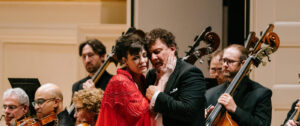
Staying within the realm of onstage fashion, I want to note that Marina Rebeka’s gown choices were thematically strategic: white for Act one; red for Act two; and black for Act three. The allusions were clever and subtle, and the gowns themselves were diva-worthy, whether she be real or fictitious. The two male leads wore formal wear. Everyone else wore suits or other stage-chic ensembles, including Dudamel.
While the audience saw only Dudamel’s back, the conductor’s electricity shot through the seats, even as he seemed to tone down his signature style to avoid intruding on the singers’ and orchestra’s magic. Yet he was still very much part of the performance—a character to watch—though at curtain call, he seemed sheepish and shy, as if he didn’t want to take credit for any of it and instead pointed to everyone else onstage. Rebeka had to drag him back out at one point. Ego often takes the shine off artists. Dudamel’s brightness may stem from his humility and joy in bringing out the best in those he works with. He succeeded, leading his band in a flawless performance of Puccini’s score. The New York Philharmonic’s maestro freshened the sound and breathed life back into well-trodden passages, but more importantly, everything served his musical goals. It wasn’t any arm waving that held attention, but that he seemed to have eyes on all sides of his head, conducting artists without even looking at them. He was spinning musical fine china and dropped not the smallest saucer. Finally, Dudamel gave the vocalists wide berths to wow the audience. Colla voce was the prime directive during set pieces, and the artists used it to its full effect.
Kaufmann’s Cavaradossi was cocky, and that interpretation seeded his later defiance of Scarpia, though his transformation. The tenor showed off the voice that makes him a superstar vocalist, but did he have the acting skills needed? One hundred percent. As mentioned earlier, the singers have very limited space to do their thing, so they cut anything too physical. Tézier, as Scarpia, has already been praised for his stagecraft, and Kaufmann maximized it with minimalism, much like his colleague.
The tenor’s highlights were, of course, “Recondita armonia.” Kaufmann thrilled the audience early on, holding the dotted eighths as they held their breath. The overall feel was playful. There was no doubt: Kaufmann set the course for a brilliant evening, the end of which brought “E lucevan le stelle.” The aria is a letter-writing scene, showing how opera often uses this narrative device to move the story forward; here, it leads to a tragic ending. What do you say about Kaufmann when so much has already been put to paper? His interpretation of the aria was deliberately slow (again, Dudamel gave him space), each note weighted with emotional purity and stunningly gorgeous singing.
Turning attention to Marina Rebeka, who followed the opera formula perfectly. Act one brought the diva bursting onto the stage, her tank full of vanity and childishness, and forward her extreme jealousy. In Act two, we saw a tough, clever, and defiant woman determined to save her love—to the point of handing her body over to the slimeball baron. Of course, she stabs him. He dies. She leaves. Storm clouds roll in for Act three’s betrayal, Cavaradossi’s death, and Tosca’s leap.
Rebeka’s big number, “Vissi d’arte,” is what the audience waits for. You’ve heard it so many times you wonder if an unheard interpretation is out there, waiting to be fostered. Was Rebeka the one? Who knows. What is known is that she slowed the aria to a crawl, so the audience didn’t miss a note. Concert productions can drift into stand-and-deliver, but she sidestepped that, keeping up her movement. She meant what she sang, and that came through her tone, color, dynamics, and pacing—everything needed to knock the piece out of the park. Her performance was so far from phoning it in that the phone wasn’t even in the auditorium.
Tosca has a strange religious piety about her. She’s a woman of the world and stage, yet she pays close attention to who’s not in the room but sees everything. God? Nope. The Magdalen and the Madonna—the two most important women in the Christian faith. Interesting. This has never surfaced in previous stagings, where piety is cultural rather than personal.
I spoke of Tézier’s physical portrayal of Scarpia, but I want to add a few observations. The French baritone’s interpretation foregrounded the baron’s predatory nature. Scarpia is a man made of lust. Even if this were my first viewing of the opera, Tézier put out untrustworthy vibes. I would’ve guessed he would cross her. The baritone didn’t telegraph the forthcoming betrayal; it was simply in the air, put there by an excellent singer-actor. The question is: Tosca knew the rapacious creep wasn’t to be trusted; so why did she? That remained (and remains) unresolved.
The performance was flawless—Dudamel did everything right, and the orchestra brought the score alive. Kaufmann was fire; Rebeka excavated character; and Tézier made sure you knew he was awful with remarkable subtlety. The characters were realized fully and freshly, and they coaxed the narrative details into view. On a stage full of stars, egos did not join them—they took the night off. The artists had to come together in a special way to create such an amazing performance. They certainly did, and the audience reaped the rewards.
Someone who deserves a special shout-out is twelve-year-old Emrys Pengelly, a treble, who sang the role of the Shepherd Boy. His voice couldn’t have been more perfect for the role, and his singing was just beautiful in tone and skill. Bravo!