Donizetti Opera Festival 2025 Review: Donizetti Songs
By Bernardo Gaitan(Photo: Studio UV – Fondazione Teatro Donizetti )
When one thinks of Donizetti, one immediately thinks of opera: sparkling comedies or intense melodramas. Yet it must be remembered that Donizetti also composed, almost furtively, a large number of intimate, inventive, exquisitely crafted songs. These pieces reveal an introspective and confessional version of him, endowed with a surprisingly wide expressive palette. This music is written for refined salons, friends, and specific dedicatees. It is music born of closeness, and therefore profoundly human.
In the foyer of the Teatro Donizetti, on the festival’s closing day, a recital awaited that had generated great expectation and curiosity among bel canto enthusiasts. This morning event formed part of Opera Rara’s monumental undertaking: an effort, ongoing for more than half a century, to record the complete corpus of Donizetti’s solo songs. A vast, nearly ungraspable body of almost two hundred works scattered throughout Austrian libraries, German castles, and other unlikely places where one would expect to find musical manuscripts.
To hear a selection of these gems live–some well known, many forgotten, and others rediscovered almost miraculously after being considered lost–was a luxury. The record label, in collaboration with the Donizetti Opera Festival (DOF), intends to present all two hundred pieces over the next three years, entrusting this admirable task to the young talents of the Bottega Donizetti.
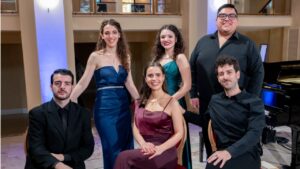
Accompanied by Maestro Giulio Zappa, a key figure in the world of opera, a pianist of prodigious sensitivity, and the pedagogical heart of the Bottega, the young singers unfolded a broad, balanced, and highly contrasting program. Zappa, who is also part of the project’s discography (he accompanied Volume No. 4 with Marie-Nicole Lemieux) offered a nuanced, flexible, warmly breathed accompaniment, supporting each performer with musicianship that felt tailor-made.
Vocal Highlights
The young singers, who had presented in this same festival edition the double bill “Il campanello” & “Deux hommes et une femme,” demonstrated not only vocal reliability but also something far more difficult: the ability to give personality to short pieces, sometimes true miniatures, yet full of theatrical intent.
Soprano Lucrezia Tacchi shone with her youthful, luminous timbre, clean articulation, and innate sense of phrasing. In “La zingara” she displayed radiant freshness; in the bolero “L’amante spagnuolo” she combined virtuosity and character, and her “L’ora del ritrovo” was tinged with gentle sweetness.
Fellow soprano Cristina De Carolis sang with elegance and complete stylistic command. Her “Faut-il renfermer dans mon âme” was a dramatic miniature of distinctly French style. In “La Bohémienne” she revealed strong temperament without ever abandoning the bel canto line.
Tenor Cristóbal Campos Marín, with his clear timbre and honest emission, took a surprising turn in the “Lamento di Cecco da Varlungo,” shaping sorrow and sighs with notable sensitivity. In the duet “Qual colomba che fuggahe” offered one of the warmest moments of the concert, balancing lyricism and nobility.
Mezzo-soprano Eleonora De Prez was versatile, refined, and theatrical. She expressed a broad dramatic palette throughout the recital. “Sull’onda tremola” and “Philis plus avare que tendre” revealed her full musicality, while in “La Fiancée du timbalier” she achieved a narration filled with tension and character. Her clear, elegant French distinguished her among the cast.
Time and again, Zappa astonished with his ability to transform the piano into an emotional extension of each singer: light and undulating in barcarolles, incisive in Spanish-flavored boleros, transparent in French songs, tender and melancholic in Italian lieder. It was a true luxury.
Baritone Francesco Bossi, a young artist of remarkable stage maturity, offered a restrained and sorrowful hero in “Un pour espoir.” In “A piè del mesto salice” he delivered a reading of great nobility. His “Te dire adieu” was among the recital’s most emotionally intense moments.
Meanwhile, the solid voice and firm projection of baritone Pierpaolo Martella, paired with his excellent diction, confirmed him as a strong presence in today’s Italian vocal scene. “Mentre dal caro lido” and “O Cloe” showed his ease in blending lyricism and character, while in “Il pegno” he displayed musical intelligence and a flawless vocal line.
The two final numbers “Sin che fedele” (an extraordinary world premiere) and the charming six-voice piece “Rataplan” brought the entire cast together in a joyful, vibrant vocal celebration. The energetic finale revealed a true sense of camaraderie among the singers, Zappa, and the loyal Bergamasque audience, who responded with warm and enthusiastic applause for the young performers.