CD Review: Pentatone’s ‘Golden Age’
By Bob DieschburgAfter their recent forays into the modern and contemporary repertory, Pentatone’s “Golden Age” indulges instead in an irresistible nostalgia for Met-proven voices: unpretentious yet charmingly picturesque, the album evokes the hedonistic atmosphere of days sadly gone by—when operatic luminaries (think Tucker, or Roberta Peters on the “Ed Sullivan Show”) dazzled with sheer vocal prowess.
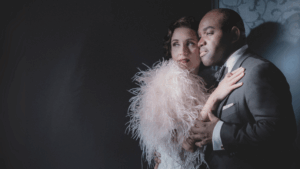
Show business at its best, then—or at least that is what the Pentatone cover, with its retro-styled Lawrence Brownlee and Erin Morley, appears to suggest. Under the baton of Ivan Repušić, they deliver an eclectic program of bel canto, with arias and duets ranging from Rossini, Donizetti, and Verdi to the French elegance of Delibes and Bizet.
From Ténor de Grâce to Ténor Lyrique
Purists will not, perhaps, hear the “true” bel canto sonority. The orchestra tends toward the pastose, yet brims with color; Repušić and the Münchner Rundfunkorchester deliberately eschew lightness in favor of more robust, opaque undertones—at some remove from historical notions of style, but highly effective–and in keeping with tradition.
The track list should fit Lawrence Brownlee like a glove. But in “Je crois entendre encore” at least, the melody’s innate airiness feels slightly compromised; Brownlee’s timbre, by habit, leans a shade too weighty for me to surrender fully to Nadir’s romantic reverie.
The duet “Ils verront si je mens!” is an entirely different story. The lyrical high point of “La jolie fille de Perth,” its melodramatic—if not outright tragic—undertones prove strikingly congenial to Brownlee’s instrument, now well past the point of no return, so to speak, on the continuum between ténor de grâce and ténor lyrique. This is especially evident in his ability to alternate seamlessly between cantabile and declamatory passages.
Similarly, Donizetti’s roles occupy a central position in the Ohio-born tenor’s repertoire. In the extended aria “Di mia patria, o bel soggiorno,” his clarion sound resonates with the Risorgimento themes of “Marino Faliero:” personal loss woven into the tricolor fabric of oppression, exile, and the struggle for freedom (unsurprisingly, the opera is classified–as per the libretto–as a tragedia lirica).
Yet musically, the piece also recalls the Rossinian idiom of fioriture and acuti (the role was created for Rubini), to which Brownlee—while adept—does not do full justice. The coloratura is smooth and the attack pitch-perfect, but from a virtuoso standpoint his delivery does not quite hit that elusive smile (con un sorriso, as contemporaries described it), that lifted Rubini’s acrobatics to the very highest spheres of critical appreciation.
An American Nightingale
A nightingale in disguise, Erin Morley emerges as the album’s true raison d’être. She is in exceptional form, for instance, in the notorious “Air des clochettes,” where her silvery timbre captures all of Delibes’ latent exoticism. It glitters with insouciance, while her delivery floats across the rapid roulades and crystalline E naturals.
What registers as pure virtuosity in Delibes takes on an air of innocence—vulnerability, perhaps—in her interpretation of “Caro nome.” Is it fair to say that Verdi may not (yet) be her favored hunting ground? Though her characterization of Gilda has undeniable appeal, it remains somewhat superficial, if not understated, in terms of expression—save, of course, for the coloraturas.
That is perfectly fine—and even though she has performed the role before, one is eager to see her break further into the Italian flagship repertoire. The same applies to the Donizetti duets, as well as “Ah, quel respect” from Rossini’s “Le comte Ory,” where Morley synchronizes with Brownlee’s natural affinity for the composer. Brownlee may command the dramatic edge, but the incomparable sheen of Morley’s voice adds a golden luminescence that fully justifies Pentatone’s invocation of opera’s “Golden Age.”