Metropolitan Opera 2026-27 Review: Medea
Sonya Yoncheva Makes Case for Performance of the Season
By David Salazar(Credit: Marty Sohl)
Cherubini’s “Medea” is a truly unique work with a fascinating history.
A work heralded as a masterwork by one Beethoven, “Medea” would then disappear into oblivion until the mid-1900s when another notable figure, Greek-American soprano Maria Callas, made it one of her most iconic roles (she also played the role of Medea in Pasolini’s film). But that rediscovery turned out to be a double-edged sword, for Callas became associated with the role and for time thereafter, any valiant attempt by a soprano to take on the role would be met with comparisons to the famed Greek soprano. Throw in the fact that the role is a towering vocal and theatrical challenge, a Mount Everest of sorts, and that creates the recipe for the work to fail the repertory mainstay label (even though it very much should be right up there).
Then there’s the version of the work. Cherubini’s opera was originally in French with dialogues, but as tradition would have it, German composer Franz Lachner added German recitatives in 1855 and those recitatives would be translated to Italian by Carlo Zangarini; it was this latter version that Callas performed and is also the version that the Met presents (this is also the case with Bizet’s “Carmen,” which if we include the recitatives is actually Bizet and Ernest Giraud’s “Carmen”).
Despite these challenges and discrepancies, the work is undeniably a tremendous piece of operatic theater. Adapted from Euripides’ classic play, it follows the titular character’s vengeance against her husband Giasone who has stolen her children away from her and is marrying Glauce to gain favor with Creonte. Betrayal, scheming, murder, and infanticide ensues.
Not Quite Peak
This is the Metropolitan Opera’s revival of its 2022-23 David McVicar production, which opened that season. I noted in my review of this production that it was some of McVicar’s best work at the Met, with two golden gates creating separation on the stage to emphasize Medea’s isolation. Upstage there is a massive mirror that allows for a different perspective of the stage below, almost creating the feeling of a different world. The first time I saw the production, I was in family circle so I barely got a chance to truly experience the effect that this mirror has on the proceedings. This time around, seated in the Orchestra section, I could actually see it. The effect is strong during the wedding, creating almost two realities for the viewer. But it does feel a bit underused and its visual potential is often wasted. At the start of Act three, Medea meditates on a future crime and the mirror turns into a projector with fire exploding around her.
Memory is interesting to question because the seeming love I had for the production during that first performance was completely absent this time around. All the elements of the production remained but felt rather stolid. With the exception of one performer (more soon), everything felt overly blocky and lacking in any dramatic drive or intention. The pacing suffered and visual interest lagged. The fire felt overly artificial. Whereas I recall the conception feeling cohesive, here it felt incomplete and half-baked. Times change, our perceptions and expectations evolve, and production teams simply lack the ability to recapture lighting in a bottle. Whatever the case might have been, something was definitely missing from this production and its ability to take this incredible piece of music drama to its highest potential.
Carlo Rizzi conducted that original run and he was solid throughout this performance, even if it got off to a sloppy start. An interchange between strings and winds during the second theme of the overture felt like the ensemble was teetering on the edge, not able to find any cohesion. You could see Rizzi over-gesticulating here to get everyone on the same page and eventually he found it. From where I was sitting, the orchestra’s sound throughout the overture felt rather homogeneous, everything blurring into a single texture that oscillated between forte and mezzo-piano. The initial chorus was also sloppy with the ensemble and the orchestra not always together. Glauce’s big aria also felt a bit unsteady between soloist and conductor and the initial impressions were not great.
That all changed once Medea arrived on the scene with Rizzi and soprano Sonya Yoncheva very much in-synch with one another. And from there, the conductor was at the top of his game with the orchestra not just strong support, but very much in dialogue with the leading lady and the other artists. The Act three opening was particularly strike, creating the sense of dread before eventually exploding into volcanic fury. The entirety of Medea’s final aria “Del fiero duo” was the most thrilling moment of the night with soprano and orchestra filling out the psychological horror unfolding.
Rizzi is a conductor that does more than just follow – he creates. The final two acts of this opera were some truly fine music-making from the maestro.
Prima Donna
Speaking of creating… The Met Opera has a ton of incredible artists. But there is perhaps no more compelling artist singing at the Met Opera at this moment, than Sonya Yoncheva. It’s ironic that when she was singing multiple productions at the Met and General Manager Peter Gelb couldn’t get enough of her, her vocal powers were considerable, but her stage presence hadn’t quite caught up. And now, at the peak of her consummate artistic powers when she should be the face of the Met Opera, she is only singing one production per season (and not even getting all important HD performance Gelb mark of approval at that).
I bring this up because her Medea was one of the most enthralling singular performances I have seen at the Met, full stop. The role is famously challenging vocally for how it demands flexibility from the soprano from top to bottom. She’s tasked with singing over an erupting orchestra in one moment; dispatching coloratura at one of the most dramatic moments of the opera; singing hushed piano before exploding into another fiery passage. It feels like one musical peak after another. And that’s without considering the dramatic demands and the physical toll that comes with it. For 2/3 of the opera, Medea dominates the stage and for 75 percent of that, she is all alone. Moreover, we have to feel some empathy for a woman hellbent on revenge and eventually (spoiler alert for a thousand-plus-year-old play and two centuries-old opera), she kills her children. We need to feel her suffering, her torment, her inner conflict at this big final moment, and everything in between. This is alone, probably more than the Callas-sized elephant in the room, is probably why this opera doesn’t get the stage time it (French or Italian version) deserves. It takes true bravery to sing this role. Radvanovsky had that courage and Yoncheva also has it in spades.
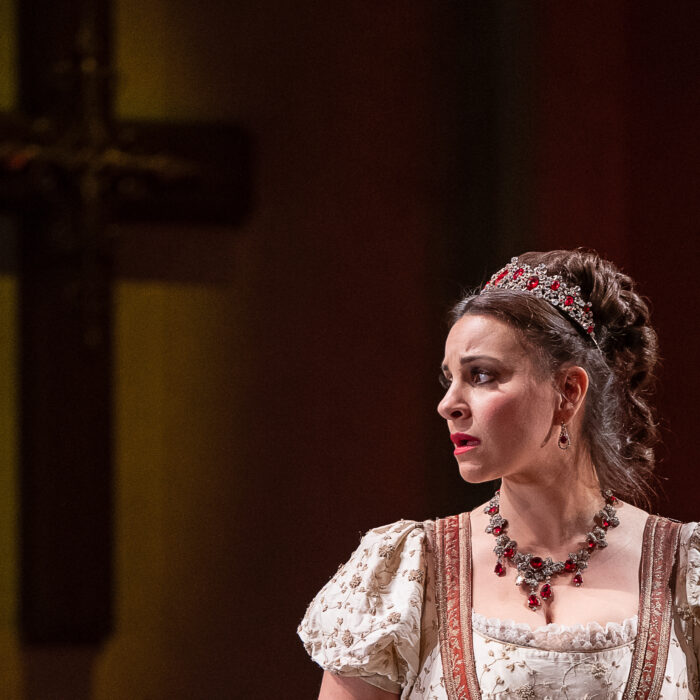
The Bulgarian soprano actually sang the French version of this opera years ago in Berlin and this is just her second production and her first foray into the Italian version. After a wobbly opening to the production, her much-foreshadowed entrance injected much needed life into the proceedings. Her physicality throughout the night was truly special to behold. Shifting from a first and potent aura-farming walk to a more slouched and slithery semi-crawling, she shifted from human to a more bestial form, expressing Medea’s shape-shifting but also psychological conflict; you felt her suffering but also her rage ready to explode. This was furthered by the intensity of her eyes, which could be fiery and knife-like in some moments, but also mournful, expressing her suffering. There were times where her movements were angular, sharp, almost predatory. But then she would soften up that physicality, expressing her vulnerability. Her finest moment was that final scene where she picks up the knife, holds it up high, and is ready to murder the children, only to stop herself and cower over them. One of the children reached out for her and she shoved him away violently; but then the other reached out for her, and held her arm and she froze, staring into his eyes, questioning herself. In the ensuing aria, as she sings of her internal conflict, she gripped the children close to her, her gaze upward, pain in her face. But then, she shifted right back into the thrill of the chase, a psychotic glare as she learned of Glauce’s death and as she faced down Giasone to reveal the death of her children. The entirety of Act three’s opening relies on her physicality as she prepares her incantations and again Yoncheva displayed tremendous physical range here as well, slithering about. This only scratches the surface and the reality is that you have to truly see Yoncheva to experience the brilliant theatrical genius on display here.
The same goes for her vocal interpretation. Yoncheva’s voice projected gloriously throughout the night; there was not a single moment where the orchestra covered her. Moreover, her range was even and well-balanced and connected from high to low with her chest voice extremely impressive in its potency and focus. More importantly, everything she did vocally illuminated the complex psychological tapestry unfolding. She delivered some exquisite pianissimo singing as she begged Giasone during her “Dei tuoi figli la madre” or pleading with Creonte for mercy. Her vulnerability was on full display here, but most prominently during that final aria, “Del fierro duo,” where the legato was pristine and polished. There was anguish in her voice, almost weeping. But when called on for more thunderous singing later in the scene, she could shift from potent highs to equally aggressive lows, never sounding forced or overwrought. The coloratura toward the end was fiery, jagged, but perfectly clean and clear. You felt that she was on the edge but always in control, making for a truly exhilarating performance. On the whole, Yoncheva delivered the true package in one of opera’s most demanding roles; the essence of music drama where both combine to create something truly memorable and cathartic. This is the kind of performance that should be seen not once or twice, but as many times as you can.
Strong Showings
The rest of the cast was also strong with Victoria Karkacheva, in her Met Opera debut, the standout as Neris. Karkacheva’s mezzo has a gorgeous roundness to it that matched well with Yoncheva’s voluminous voice. Her legato lines throughout her “Solo un pianto con te versare” cascaded beautifully into one another and as the night wore on, her presence grew as she became the only person to truly challenge Medea. Her scene with Medea and the children was notable for how Karkacheva allowed her mezzo to explode with intensity that matched Yoncheva’s, creating a moment of musical and dramatic tension.
Michael Spyres, fresh off a highly successful run as Tristan last Spring, returned as another mythical hero, Giasone. His darker voice gave his character a sturdy presence, though he sang with delicacy throughout his opening aria. That contrasted nicely with the more punchy sound he emitted during his scenes with Medea in their duet.
As Glauce, Elena Villalón showcased her shimmering soprano throughout her aria “O Amore, vieni a me!” though during the latter sections of the aria, with the orchestra at its most potent and the vocal line at its highest, her voice started sounding stretched, the highs pinched.
Alexandros Stavrakakis’ honeyed bass was perfect for the role of Creonte, already softening him as a character and providing strong contrast to Spyres’ more fiery approach. While he remained stern in his big scene with Medea, Stavrakakis’ sang with clean legato throughout, making his Creonte authoritative and elegant.
Credit must be given to Anton Ratz and Jasper Thurston-Vargo as Medea’s children. As noted, they get a major appearance near the end of the opera as the eponymous character meditates on her potential crime and that the peak of the scene, she actually raises her knife against them. One of them gets “slapped” in a moment that was so perfectly performed as to create a massive collective gasp from the audience. The child tasked with this moment pulled it off beautifully. The other child had the task of reaching out and touching his mother, all while holding her gaze. Following that other startling moment, this one was perhaps even more impactful for how real it felt and how he and Yoncheva connected over it, however briefly. While neither Ratz or Thurston-Vargo sang, their presence in their one moment was fascinating. On the heels of a sterling child performance in “Lincoln in the Bardo,” the Met is already showcasing some scene-stealing from the next generation.
I said it earlier and I will re-iterate it – Yoncheva is the real deal and perhaps the biggest deal on the Met stage this season. “Medea” has taken a while to get to the Met and, based on the work’s history, it might have some trouble making consistent comebacks, making the urgency of seeing this great work with a supreme artist all the more pressing.