Canadian Opera Company 2025-26 Review: Bluebeard’s Castle / Erwartung
Robert Lepage’s Raw and Cathartic Production is a Masterpiece
By Ossama el Naggar(Photo: Michael Cooper)
I attended this performance with some hesitation, having already seen its 1993 Toronto premiere as well as two additional times, here and in Montreal. Robert Lepage’s production was striking the first time, but would it be as powerful three decades later? Amazingly, it was. The production (seen May 8) has aged well; it was as mesmerizing as it was thirty years ago.
Production Details
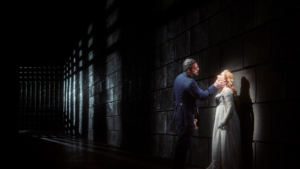
Inspired by Jean Cocteau (1889-1963), particularly his visual phantasmagoric imagery, Lepage succeeded in taking the audience to the darkest corners of the psyche. These stunning images astonish and will remain engraved in memory. However, Lepage’s genius is in insinuation; the mystery of the unseen is infinitely more memorable rather than overwrought gore. One can easily classify the evening’s double bill as opera in the horror genre, and true to its greatest director, Alfred Hitchcock, the suggested more effective than the visually concrete. In Bartók’s opera, the seven doors are never completely open to expose the contents of the rooms. Light glimmers through keyholes and a flood of it overtakes the stage once the doors are open. This suggests horror more effectively than any explicit imagery. Indeed, Robert Thomson’s brilliant use of lighting is one of this production’s greatest strengths.
Almost as striking as thirty-three years ago was the pool of tears and then blood from which three of Bluebeard’s wives emerged. The blood-curdling effect is as tremendous as three decades earlier precisely because it is not explicit. The solemn procession of the three dead wives was so well choreographed that it could only evoke terror (and death). At the end, the three dress Judith in a black mantle and accompany her into the seventh room, insinuating that she too has joined them (i.e. that Bluebeard has killed her). There’s no overt violence, only the suggestion of it through the imaginative staging and from Bartók’s marvelously evocative music.
Schoenberg’s “Erwartung” is possibly even bleaker than Bartók’s opera. Here, Lepage used powerful surrealist imagery via the contorted movements of three actors: the Doctor, the woman’s lover and that lover’s mistress. Images, such as a tree sprouting horizontally through the stage; the lovers’s bed moving from horizontal to vertical to expose the lovers standing rather than lying down; and the sinewy figure of the lover exiting the bed and hiding behind it all evoke surrealist artist René Magritte (1898-1967) as well as Cocteau’s phantasmagoria from such films “La belle et la bête” (1946) and “Orphée” (1950). Even the scribbling projected on a transparent screen of words like “Tier” (animal) and “Lieber” (lover) evoke Cocteau’s lithographs.
Illuminating Cast
In addition to the superb staging, the three soloists in the two short operas were more than up to the challenge of their demanding roles. Bass-baritone Christian Van Horn managed to portray an ambiguous Bluebeard, terrorizing but also tormented. His posture and commanding stage presence were appropriate for this ominous nobleman. Only such an overwhelming presence could have explained Judith’s morbid attraction.
Scottish mezzo Karen Cargill portrayed a convincingly complex Judith, one who had the strength of character to defy her family, leaving her betrothed to follow the mysterious Bluebeard, while being attracted to the morbid and subconsciously seeking her own self-destruction. Thanks to her warm, powerful voice, she was able to comfortably inhabit this elaborate character. However, at times one felt her voice was pushed to its limits. While perhaps not vocally attractive, dramatically it suited the complex character, accentuating Judith’s humanity and vulnerability.
The lyric-dramatic German soprano Anna Gabler was the perfect choice for The Woman in “Erwartung.” Avoiding excess, Gabler captured the tormented woman to a tee. This “Woman” was tormented, but never hysterical. Thanks to her powerful yet elegant soprano, her portrayal was of one once blessed in life who’s fallen from grace, from a crime of passion she has committed or related to her mental health.
Musical Highlights
Johannes Debus led the orchestra masterfully, bringing out the lyricism in both works, no easy task in Schoenberg. In Bartók’s opera, so marvelously Hungarian in mood and manner, the conductor devoted special attention to the two singers, making sure the orchestra never drowned their voices. As with Janáček, whose “Jenůfa” was memorably staged in Montreal last November, Bartok let the text determine the flow of the music.
The first entrance of the oboes and clarinets introduce a minor second, which becomes the opera’s recurring “blood-motif,” building to an increasing intensity as Judith discovers how blood has tainted Bluebeard’s possessions, followed by the chaos upon her final demand that the seventh door be opened. As one expects with Bartok, there is no shortage of achingly beautiful solo string passages as well as thundering percussion and majestic brass passages. While Bartok’s inimitable style is everywhere in this work, there are also echoes of Strauss and even Wagner. Throughout, the music acts as a sonic reflection of the bond between Bluebeard and Judith.
One of the great triumphs of the evening was the felicitous pairing of these two works, as both are of similar sensibilities. Both were written in the early twentieth century in the soon-to-vanish Austro-Hungarian Empire. They share a high degree of mystery; we are never sure that Bluebeard has murdered his bride. Likewise, the recollections of The Woman in “Erwartung” may be accurate memories of a romance ending with the woman murdering her lover, or they could be ravings of a lunatic. In either case, the result was a riveting evening, replete with profound emotion. This was opera at its very best, raw and cathartic.