Birgit Nilsson Festival 2026 Review: Der fliegende Holländer
An Impressive Cast in Wagner’s Drama by the Sea
By Zenaida des Aubris(Photo: Gunilla Hovenäs)
In keeping with this year’s theme, “The Sea,” the week-long Birgit Nilsson Festival concluded with a semi-staged open-air performance of Wagner’s “Der fliegende Holländer” at Båstad Tennis Stadium in south Sweden. Few settings could have been more apt. The sea lay nearby, very close to where Birgit Nilsson was born and raised, while Wagner’s score summoned its own world of raging water, ghostly wanderings, and impossible redemption.
Founded in 2018, the festival has established itself as a fixture of Sweden’s summer cultural calendar. Its principal open-air events take place in a stadium built for tennis tournaments, with a temporary shell covering the orchestra and chorus. Amplification was unavoidable in a space exposed to the elements. On this occasion, the weather gods appeared to be fans of the legendary soprano: clear skies and a cool evening breeze accompanied the performance, even though the sound system and video transmission, as well as the use of the restricted stage space, remain works in progress. But these details did not diminish the pleasure of the evening’s performance.
A Dutchman Without Rest
Anelia Kadieva Jonsson’s scenic realization was necessarily economical. With no scenery and limited space for movement, the drama emerged primarily through the emotional responses of the protagonists. This placed the burden on an international cast of unusual distinction.
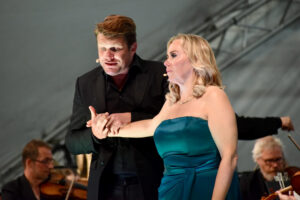
Christopher Maltman embodied the doomed Dutchman with a somber, weathered timbre. His interpretation emphasized not only exhaustion but frustration shading into anger: this was a man embittered by centuries of searching for love, redemption, and release. Maltman’s authority gave weight to Wagner’s own libretto, in which the supernatural curse becomes inseparable from a profoundly human longing for love and oblivion.
Elisabet Strid presented Senta as a woman divided between duty and escape. She was bound to her father, Daland, and pursued by her childhood sweetheart, Erik, yet obsessed with surrendering herself to the mysterious stranger. Strid’s dramatic soprano communicated both the character’s fervor and her suffocation within a restrictive environment. Her Senta did not merely fall in love with the Dutchman; she seized upon him as a possible route out of the life allotted to her.
As Daland, Günther Groissböck brought imposing bass resonance and a persuasive measure of mercantile willfulness. He made clear that, as Senta’s father, he was entirely prepared to barter his daughter for the riches promised by the Dutchman, while avoiding outright caricature.
Stanislas de Barbeyrac sang Erik with a clear, warm tenor. He became the opera’s unheard voice of reason: sincere, anxious, and powerless before Senta’s fixation.
Martina Dike gave Mary concise authority with her full-bodied mezzo, embodying the social and moral order that Senta was determined to resist.
Tobias Westman brought a light lyric tenor to the Steersman. His singing was attractive in itself, although the interpretation sounded somewhat slender beside the heavier instruments surrounding him.
Orchestral Seas
Henrik Nánási led the Helsingborg Symphony Orchestra with energy and purposeful tempi. He sustained the score’s forward momentum without reducing it to mere turbulence, although the horn and brass sections occasionally emerged as the orchestra’s weak point, with moments of uncertain ensemble and intonation.
Five amateur choral associations joined forces for Wagner’s substantial chorus writing. Their contribution represented an admirable feat of regional coordination and gave the festival finale a genuine communal dimension, even if collective enthusiasm was not always matched by vocal polish.
Thanks to the coordination and support of the Birgit Nilsson Foundation, the development of the Festival has been impressive and focused on its many activities. It brings together selected young singers for a week of master classes, offers recitals to its scholarship recipients, and presents lectures on relevant topics and opera programs for children. More than 20 events spread across the week brought regional, national, and international attention to this popular community by the sea. “Der fliegende Holländer” provided a fittingly ambitious finale — a tale of ceaseless wandering presented within the landscape from which the legendary Nilsson began her own remarkable journey onto the world stage.