Teatro Municipale di Piacenza 2025-26 Review: Der fliegende Holländer
By Bernardo Gaitan(Photo: © Gianni Cravedi)
It came as little surprise to find “Der fliegende Holländer” in Teatro Municipale di Piacenza’s program as the closing production of the 2025-26 season. Due to technical and organizational reasons related to the staging, “Lohengrin,” also by Wagner, originally scheduled for 6 and 8 November 2026, was replaced by “Der fliegende Holländer.” The theater’s management opted to retain a Wagnerian work within the current opera season, thus ensuring continuity in the artistic project.
Wagner is not a frequent presence in the programming of Italian opera houses, making the debut of this opera in Piacenza all the more successful. Composed between 1841 and 1843, “Der fliegende Holländer” presented 150 years after its Italian premiere and never before performed in Piacenza, marks a decisive stage in the evolution of the repertoire of Italian opera houses.
Wagner draws upon the myth of the Flying Dutchman, one of Europe’s most celebrated maritime legends. Its protagonist is a Dutch captain condemned to sail the seas for eternity, although he is granted one possibility of escaping the curse: every seven years, he is allowed to come ashore in search of a woman capable of loving him with absolute fidelity until death. Finally, having won Senta’s love, the Dutchman is released from his condemnation, and the two are reunited in death and redemption.
A man without an Ithaca, without a Penelope waiting for him, without the certainty of finally being able to return home. This is how stage director Matteo Mazzoni explained the true curse of the Flying Dutchman. For the Italian creative artist, the curse is something more than a condemnation: while Ulysses crosses the sea to rediscover the place to which he belongs, the Dutchman is condemned to sail because that place no longer exists, or perhaps never existed.
(Photo: © Gianni Cravedi)
Production Details Astonishing Realism
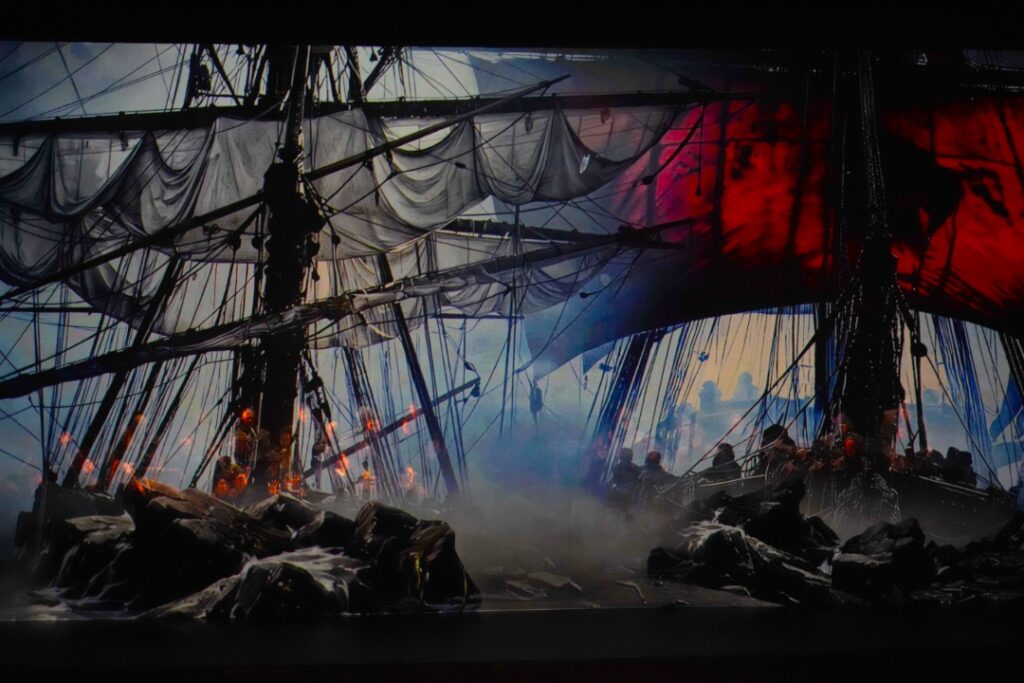
Starting from this premise, Mazzoni signs what might be the finest production at the Teatro Municipale di Piacenza to date. It is a new staging co-produced with the Teatro Comunale di Modena. One of the production’s major achievements is the work of video designer Luca Attilii, who brings Mazzoni’s vision to life with remarkable clarity through videos and animations of the highest quality.
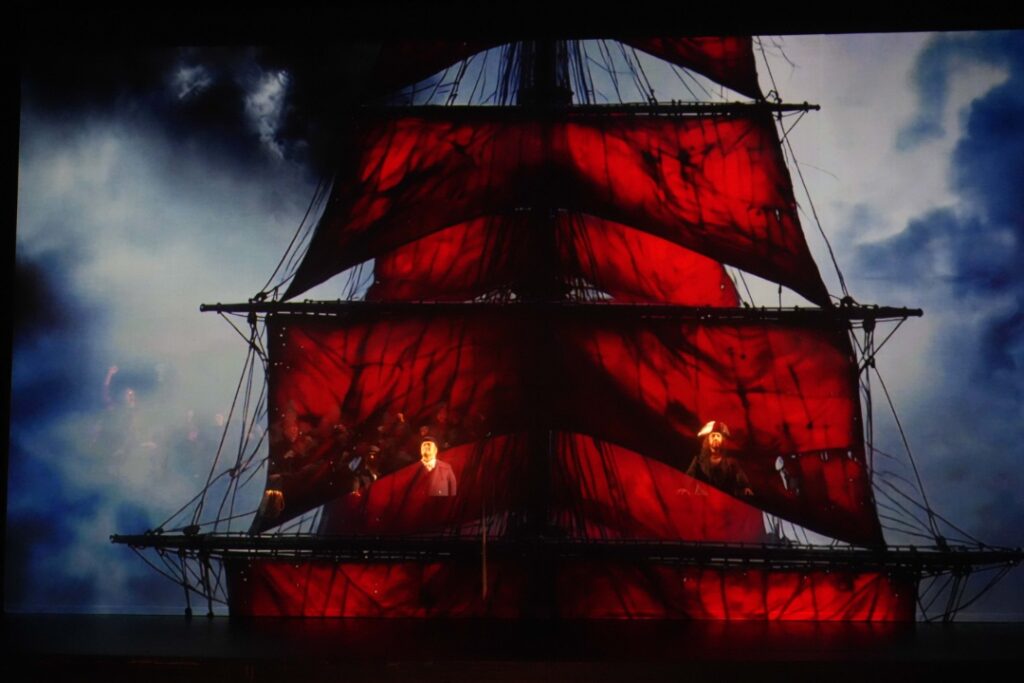
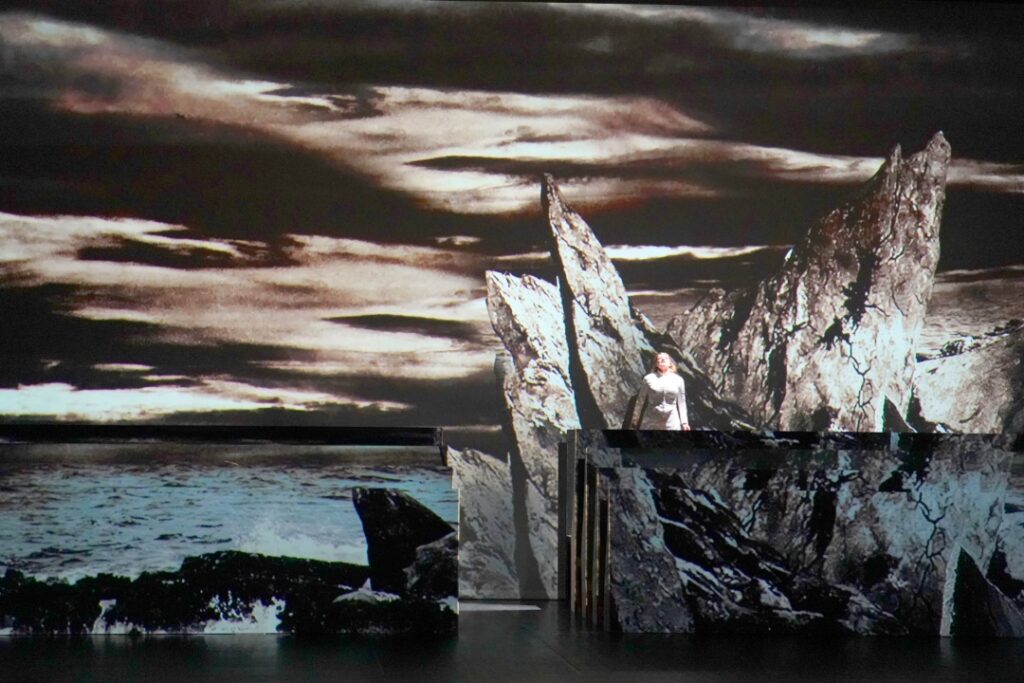
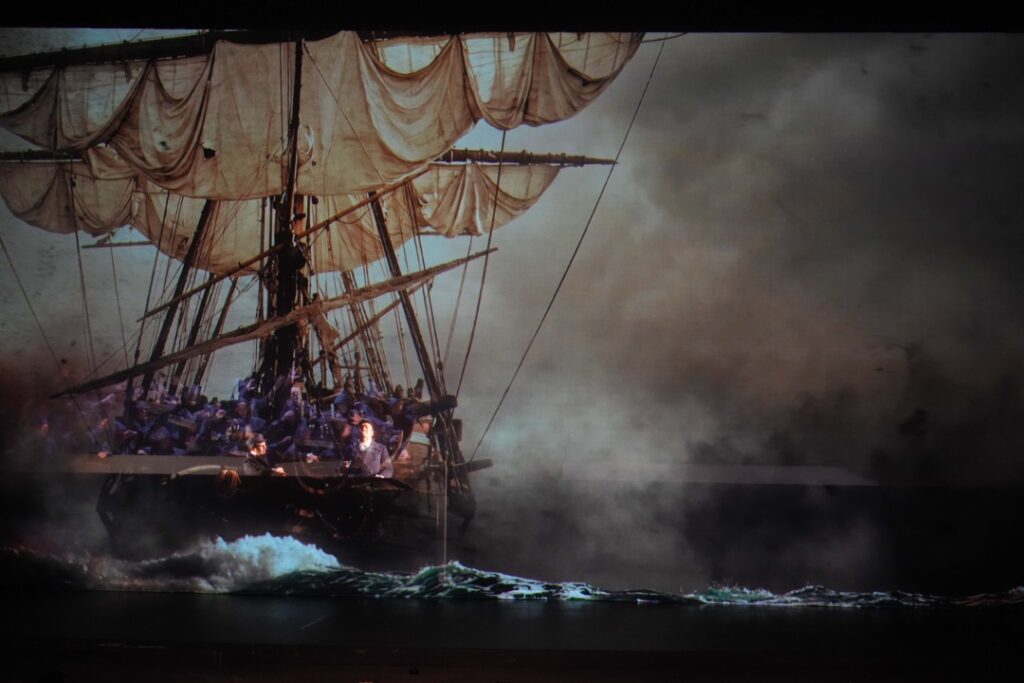
The result is a stage picture of astonishing realism, capable of creating a striking effect from the very moment the curtain rises. With ingenious, highly discreet black platforms, on which the chorus members appear, the animations depict the approach of the great ship through projections, while Daland’s sailors suddenly emerge within the animated images, aboard their respective vessels. The illusion is perfect: it looks like a film, but one unfolding live before our eyes. The projections are not limited to the Dutchman’s ship; they also build dramatic tension through the turbulent sea, paradise, the cloud-filled sky and the two vessels that repeatedly confront one another. Everything comes to life with a naturalness rarely achieved through projections. In reality, there is no physical scenery, but nothing more is needed.
Mazzoni’s talent does not end there. He is also responsible for the costumes and lighting. The costumes, classical in style and paradoxically in keeping with the staging itself, stand out for their beauty, although they resort to certain clichés. Daland wears the traditional attire of a northern European sailor; Senta appears in an immaculate white dress; and the Dutchman wears the typical pirate outfit, entirely in black, with high boots, a hat and an open-chested shirt. Combined with the lighting design, these elements create a ghostly, mysterious atmosphere that envelops the audience from the very beginning.
Conductor Martijn Dendievel Highlights
In the pit, the result was even more surprising. Martijn Dendievel‘s conducting came close to perfection. From the overture, with the storm unleashed in the orchestra and the Dutchman’s theme played at full volume by the brass, one could sense that this would be an extraordinary performance: and so it proved. The Belgian conductor demonstrated a profound command of the Wagnerian style and great sensitivity in the more melancholic passages, such as Senta’s theme and the opera’s finale.
At the same time, Dendievel knew how to draw extraordinary results from the Orchestra dell’Emilia Romagna Arturo Toscanini, whose musicians responded attentively to his indications and delivered a performance of a very high standard. The contribution of the Coro del Teatro Municipale di Piacenza, under the direction of Corrado Casati, was equally successful.
(Photo: © Gianni Cravedi)
Claudio Sgura as The Dutchman
Claudio Sgura as the Dutchman was particularly impressive in his role debut. The Italian baritone approached the part with great seriousness and achieved excellent results. His voice was ample, and his dark timbre was well suited to the tormented nature of the character, whom he portrayed with authority. He was always fully in character, irascible and mysterious, just as one might imagine of a cursed pirate who no longer expects anything from life. His appearance from the darkness inspired a certain degree of fear. It was a highly convincing interpretation from a baritone who was equally comfortable with both the stage direction and the musical demands of the role. His vocal line was consistently clean with a powerful timbre and clear diction.
Johanni van Oostrum as Senta
Johanni van Oostrum portrayed Senta with a beautiful timbre, well-supported high notes and elegant phrasing, all of which completed her performance. The South African singer’s voice possessed a lovely color and a carefully shaped vocal line; her interpretation was imbued with the appropriate character. Particularly noteworthy was the strength of her upper register, consistently in tune and of outstanding quality, as well as her commitment in the moments of greatest intensity.
The duet with the Dutchman reached a high level of dramatic and emotional intensity: a sense of despair could be perceived in her voice, arising from a highly accomplished interpretation shaped by the stage direction.
(Photo: © Gianni Cravedi)
Sorin Coliban as Daland
Sorin Coliban was also very successful as Daland. His low register was solid and well-colored. He built his character with just the right balance of paternal warmth and greed. From the beginning of the opera, he impressed with a robust, dark and powerful vocal presence of excellent tonal quality. His appearance in the opening scene was striking. His German diction was exceptionally clear, and his acting was fantastic. The Romanian bass-baritone portrayed a highly jovial Daland, supported by a smooth, well-timbred voice.
Ian Koziara as Erik
Ian Koziara as Erik was competent, managing to give particular prominence to a somewhat secondary role. His acting abilities were especially notable in conveying the tragic torment of incomprehension. He constantly lamented, moved and gestured in a physical performance that contributed to conveying his anxiety. Vocally, he offered a clean vocal line with considerable interpretative ability and quality. Wagnerian repertoire is probably not the most suitable choice for his vocal characteristics. It would be interesting to hear him in a lighter repertoire, such as Mozart or bel canto. Nevertheless, his performance was more than adequate.
(Photo: © Gianni Cravedi)
Illuminating Cast
Special mention must be made of Paolo Antognetti‘s Steuermann, whose bright, secure voice turned his Act one song into a little gem. His interpretation was rich in effects, with effortless, full-bodied high notes. The result was a truly beautiful contribution, despite the brevity of the role.
Mezzo-soprano Ester Ferraro as Mary displayed consistent stage confidence and vocal poise.
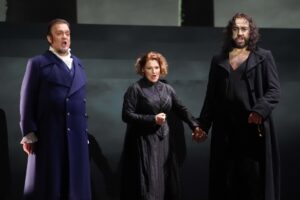
At the end of the performance, the success was resounding, with an exceptionally prolonged applause. The audience offered a warm and enthusiastic reception during the curtain call, which continued until the very last moment, making its satisfaction abundantly clear. A major round of applause is also due to the theater for bringing the season to a magnificent close. The new 2026-27 season will open during the week before Christmas with Umberto Giordano’s “Siberia.”