Metropolitan Opera 2026-27 Review: Tosca
Saioa Hernández is Fearless in Uneven Revival of Puccini’s Thriller
By Francisco Salazar(Credit: Marty Sohl / Met Opera)
On Nov. 9, the Met presented the third performance of its revival of “Tosca.” This season the company will present a total of 25 performances with five divas.
For its opening revival, the company featured the debut of Spanish soprano Saioa Hernández, a soprano who has conquered all the European houses in the world and whom Montserrat Caballé famously called “the diva of our century.”
On this evening, the soprano didn’t disappoint and proved to be fearless in her incarnation of Tosca, even if the rest of her company was not quite on her level.
An Inspired Debut
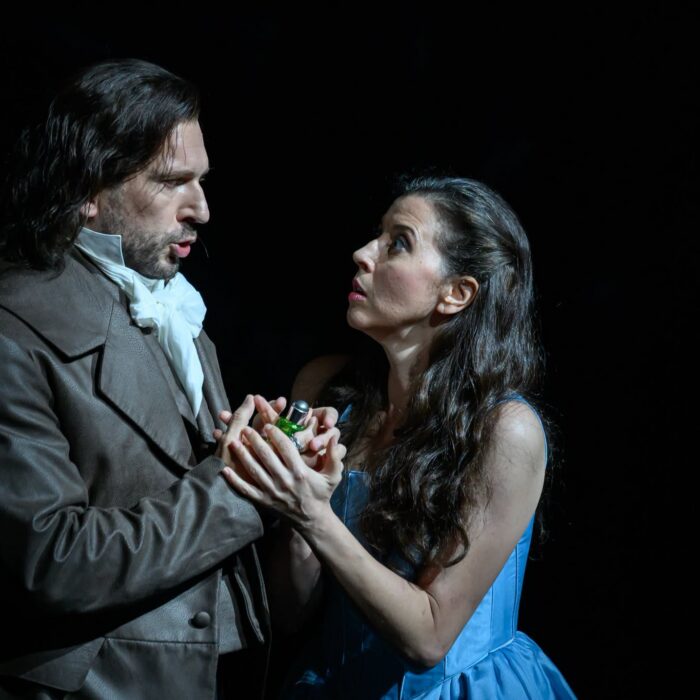
As Tosca, Saioa Hernández brought a fully fledged multi-dimensional character that was fearless and unpredictable. In Act one, her Tosca was flirtatious and jealous with Cavaradossi but at the same time pious as she entered the church and kneeled down to pray and when she went to kiss Cavaradossi she covered their faces with her shawl. There was also youthful energy that she brought in her facial expressions and in her energetic blocking. That youthfulness transformed into frustration and fear as well as jealousy in her encounter with Scarpia. That further evolved in Act two as her fear increased with Hernández continuously avoiding and runing from Scarpia’s pursuit. But this Tosca also had some strength and there were moments where Hernández confronted Scarpia with defiance and confidence, especially as Scarpia suggested Cavaradossi was betraying her.
In Act three, you could sense devastation mixed with forcefulness and strength in her “Il tuo sangue o il mio amore” before turned to the playfulness as she attempted to instill confidence in her Cavaradossi. But upon seeing her dead lover, the soprano’s frenzied urgency turned back to defiance as she jumped to her death.
Hernández’s interpretation also brought some new blocking to the David McVicar production. One was the famed jump. Here Hernández simply went to the edge and jumped out of desperation and defiance. There was no hesitation or preparing, as other sopranos have done in this production. She also fixed Scarpia’s death scene which showcases the infamous run around the table for the second stab. Here, Hernández stopped a moment by a seat to look at Scarpia and when she noticed that he was trying to escape, she went for the second stab. It worked very well and solved one of the oddest directorial choices of this production.
Vocally, Hernández had it all. Her opening “Mario Mario son qui!” rang with a round, plush, commanding presence that featured her resonant chest voice as she questioned Cavaradossi. Then in her “Ora stammi a sentir” and “Non la sospiri la nostra casetta,” Hernández sang with a suave, seductive tone that captured the lush music. She opened with light, staccato phrases that turned into connected legato lines, all while relishing every rallentando she could to emphasize Tosca’s passionate emotions. The voice’s power continuously grew until she reached the climatic “Arde a Tosca folle amor!” But then she scaled it back to a sensual piano in her ensuing lines. In the the “Chi è quella donna bionda lassù,” the soprano emphasized the more accentuated rhythms of the music to showcase her character’s jealousy before returning to her connected and sumptuous legato singing with a brighter sound on “Sì, lo sento… ti tormento,” all while floating some beautiful notes.
In her duet with Quinn Kelsey’s Scarpia, Hernández’s opening exchanges were sung with a softer timbre that slowly turned jealousy and rage. Here, her vocal power increased as she began “Ed io venivo a lui tutta dogliosa,” which eventually exploded with melancholic cries. She ended the duet with an expressive “Dio mi perdona” and “Egli vede ch’io piango!” that was filled with pain.
In Act two Hernández entered with command, her voice showcasing confidence in her first exchange with Scarpia. As Kelsey’s Scarpia continued to probe and lust over her, Hernández’s voice turned to desperation and soared in “Orsù, Tosca parlate” slowly crescendoing with the music and eventually hitting chilling and powerful high Cs that finally saw the soprano deploy the full strength of her dramatic potency. It was majestic in every way and as she reached her lower chest voice in “Che v’ho fatto in vita mia?,” every note was clear and filled with distress.
You would expect that Hernández would continue to grow her dramatic force throughout the rest of the act, but her “Vissi d’arte” was quite the opposite. Yes, it was emotional, but it was also introspective and her sound was unusually contained, creating an intimate interpretation that pulled you in. Her opening lines saw the soprano use floated pianissimos that slowly built as the piece progressed, showcasing a round and rich middle voice. Her “Nell’ora del dolore” was reminiscent of a lament and her climactic “perché me ne rimuneri così?” was sung with gorgeous expression, while not overextending the phrase.
By the end of the act, the soprano’s fiery character returned as she stabbed Scarpia looking at him in madness and the “Questo è il bacio di Tosca!” was emoted with vigor. But that fear and innocence from the first act returned shortly after as she washed her hands in fear and pronounced the final text of the act “E avanti a lui tramava tutta Roma.”
Act three was another highlight for the Spanish soprano as she entered with joy and excitement at seeing her lover. Her timbre brightened on “… e al cavaliere che l’accompagna” emphasizing triumph. But then in her “Il tuo sangue o il mio amore,” the soprano dug into her deeper chest voice with staccato lines, the middle voice obtainimg a darker timbre. Her face was also overwhelmed with fear as she recounted Scarpia’s murder. That quickly changed in “Senti… l’ora è vicina; io già raccolsi,” as she sang with a lighter tone, phrasing again with the smooth legato from their first duet and bringing that same youthful and flirtatious energy that we were introduced to in the church. Hernández once again succeeded in floating gorgeous piano lines before returning to the triumphant voice in “Armonie di canti diffonderem!” In the final moments, as she discovered that Cavaradossi was dead, her cries of “Mario! Mario! Morto! Morto!” were full of desperation. The final “O Scarpia, avanti a Dio!” was confident and defiant.
Strong Voice
In the role of Cavaradossi, SeokJong Baek kicked off his busy Met season with his ardent tone. He began his evening with an impeccably sung “Recondita armonia,” with the interpretation suitably capturing the romantic hero. In his ensuing duet with Hernández, Baek brought a smooth legato line to “Quale occhio al mondo può star di paro,” and his voice continued to open up throughout the duet as the two sang the climatic final melody.
In Act two, Baek’s intensity ramped up, especially during the interrogation scene with each “nego” and “non lo so” more accented and forte. The high point of his performance came with his show-stopping “Vittoria Vittoria!,” which he held out for an extended period getting a huge ovation that covered his following lines “L’alba vindice appar.” But he continued to increase his intensity as he repeated “carnefice!,” his movements increasingly violent.
Act three also saw some highlights for Baek. His “E lucevan le stelle” was sung with gorgeously connected lines and ardent high notes. While it lacked a true pianissimo sound and a true climax (more on that later), the tenor sang with great emotion. In the second duet with Hernández, Baek scaled back his voice, finally emitting a piano sound in “O dolci mani mansuete e pure.” While the tenor does not have a natural ease with the dynamic, he still managed to create tender phrases that blended gorgeously with the soprano and it was refreshing to hear the tenor show a different color to his vocal palette. As the duet came to its conclusion in “Armonie di canti diffonderem!,” Baek’s voice exploded with sound on his high note.
Uneven
Quinn Kelsey reprised his turn as Scarpia, a role he first debuted at the Met in 2024. When he first sang the role, Kelsey leaned into the bel canto singing that he does so well in Verdi operas, but the result was an uneven character lacking the menacing quality of Scarpia. This time around, he leaned more into the vigorous, jagged edges of his voices to create that imposing and threatening figure. But physically, Kelsey’s Scarpia was lacking.
Kelsey came off as passive and incredibly hesitant when it came to the violent actions of Scarpia in Act two. When he had to touch or grab Hernández, he didn’t come off as fully committed. At one point, when they were both on the floor, Kelsey’s movements were tentative. Throughout torture scene he loomed over Hernández but he wasn’t quick enough to match the tenacity of his stage partner. It just wasn’t imposing or menacing.
However, his vocal approach was a different story.
His entrance “Un tal baccano in chiesa!” was potent, while his duet with Hernández was sung with a suave and manipulating tone. The “Te Deum” was delivered with immaculate legato lines, but he also accented his lust for Tosca.
Act two was also sung with more confidence. “Ha piu forte sapore” was rich in tone but also showcased the baritone digging into the text to emphasize that desire. His high notes were also powerful.
Then in his exchanges with Baek, his repetition of the text “Dov’è Angelotti?” and the entire interrogation scene saw Kelsey build in dynamics, his tone becoming more vigorous. The torture scene, “Orsù, Tosca, parlate” also saw him sing with strength and his “Aprite le porte che n’oda i lamenti!” was terrifying. His “Nel pozzo del giardino Vittoria” also saw Kelsey snarl, while “Già – Mi dicon venal, ma a donna bella” saw the baritone give the aria some sarcasm before climaxing to an all-consuming lustful high note.
Arduous
The biggest issue of the evening, however, was conductor Oksana Lyniv. Everything was a distraction, from the snare drum in the Shepherd’s song that covered the child voice; the sluggish tempo that introduces the theme to “E lucevan le stelle” felt interminable; and the musical interlude before Tosca stabs Scarpia emphasized random horns and winds, throwing off the overall musical tapestry. All these embellishments and incredibly slow tempi took away from the momentum of the piece. The opening of each act was slower and the conclusions were bombastic. Moreover, there was a disconnect with the singers. In the “Te Deum,” she covered the chorus. During “Vissi d’arte,” Lyniv went at her own tempo, extending lines when Hernández was already done with them. In Scarpia’s arias, she extended every line, draining the villainy of the music. In “E lucevan le stelle” there was no climax because everything was incredibly extended and lacking momentum. And in the final duet between Tosca and Cavaradossi, the orchestra seemed to have disappeared only to return to emphasize bombastic horns and winds. The best part of Lyniv’s evening was the final recapitulation of the “E lucevan le stelle” once Tosca jumps because she followed the fiery expression and vocal power of Hernández’s final lines. Ultimately, Lyniv’s interpretation was not for me and I feel it lacks the Italianate qualities that Puccini puts into his score. It was overly, slow, and lacking in flow and momentum.
In all, this was Hernández’s evening and one hopes that she will return soon to headline a new production.