BBC Proms 2026 Review: The Met Orchestra Plays Mahler
Stumbles in Mahler’s lugubrious fairground fazed players in this unevocative concert
By Sophia LambtonCaressing with a trembling hand, the characters of Mahler’s works exert the urgent longing gripping those near death. In restless staggers figures grasp for memories, confusing themes that strike a chord with turns of flittering illusion. Tiptoeing through this limbo with a limited imagination, the MET Orchestra extracted only glints of these travails under the baton of Yannick Nézet-Séguin at Thursday, August 27th’s BBC Proms event.
Beginning with the seven-minute spell of Kaija Saariaho’s “Lumière et pesanteur” (“Light and Gravity”), the maestro led musicians through a languid malaise. A trumpet written to be mystifying trudged its trill while oboes seemed drunken. Nevertheless, strings sneaked into eerie tremolo and harp glissandi slid mellifluously. Snippets of the changing elements were tangible at other intervals as well, but overall such affects were elusive.
Channeling the master of the “Rückert-Lieder” in his “Blicke mir nicht in die Lieder!” (“Look not at my songs!”), mezzo-soprano Joyce DiDonato played a frantic Mahler stalling critics. In a frenetic-yet-collected charge through “Selber darf ich nicht getrauen / Ihrem Wachsen zuzuschauen” (“Even I don’t dare to watch them grow”), the vocalist exhibited the anxious haste that plagues composers with a deadline.
However, “Ich atmet’ einen linden Duft” (“I breathed a gentle scent”) emerged with an unartistic strenuousness. Executing the F sharp in the first “linden” insecurely, DiDonato steeped the song in awe yet struggled with the portamento of A sharp to E on “Ha…and.” The final phrase “Der Liebe linden Duft” (“The gentle scent of love”) was wrapped up wistfully and “Liebst Du um Schönheit” (“If you love for beauty”) rounded notes serenely. “Liebe die Meerfrau” (“love the mermaid”) relished a high F of gleeful worship but the one accompanying the last “Liebe” surfaced feebly.
Tremulous attempts confronted both the narrator and his portrayer in “Um Mitternacht” — a meditation on the loneliness of night. Imbuing syllables with vulnerability, the mezzo overstressed her instrument in “Und aufgeblickt zum Himmel” (“And glanced up to heaven”), straining the two final half notes. Nonetheless, “Kein Stern vom Sterngewimmel / Hat mir gelacht” (“No star from the starry firmament smiled down on me”) extended pristine diction in a trepidant confession. The 14-note melisma of “entscheiden” in “Nicht konnt’ ich sie entscheiden” – an allusion to our powerlessness – masked a slipping pitch with plaintive phrasing.
Retreating into the depths of the self, the poet of “Ich bin der Welt abhanden gekommen” stood transfixed in DiDonato’s characterization. His surrender to oblivion in “Sie mag wohl glauben, ich sei gestorben!” (“The world might as well think me dead”) hinged on precariousness, hiding vocal flaws in throes of rapture. Nevertheless, “Und ruh’ in einem stillen Gebiet” (“And I rest in a tranquil domain”) succumbed to an illicit breath between the slurred C and B flat of “stillen” that put creativity at stake.
Intricacies were untraceable in most of Nézet-Séguin’s interpretations of the “Rückert-Lieder.” The “sehr zart” (“very delicate”) expression of “Ich atmet’ einen linden Duft” made for a muffled clarinet while woodwind persevered too lengthily in the “morendo” (“dying”) end. “Liebst Du um Schönheit” opened with an oboe melody not intimate, as dictated by Mahler’s score, but boastful. Though the oboes d’amore announcing “Um Mitternacht” delivered a humble entreaty, the cor anglais heralding “Ich bin der Welt abhanden gekommen” dragged sluggish tenuto notes.
Sleigh bells chugged to introduce “Bedächtig, nicht eilen” – the first movement of Mahler’s Symphony No. 4. An ode to childlike wondrousness, the work evokes visions of a fairground rife with lures both mundane and supernatural: magic tricks and peril thrill and trill in equal measure.
Twirling carousels were within earshot as Nézet-Séguin led sprightly strings through well-paced ditties. Their attraction was soon scrapped for straggling double basses and dim volume from the violins. Staccato on the oboes galloped like a hopping pony yet the image was short-lived. Some iterations of the sleigh bells’ festive route rang clunkily, resembling chinking flutes on the New Year more than Christmas hijinks. The col legno section on the violins was ominous but buried under other instruments; tenuto notes an octave higher shimmered short of a bewitching trance.
A sour solo horn crept cowering into the second movement “In gemächlicher Bewegung,” prefacing a scordatura violin that tackled its staccato skimpily and limply. In this panoply of prancing rides the nuances were scant. Glissando on the violins became a hiss while trumpets fizzled out too quickly. Spilling lazy beats, both triangle and tam-tam, conjured up a vision of a cranky clown too spent to squeeze his horn.
Despite a marking of “nicht schleppen” (“don’t drag”) for the strings in the third movement “Ruhevoll,” a lag prevailed. Horns also flagged in energy and soon the trumpets were infected. Under a precursor to Symphony No. 5’s beloved “Adagietto,” the bassoons played flat.
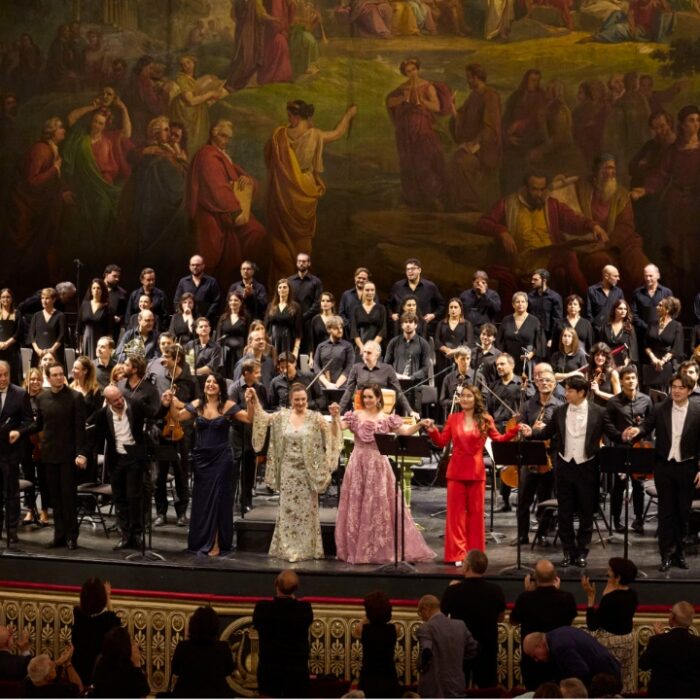
Performing the soprano part of final movement “Sehr behaglich,” DiDonato was confined to a far corner behind every member of the orchestra. This staging threatened her imperious notes with not just fortes from bombastic brass but tinkles on the triangle. Although the challenging melisma in “Kein Musik ist ja nicht auf Erden” (“There is no music, no music on earth”) unrolled celestially, the high G and E of “Sanct Peter im Himmel sieht zu” (“Saint Peter in heaven looks on”) pealed like shrieks. In a soprano section almost teeming with high notes, many were beyond the reach of this prolific mezzo.
Proffering the “Resurrection” Symphony’s “Urlicht” as DiDonato’s encore, Nézet-Séguin led trumpets as harmonious as crumpling foil. Although the singer’s poignancy was vivid, her seclusion made it hard to see and hear.
Lush violins were outliers in this display of faded Mahler. Capturing the tones of the composer in untextured and pale shades, Nézet-Séguin’s conducting of the MET Ensemble sketched a flimsy template. Poetry and Gothic fairytales were tricks played by an ailing mind: mere figments born of yearning.