Bayreuth Festival 2026 Review: Götterdämmerung
Twilight of The Image – In defense of Bayreuth’s AI ‘Ring’ cycle
By Vincent Lombardo(Credit: Enrico Nawarath)
“The world is a generalized form of the spirit, its symbolic picture.”
– Novalis
“A poet’s word alone can express what is artificial in a floating image.”
– Anonymous aphorism
If Wagner’s “Ring cycle” is deep, “Götterdämmerung” is its deepest point. As the Norns, mythical weavers of destiny, represent the past, present, and future, so too does this sadly unappreciated Bayreuth AI anniversary “Der Ring des Nibelungen,” battling against the rolling waves of modern society’s popular prejudices. Not only do the three primordial Norse dísir spin the threads of our lives, they envision time itself as the tapestry of history, and our presence upon it as fleeting entities within the span of world events. All-too-few of us realised that what occurred this year in the Festspielhaus offered a glimpse into the radical future of human technology. Even by its own admission, the use of AI in this “Ring” merely purported to capture the essence of a theater’s storied treatment of a monumental work. Images from historic “Ring cycles,” from 1876 onwards, were promised as the production’s trademark, and they were there, alongside pictorial references to contemporaneous world events. Yet for many of us, the flashing photographs and scene sketches passed all too fleetingly. The guessing game, identifying which exact scene from a past production was being momentarily projected, was never the intent. It ultimately made little difference in problematizing the AI opera onstage. Recognizable reference points of these transitory images never fully coalesced, demanding that the spectator seek sanctuary in a “Ring” performance as they previously knew or imagined it. The audience’s relationship with the AI-generated imagery was thus disjointed, evoking within each one of us personal recollections that relied upon our knowledge of historical “Ring” productions. Though images from the past serve as starting points that can give importance to our present, the execution here led to confusion. Nothing was surprisingly innovative, creating wonder (be it gimmicky or not). Characters onstage disappeared, engulfed in a barrage of cinematographic imagery akin to the art of Carl Gustav Jung’s “Red Book.”
A Squirrel Ran along AI’s Strands
As the projected images were considered the focal point of this self-declared experimental “Ring,” it was a singularly distinct likeness that caused the greatest unrest among spectators, becoming the topic of vivid and vehement hour-long discussions between the Acts. The image was innocuous-enough on its own: a squirrel that appeared throughout the “Prologue” while the three Norns, in attempting to command the world’s future, used too much force and caused destiny’s rope to snap, signaling the loss of their own wisdom. “What was the squirrel doing there?” people asked, “Why these images for image’s sake?” One regular patron asked if it was supposed “to be something like that red fox running about” in Bayreuth’s 2023 Augmented Reality (AR) flatlands in “Parsifal.” In that most mystical of all Grail operas, the fox roaming within the frame of our glasses seemed to represent Nature seeking to repair a dystopian world destroyed by Man’s abusive consumption through greed. In “Parsifal,” Wagner musically portrayed “uncontaminated Nature” within the Grail’s sanctuary, wherein no-one could conceive of shooting a swan (as the unknowing Parsifal does). Thus, the fox appeared to be the stage director’s symbolic suggestion for environmentalism. Here in “Götterdämmerung,” however, the AI squirrel was discovered remotely, within the computer’s algorithmic research into subconscious, at times surreal, “free associations” – and then projected directly onscreen. The research engine spun about the World Ash Tree, cross-referencing a 17th century Icelandic design that depicts a squirrel running up its bark. This is the squirrel Ratatoskr, the legendary go-between for the eagle in the upper branches of Yggdrasil and the corpse-eating dragon, Nighogg, who lurks in its roots. The red fox of “Parsifal” was consciously inserted as an AR mascot, a pure Regietheater device. The squirrel declared itself as a historical citation inserted into a mythic tapestry, drawn together by the disparate, probing strands of AI.
Another contested point regarding the direction of this production related to the depiction of “Chronological Western History” – 150 years of Occidental culture, portrayed alongside the visual timeline of the Bayreuth Festival. “Götterdämmerung” brought us into the 21st century, and with it the all-too-realistic horrors of globalization, fake news, climate change, environmental destruction, and disrupted social systems. The intention was to have historical images evoke the everyday things we spoke about in the same years as the projected Bayreuth “Ring” productions (right up to the Schwarz “Ring” of 2022). Many objected to witnessing a Wagnerian opera in such a manner, demanding instead realistic, meaningful stage action to more recognizably tell the story. For many it was not the AI images themselves that ruined the performance or called its ethics into question, but the continual bombardment of imagery removed audiences from the physical immediacy of everything that traditionally constitutes a theatrical event. The incongruencies of time and form were overbearing, transforming the iconic into something merely out of joint.
Parameters for the Unseen
Critics and public alike did not accept Bayreuth’s AI “Ring cycle” for what it declared itself to be. It was a metaphor for what is unseen. It placed the psycholinguistic variables of modern cognitive experiments – those that evaluate how humans perceive figurative language and images – within a computerized, procedurally generated, framework. When we come face-to-face with a new artistic creation our reactions are often wrongly preconceived, which can lead us to disappointment, confusion, and even hostility. Stravinsky’s “The Rite of Spring” (1913), was smeared by Le Figaro as a “laborious and childish barbarism,” attacking both the “jagged” music and “primitive” style. An almost inconceivable critique today! Meanwhile, the adroit critic of the literary periodical Gil Blas modestly admitted that it marked the “…advent of a new music, for which my sensibility and my taste are not yet prepared.”
History has repeated itself. Bayreuth’s AI “Ring cycle” was near-unanimously judged as an utterly negative experience. Ignored were the declarations of the creative team that they had put into action what they had set out to accomplish and were not to be listed as stage directors. For years to come, we may look back upon this production as a missed opportunity. This is not entirely our own fault. By nature, we do not possess sufficient comprehension of humanity as our species, and the world around us, inevitably marches into the unknown of the future, within which dwells AI and all its benefits and horrors. Our grandparents could have scarce imaged us walking around with mobile telephones, sending an email to a friend on the other side of the planet in mere seconds. The same goes, in the reverse, for all those testimonies of previous “Ring cycle” anniversaries. Tricks are being played with time, tinting all that is behind us as outdated, and all that is ahead as scandalous. The 1927 version of Wagner’s original production saw commercial electrical microphone recordings introduced into the Festspielhaus for the first time, while painted background flats were partially substituted with electric stage lighting and color projections. Slowly we were moved away from naturalism towards Wieland Wagner’s 1950 utilisation of minimalist scenographer Adolphe Appia’s ideas. The acclaimed 1976 Boulez-Chéreau anti-bourgeois version partially broke with tradition for being politically revolutionary, yet remained conventional and deeply psychological in its exquisite blocking – the ways that the characters shifted positions to indicate subtle balances of power was truly illuminating. Now we have the merits of an AI version to contend with, as images continuously flowed across the screen as if accompanying the Rhine itself. All was held together as if in a half-dream, the somnambulistic awareness of psychic energy that Wagner himself often experienced.
In truth, Bayreuth proudly and satisfactorially made “innovation” a vital ingredient of the Festspiel. For those of us who held sympathies for this revolutionary AI escapade, the reaction of a large percentage of critics and public was odd. Was it a question of taste? Perhaps so. We are living through a golden age of Regietheater. At times ghastly modifications, some of them bordering on the ridiculous, still receive widespread public favor. One believes that plaudits and accolades for any staging that wanders far from its connection to the original can be challenged – yet innovation itself does not innately deserve harsh judgement. Claus Guth’s unique “La Bohème,” set aboard a spaceship, was not as absurd as many first thought. It effectively created emotional bridges to the inherent sentiments of Puccini’s post-Romantic masterpiece. Conversely, some believe that a string of unsatisfying Bayreuth productions have held sway from 2020 onwards: the Schwarz “Ring cycle,” Schwab’s “Tristan und Isolde,” Sharon’s “Lohengrin,” Scheib’s AR “Parsifal,” and Tcherniakov’s “Der fliegende Holländer.” Certain critics contested these stagings, considering them to be errant and wanton.
A “Succès D’estime,” It Was Not
As the precepts of this AI representation had been already clearly laid out, the ensuing harsh, perhaps unfair, criticism felt unwarranted and at times exaggerated. For many, the sophisticated yet complicated visual maneuvers did not overtly transmute into realistic physical stage gestures or action. Additionally, it appeared that the choice of images pertaining to historical Bayreuth productions were not meant to be simply celebrative, but to create dialogue by situating the Romantic essences of Wagner’s art in the midst of sociopolitical juxtapositions. The role of the curator and crew was to allow the previously selected images to flow autonomously and seemingly without aim. The production team otherwise remained as observers. So too were the singers, becoming archetypal figurines, uniformly costumed and stationary as if floating in holographic space between scrims of eternal imagery. Something like this had been explored in Kupfer’s “laser Ring” (1988). It was initially booed, as one might imagine. Well one might ask the cultured, faithful, and demanding Festspiele audience what is it that they want, exactly? Despite this historical context, it was nonetheless shocking that the comments reserved for the creators of this mise-en-scène were so harsh and uncomprehending, refusing to accept the experiment at face value. The opinions of the vast majority of journalists cried out for a minimum of the established norms of theatrical representation, a consensus of frustration settling across them. Yet such an attempt at realism would have broken with the essence of the experiment, and all would have been as shattered as Siegfried’s sword. Ironically, many spectators noticed that by “Siegfried,” the flow of AI-generated images appeared slower – whether a dubious concession or not.
The 2026 AI “Ring 10010110 – From Myth to Code” needs to be praised, or at least confronted, for what it was. It is not correct to state that this apparently “static” staging was an opera in (semi-)concert form, and that if it had been presented thus all would have been for the better. A concert form would have had the singers don formal evening dress and that is all. A semi-concert form would have included some objects and touches of costuming (maybe a fan for Carmen, a shawl for Azucena, and a spear for Wotan), as well as images projected onto a screen backdrop. Those who sarcastically suggested that any of that would have been better than the AI version we got did little beyond vent their frustrations. One recoiled in disbelief from such statements, as few of us have ever seen a satisfactory opera in concert form.
Much criticism has been given to the apparatus of the AI machinery itself. It failed to link Wagner’s dramatic libretto with a suitable stage representation, creating an irredeemable void right where communication between actor and audience should take place. Yet the protagonists wore infrared trackers to send the computer terminal messages as to their onstage positions. However static and anchored they were, they remained monitored by a visual cybernetic system. So very different then were their roles. In truth they guided us in a surreptitious manner through the opera’s music. Maybe this is only a beginning, but ultimately what we were seeing were the transmutation of human emotions and kinetic energies, not those of robots. But even those who supported this experimental endeavor admitted that there were no new inventions as to form, nothing that could lift the spectator to other realities. As with the AR eyeglasses of “Parsifal,” we did not experience what yet remains the purview only of science fiction.
Though criticism of this production did not speak of the Orwellian dangers of contemporary AI, the news did bring to mind future dangers such as HAL 9000 from “2001: A Space Odyssey.” We recalled that only by outwitting this technological Frankenstein’s monster could Arthur C. Clarke’s protagonist astronaut, Dr. Bowman, reach other worlds in his – and humanity’s – ongoing challenge to reach eternity by overcoming the bonds of time’s realities. Did not the same metaphor occur within this version of Wagner’s “Ring cycle?” We witnessed the ongoing saga of humanity’s progress towards tomorrow through our past.
A Sense of Great Objectivity
During the first rehearsals of “Götterdämmerung” for the premiere “Ring,” Heinrich Porges recalled that Wagner wanted the Norns “to be of sublime calm.” This was how they now were, as were all the characters in this anniversary “Ring,” built around statuary postures, half hidden within gigantic, flashing images. Wagner asked that the Norns be “absolutely motionless, their subsequent movements as limited as possible, their knowledge coming off the rope of destiny they are glancing at.” Might it be that the curator of this production, Marcus Lobbes, read this eyewitness account of Wagner rehearsing the “Ring?” In thinking back to the many “Ring cycles” one has seen, the great scene atop Brünnhilde’s rock always worked best when it was extremely static, the music’s solemnity lives within the singing-actors’ words. Some productions annoyingly had the Norns playing about, clumsily and boringly handling this most sacred of all fibers, all of us just waiting to see how it would break. When it finally does – indeed a truly vibrant and dramatic moment – the underlying musical framework remains ever-riveted to the developing flow of melody and harmony. It is a faithful portrayal of characters existing outside the narrative, observing all that progresses in a similar manner to the audience. The “Prelude” warns us of the shifting realities of time, light, and the metaphysical that are to follow us for four evenings until Valhalla falls. Twilight, in its simplicity, is the symbol of all this and that which lies beyond physical sense perception. Twilight of the Gods – a light so imperceptible that it comes to represent the dark, a moment of the day when we sense an oncoming end. Does it lead through the darkness to resurrection? This is the mystery of the metaphysical, and it was well-served by having AI take partial possession of the stage.
The surreal presences of the Norns came to us through images, light, and sound, affording us no distractions nor direct implications. Thus each spectator began their “Ring” journey as if they were dreaming, sailing through their own creation myth of kaleidoscopic collages. What we could make out of the silhouetted singers were grey-clad beings, either distant from or the true embodiment of Wagner’s vision. One felt they evoked deer antlered shamans, ghostly Noh actors, uncanny Hoffmannesque doppelgängers, and the sense of eeriness that accompanies playing with the forces of destiny. What was depicted here were the sorts of choices any director could make for the presentation of the Norns. Naturally, the AI imagery may have had nothing to do with the silhouettes upon the stage, but the audience were free to interpret what they liked and see what they would. This may be the future of AI, and this is why the experiment should be defended. One is not suggesting that there is intrinsic artistic merit in an “anything goes” potpourri of images, both fascinating and disturbing, but rather that this production marked the beginning of journey towards new technological lands. We will arrive there for sure, and we will discover it as time marches on. The “Ring” can never cease being discovered, so long as we keep our third eyes open, even in the darkness of twilight, where the Norns touch upon what is cosmic within us all.
The Music of Rediscovery
The comments of critics and public demonstrated the glee and dismay pent up over the run of four “Ring” evenings. There was little question as to how things would go at curtain’s fall, and there were also predictable exaggerations. It is natural for the musical aspects to be lauded as a saving grace when confronted with the delusions of a staging that had, for many, ignored Wagner the dramatist as well as removing all the trappings of theatrical action. As we have stated, the objectives and intricacies of the production were not understood nor accepted by the majority of the audience. Thus, the accolades for Maestro Christian Thielemann – truly merited – went beyond the realities of what was largely a straightforward interpretation. Those critiques of the production that grew out of disdain for the AI brought many to rediscover the power and beauty of the monumental score. Much fuss was made over the playing of Siegfried’s “Funeral March” as if it had never before been heard in such manner. One suspects this was an over-reaction in a noble attempt to restore an element of sacrosanctity to the Bayreuth Festspiel. We must remember that when reacting to music within the totality of a performance, it can assume greater meaning, causing sensations previously unfelt. Opera lovers know what to expect when anticipating a precious moment in an opera that has always moved them, yet how often are they taken aback, left unsettled, or overcome by other, deeper sensations?
Can there really be a “favorite” version of Wagner’s portrayal of a hero’s passing? This is a complicated matter, and a book could be written about it. By “Funeral March” we refer to the moments from Siegfried’s dying words to Gutrune’s “War das seine Horn?” (“Was that his horn?”). The timings of various interpretations have little to do with the emotional outpourings for a conductor and his orchestra. Rudolf Moralt’s 1949 version, from the first-ever recorded “Ring,” clocked in with a swift “Funeral March” of 6.41 minutes (and that in the days when all was slowly paced). Yet it is uniquely shaped and notable for its suppressed, anguished brass sneers, likened to Karl Böhm’s 6.48 minutes. Herbert von Karajan’s 8:29 minutes was extremely well-balanced, and ran the gamut of subtle emotions. Georg Solti, in his first ever Stereo “Ring,” was the most hard-hitting, with almost banging brass outbursts decrying tragedy. Thielemann himself gave us a “Funeral March” at the 2010 Bayreuth Festspiel of 7:54 minutes, in 2011 at Vienna of 7:20 minutes, and here again at Bayreuth of 7:12 minutes. Each one is shaped diversely as the maestro explores various emotions to fit the moment, bringing his unique reaction to each production that he stands before. This 2026 rendition of a great moment in the opera is as good as it is simply because all divisions of notes and pauses and the weight of tone and volume ask something special of each instrument while communicating a sense of drama. Thielemann’s approach to the entire “Ring cycle” is close to Marek Janowski’s Staatskapelle Dresden 1983 studio recording, wherein the “Funeral March” was set at a brisk 6:29 minutes. Clearly, seven minutes of grandiose music has no set rules as far as interpretation goes. In that sense, those who reserved the word “magnificent” for Thielemann’s 2026 endeavours were also speaking of Wagner’s music and the potencies of the drama.
Voices Self-Abandoned to Their Shadows
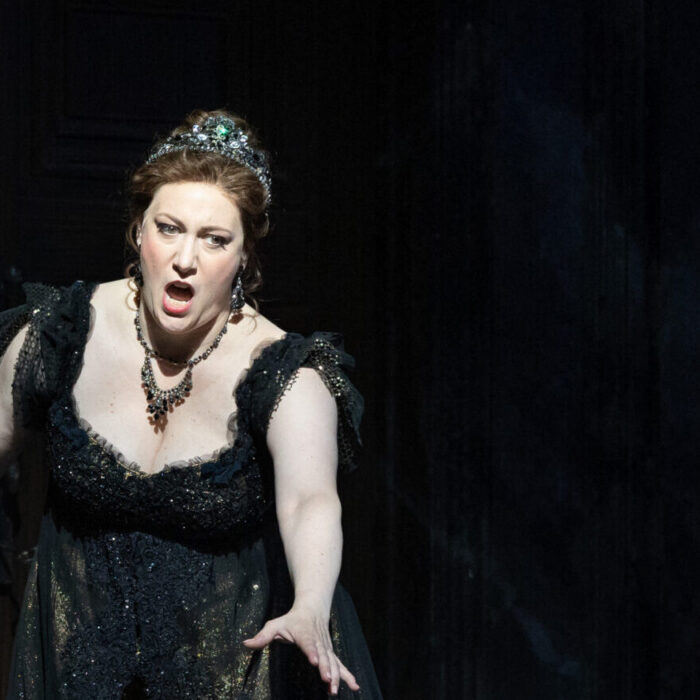
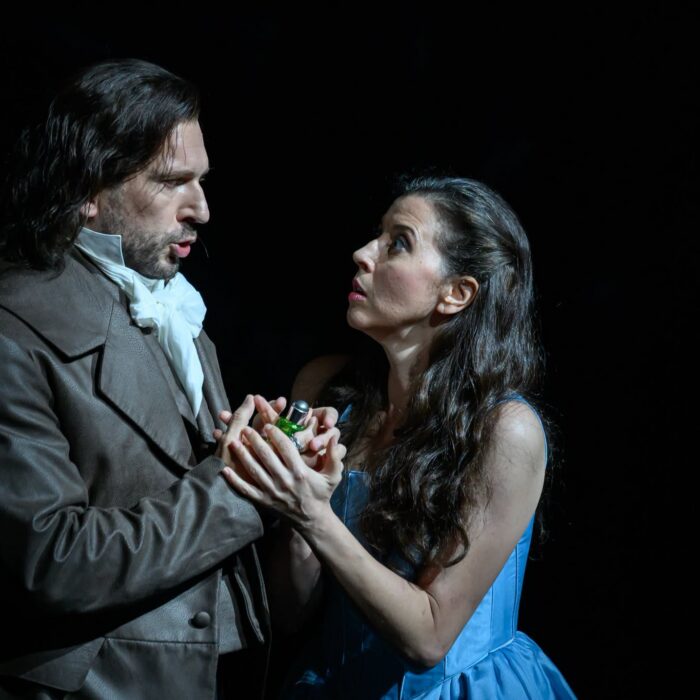
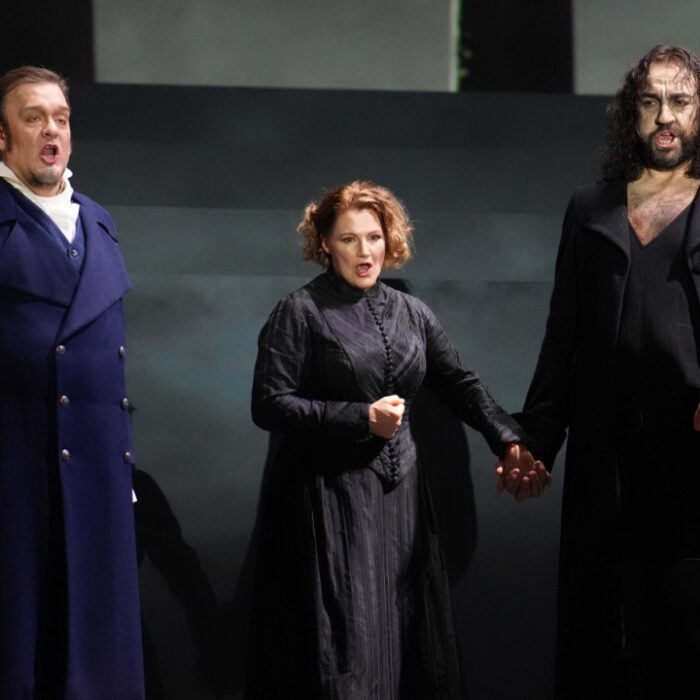
Very few operagoers failed to speak of the singers in this AI “Ring,” not so much for their vocal accomplishments as their dutiful adherence to the immobility imposed upon them by the production crew and costumer. One wonders how each performer felt as they sang through the roles that are part of their very lives, now wedged between shade and shadow. From a critical standpoint they were sacrificed: prisoners to AI-generated imagery, separated from us by gauze-like scrims. One sensed that the AI parade of flashing colors in front of their eyes were sources of distraction. Yet, as the truly great professionals that we know them to be, they remained riveted to the stage and to the score. In their uniform garb they stood for hours, drawing us into Wagner’s cosmic tale. The costumes of Pia Maria Mackert were pure simplicity of line, each just different enough to distinguish between characters. As archetypal shapes, we saw hints of the pagan druid, the classical toga, and even Victorian elegance, all woven into one. One felt that the research undertaken to create these costumes was not an attempt to create what was immediately appealing, but bear witness to all that could be attached to the dramatic action. This was a sophisticated operation, wherein the “look” of the gods, giants, supernatural beings, dwarves, and earthly dwellers in all four operas responded to the realities as being immersed in a holographic, AI world resembling Dante’s “forest dark.” There was variation in these personages: Brünnhilde was dressed unlike Fricka and Gutrune, while the giants were in black as opposed to shades of grey. Grey was for many the common color, yet it was never presented in a way that was tiresome or uninteresting, and forever progressed hand in hand with Wagner’s visions.
In tune with the rest of this review, one would prefer to say less of the singers, who were selected to perform through the graces of their vocal near-aristocracy, each being an established Wagnerian interpreter. Those who know them have already read just about every adjective of praise that can be possibly put to paper. One shall simply pay tribute to what made them, as ever, unique, even in this minimally active staging. Tenor Klaus Florian Vogt as Siegfried sang effortlessly and sweetly, true to his unique characteristic, and was emotionally draining as the heroic battler for truth. He also sang Siegmund and Loge in this year’s cycle. The Brünnhilde of soprano Camilla Nylund once again brought us a beloved Valkyrie, truly convincing in her ever-changing sentiments, her voice outpouring Wagner’s dramatic emotions. Seen at La Scala last year, one may say that for this Bayreuth production there were subtle differences, nuances of purely theatrical invention. This was a demonstration, perhaps, of her unfailing research into a character who is one of opera’s most intricate personalities.
The Gibichung clan of schemers and evildoers captured all the essences of their inhuman deeds, delightfully darkly Shakespearean at every turn. They also aptly portrayed the weaknesses that such unstable beings inherently suffer from. Hagen, sung by bass Mika Kares, was terrifyingly bent on power. Soprano Magdalena Hinterdobler’s Gutrune was a tragically Orphelia-like silhouette. Baritone Michael Kupfer-Radecky’s Gunther was, as ever, all-too-late in his repenting. All that was psychological in their constitution, as revealed through their interpretations, must have been magically conditioned by Maestro Thielemann. Alberich, sung by baritone Jochen Schmeckenbecher, who appears throughout the “Ring,” was once again the desperate, lost, pathetic soul of little humanity, never allowing himself to forget that it was his theft of the ring for greed that set the whole of the Tetralogy into motion.
Waltraute the Valkyrie, sung by mezzo-soprano Christa Mayer (who also performed Erda), captured every moment of her passionate plea to Brünnhilde to give up the ring for the benefit of all. The entire scene was fantastic as both singers, along with Thielemann, lifted the dramatic weight of their predicaments to the stars while breathing in the air of compassion as only two sisters bound by trust can do. Not only were their voices magnificent, but every word echoed through to the roots of their godly commitments. The Norns (mezzo-soprano Anna Kissjudit, also performing Fricka, mezzo-soprano Alexandra Ionis, and soprano Magdalena Hinterdobler) appeared to have darkened their voices to underline not their involvement in putting order to the world, but the fragility of the world’s very existence. The Rhine Maidens Woglinde (soprano Katharina Konradi), Wellgunde (mezzo-soprano Natalia Skrycka) and Floßhilde (mezzo-soprano Marie Henriette Reinhold) innocently splashed about, as in “Das Rheingold,” having apparently not learned their lesson for allowing the ring to have been stolen due to their naivety. Perfectly matched, they conveyed youthfulness while also precisely enunciating their melody, like children during a singing lesson. This added to their sprightly, light-hearted characterizations. The Festspielchor, directed by Thomas Eitler-de Lint, and Festspielorchester were true to form, and perhaps for this anniversary run they added just a bit more, even though they were all unseen – maybe a common denominator in a rapidly-approaching world of AI realities.
Categories
Stage Reviews