Bayreuth Festival 2026 Review: Der fliegende Holländer
Asmik Grigorian’s Incendiary Performance Crowns Wagner’s Reimagined Masterwork
By Christina Waters(Photo: Enrico Nawrath)
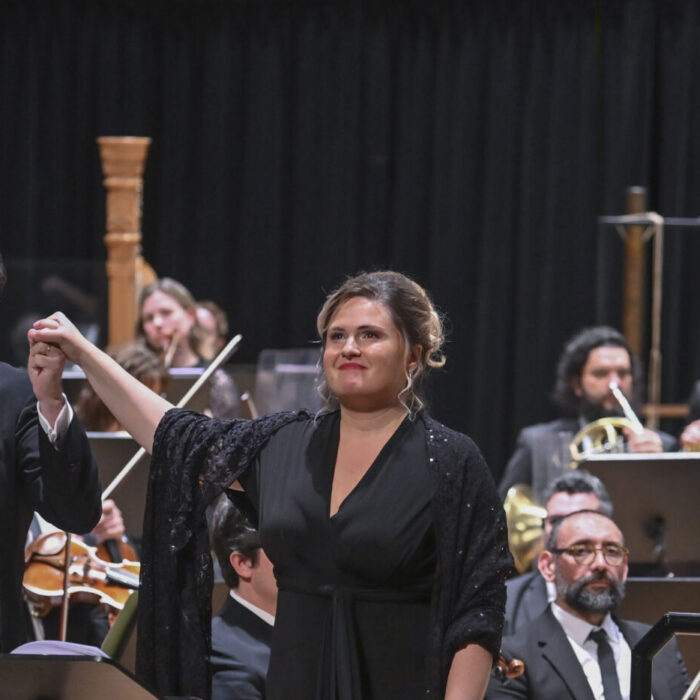
The night, replete with artistry on all sides, belonged to the Lithuanian soprano Asmik Grigorian, who spun a brilliant column of sound throughout her fiercely emotional storytelling. Vocal pyrotechnics were amplified by Grigorian’s astonishing physical dexterity, her restless, near-gymnastic body language.
Her interpretation of the role of Senta, daughter of influential villager Daland, unleashed a rebellion against the men who sought to dominate her. Destined, by her father’s bargain, for betrothal to the stranger, Senta stubbornly defied not only her father’s wishes, but those of her former suitor Erik, and eventually the newcomer with whom she becomes transfixed.
Whether or not this version of the opera could steer toward the myth that only a woman’s pledge of fidelity can free the Dutchman from his wandering curse, remained uncertain. It was however an effervescent point of deliberate tension throughout the concentrated two hours and twenty minutes of the opera. Plus a large part of the pleasure of this performance was in being kept both focused on the plotlines unfolding as well as unbalanced by what actually transpired.
Production Details
Dmitri Tcherniakov‘s production, first staged in 2021, is a psychologically rich interpretation that requires audiences to map Wagner’s original libretto onto a very different setting. In this version, there is no sea, no ship, and no earthly woman who ends her life when the Dutchman leaves her. Instead of a sea captain and his crew, we find rowdy villagers negotiating whatever will keep their small world intact. Women angry with their men, and men brokering their futures with fistfuls of lies.
In this, the second of three performances of “Der fliegende Holländer” during the 2026 Bayreuth Festival, audiences were given a new, compelling “back story” about the events leading up to the start of Act one. As the overture unearthed themes that will be developed in later operas, a hint of Walküre, a taste of Tristan, we observed scenes in a village set in a timeless present. A young boy sees his mother involved in a sexual adventure with a man who quickly casts her away. Looking up again, the boy watches his mother throw herself through a high window, and this suicide propels the action to come. Rejection will become the recurring theme of this interpretation, rather than the fulfillment of an ancient curse.
With this early trauma seared into his soul, the young boy, now the Dutchman, has returned to his home village with revenge on his mind. While there’s no particular rationale for this new angle on the tale of the haunted mariner, somehow it doesn’t get in the way. Once we buy into this alternative motivation for his visit back to his Heimat, the opera unfolding sweeps us up in its action.
Of course this new narrative clashes occasionally with both text, e.g. as the Holländer unfolds his personal curse with the dramatic passage “Die Frist is Um,” and music, as in Act three where the tympani shimmer with faux waves and storm dynamics, but frankly all that matters in this production is the outstanding cast of performers.
Illuminating Cast
Carousing with his “shipmate” partners in the village bar, Kieran Carrel as Der Steuermann opens the opera explaining to the village honcho Daland (the tireless Mika Kares) the curse of the wandering sailor. The sheer beauty of Carrel’s honey-toned tenor voice promises a future filled with portrayals of Sigmunde, perhaps a Lohengrin here and there. Played against the booming legato of Karas, Carrel held his own with passion and delightful antics.
Kares, a noted Hagan and Fasolt in numerous past performances of “The Ring,” brought stunning energy to his key role. The voice, always a definitive anchor to ensemble passages, supplied gravitas without lacking in fluidity.
High marks go to Chorus Director Thomas Eitler-de Lint, who polished his 100 singers into an organic creature capable of moving, reacting, and emoting as a single idea. And all the while singing with power and gorgeous accuracy. From whispered innuendo up into fortissimi confrontation, these voices easily rose above even the Festival orchestra as if the invisible (and in this version, implied) waves had materialized into sonic power. Such a balanced fusion of harmonies, an incredible achievement even if at moments the voices became detached from the orchestra.
Conductor Oksana Lyniv had her hands full setting a consistent and insistent overall tempi. Indeed there were occasional lapses in synchronization between on-stage singers and the musicians in the hidden orchestra. Coordinating two hundred players is a notorious task under any conditions, but all the more so in the unforgiving acoustics of Wagner’s Festhalle.
Lyniv powered her orchestra to episodes of rhapsodic beauty, especially the strings, and in general acquitted herself well in what has to have been a huge feather in her conducting cap. To command the podium during this 150th anniversary season of the Festival is an achievement indeed.
Revenge Served Hot
As we were plunged into the small world of the village saloon, littered with the usual habitués in various states of drunkenness, suddenly one of the drinkers revealed himself to be the Dutchman, played and sung with power and physical command by Nicholas Brownlee. Continuing the tale saga of the seven-year curse the Steuermann had begun, Brownlee used his eloquent gestures and commanding size to good effect. He immediately established the dominance of his character, a dominance that might just prove to be his downfall. If his intonation was a bit rough at first, it had loosened up as the first Act progressed. Fully warmed up, he almost matched the heldenbariton of Kares, especially in their witty, closely choreographed duets negotiating the terms of his daughter’s future. Later in the courtship scene between Brownlee and his intended Senta, he continued offering a huge palette of sonic colors, matched by believable gestures of emotional urgency. Ultimately Brownlee proved an even better actor than singer in this role.
At the opening saloon, the Dutchman and the village’s most important citizen, Daland, quickly hit it off and agreed to exchange Daland’s daughter Senta for whatever the Dutchman was offering.
Throughout his vocal passages, Kares—a memorable Hagan in last year’s “Die Gotterdämmerung,” grew in authority. His legacy bass tessitura increasingly polished, with nary an edge to impede his stupendous legatos of dark, molten energy. The voice seems to have expanded in size and multi dimensions in only one year.
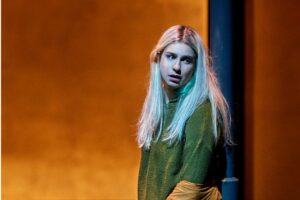
In the second Act we met the soprano star who runs away with this Holländer. Grigorian played her Senta as a brooding punkster who is her own woman, complete with pink streaks in her hair. Insisting on doing everything her way, she grabbed control of her chorus of spinners, (now interpreted as a choral group having a rehearsal), mocking the choral leader Mary, Daland’s partner and apparent second order feminist, who doesn’t approve of Senta’s rebellious streak. Sung capably by Nadine Weissman, Mary is given little to work vocally with by Wagner but, as we ultimately found out, has everything to do with how it all ends.
Wild at Heart
As a hipster badgirl, wearing hoodie and trainers, Grigorian was a wild child, armed with plenty of attitude and the physical agility to go with it. Her eye-popping stage antics (this was not your grandmother’s Senta!) defiantly delivered every moment of her thrilling performance. I felt I was watching a whole new variety of opera singer unfolding before my eyes. Loose-limbed and gymnastic in her sudden twirls, and crouching gestures, Grigorian was a revelation in the physical interpretation of Wagner’s fairytale heroine. But for my money it was all about her voice! Soaring, aching, and so thrillingly controlled, it was the stuff revolutions are made of.
Grigorian had the entire house in her pocket from the moment she sang her provocative overtake of the women’s choral rehearsal. Even more so as she rejected her father’s arranged engagement, when forced home for dinner to meet her new “fiancé,” the Dutchman. And yet, given crafty staging the two had immediate chemistry along with well-timed eye contact.
Meanwhile, lurking about and stalking Senta, was her alleged boyfriend Erik, sung with irritating 19th century gestures by Benjamin Bruns, who often seemed to belong in a different opera. He performed his thankless role valiantly, helping to fuel both the revenge motif and the feminist subtext, and yet we couldn’t help but feel that both the character and the singer lacked compelling backbone to have been anything like a genuine rival. In these ways Bruns was the perfect rejected suitor, yet vocally he struggled with intonation and fell back upon repetitive hand gestures.
Table Manners
As imagined by Tcherniakov, the set of revolving village buildings and interiors, was serviceable yet uninspired. In its favor it must be said that the sight of little residential façades didn’t get in the way. It all formed its secure visual envelope and then let the action unfold. However, in Act two’s central moments, the dinner at Daland’s that puts Senta and the Dutchman face to face, the table setting was both dull and unromantic. When the two began to sing of their newfound attraction, unleashing some of the opera’s most gorgeous music and spine-tingling coloratura, the setting of casseroles and dishware was visually intrusive. Here again, the bass and soprano attunement was stunning. And for long moments in the center of the opera, the mapping of Wagner’s bittersweet love affair onto this production’s motives of tension and revenge felt not only organic, but inevitable.
The opera began without waves, without a ship and ended with an equally myth-breaking event. Instead of Senta being willing to follow her newfound love into an eternal sleep, we find the Dutchman refusing her desire to join him. He rebuffed her and cursed the entire village as well. Was this the revenge for his mother’s suicide? Was he torn between home and wandering, rejecting comfort only to return to his endless cycle of longing? We’ll never know because the curse of the Dutchman was ended by a single shot from Mary’s gun. A wonderfully shocking conclusion, to which it is folly to point out, yes, but the Dutchman is supposed to be already dead. With Wagner, it is never reasonable to apply reason to the plotlines, either his original ones or those dreamed up by 21st century revisionists.
The end of the night belonged to Asmik Grigorian. The audience for the second performance of “Der fliegende Holländer” went wild for her, stomping their feet, storming the stage with brava’s, and demanding many curtain calls. She simply owned the opera from the very first note she sang, and put her signature on it with her final, poignant cries of love and disbelief. Her performance was historical.