Bayreuth Festival 2026 Review: Parsifal
Directorial Ennui Threatens Wagner’s Sublime Score
By Christina Waters(Photo: Bayreuther Festspiele)
Was it possible for director Jay Scheib to offer a production even more unappetizing than his 2023 debut of “Parsifal,” with its much-touted AR frills? Yes it was, and it was on full display last night. This slightly rearranged version, with needless costume tweaks, ruinous visual design, and arbitrary staging, threatened even this most sublime of Richard Wagner’s music.
Wagner’s ultimate consecration was specifically created for this hall and its unparalleled acoustics. This music was not created to be undone by self-indulgent optics.
Production Details
On August 20th “Parsifal” once again featured Heldentenor Andreas Schager as the eponymous “pure fool” who would accidentally save an entire fellowship of the Holy Grail. Still in one piece after a staggering marathon of performing in “Rienzi” the night before, Schager roamed the stage as if looking for a director to supply some, well, direction.
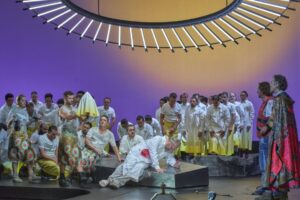
As the keeper of the Grail legend, Gurnemanz, sung by Georg Zeppenfeld explained the situation, while a sleeping Kundry performed by Finnish mezzo-soprano Miina-Liisa Värelä lay sleeping at the edge of a pool of water, all closely watched by a live video feed.
In this iteration of his “Parsifal,” Scheib again chose the quick and dirty solution of video projections to saturate the entire back wall of the stage. This technique often allowed the audience to study the singers (interesting) as well as the inexplicable movements of the various Grail attendants littering the stage (not interesting). It also forced attention away from the music, and the singers, and onto unwanted (repugnant) images.
The opera’s fabled overture, played against the scenic non-sequitur of attempted, or perhaps consummated copulation by Gurnemanz and a random female, revealed a few early orchestral struggles. Given the spare grandeur of the ascending musical lines, each instrument is so exposed that uneven entrances, and harmonic disconnects were unfortunately magnified. Yet the sheer transcendence of Wagner’s compositional ideas soared above even the ludicrous antics onstage. At least for a while!
Repulsive Imagery Versus Astonishing Music
Act one’s repulsive visuals—a relentless large-scale live video of Amfortas’ oozing, bleeding, pustulant wound—made it next to impossible to respond emotionally to the music. Nor did it allow much attention to be paid to Grail archivist Gurnemanz, an always amazing and articulate Zeppenfeld, as he sang the long and hallowed, very long and hallowed backstory to the present plight of the Grail-less knights.
Next we were presented with an illuminated circular structure, ascending out of the pool from where it hovered while the Grail fellowship assembled, clad in futuristic camouflage gear too ugly for any recycling bin. The costuming by Meentje Nielsen is unforgiveable. Against this pointless setting, Michael Volle as Amfortas staggered in with his eternal bleeding wound, while Grail keepers set up the accoutrements of what appeared to be a Catholic mass.
The Grail, now conceived as a chunk of blue cobalt (don’t ask) was exposed for all-around adoration, and then covered up again. Meanwhile Kundry and her unexplained doppelgänger lolled about and watched.
The entire hall squirmed and shuffled with discomfort as the live video force-fed the audience closeups of Amfortas’ wound, realistically pulsating with fresh blood. Utterly repellent. The ludicrous costuming, and snippets of arbitrary symbolism finished off any dignity the opening hour might have mustered.
On a positive note however, live closeups of the prodigious Schager as he sang, allowed the audience to explore the tenor’s unique ability to produce compelling vocal beauty. Watching his breath control and preparation for each phrase was indeed fascinating.
How he does it is one of the great mysteries of modern opera.
Garden of Delights?
Act two opened with the baritone Jordan Shanahan‘s resounding portrayal of flawed sorcerer Klingsor, writhing in a lipstick pink suit before unleashing his garden of flower maidens, and ultimate weapon of seduction—Kundry—on the innocent Parsifal.
Costumed in acres of fleshy pink, with lurid tights and floral flounces, the maidens sang beautifully, climbing and crawling all over Parsifal in an attempt to doom him by way of sex on demand. And Schager’s Parsifal appeared to be loving it, spinning and stroking his way through the colorful orgy, a holy fool in the Playboy mansion pool house. His character knew something delicious was within his grasp, he simply didn’t know quite what to do with it all.
The second Act’s musical ingenuity shows off Wagner’s reinvention of the entire art form, the Gesamtkunstwerk, and in the increasingly assured orchestra one could hear everything, chromatics and succulent mood changes, that Gustav Mahler wanted to be.
Special praise must go to the controlled dynamics of the horns, from velvety innuendo up through a cascade of chromatics into celestial whispers.
Will the holy fool answer every prayer? From the enchanted earth woman Kundry’s desire to finally die to the Grail fellowship’s need to move on with their lives? He might have been able to achieve some traction with these psychological/mystical tasks but director Scheib forgot to provide stage directions!
Meandering Middle
In the central negotiation between Kundry and Parsifal—her attempts to remind him of his own past and his growing desire fed by that fatal kiss—the audience was confounded by the sheer repetition of a very few gestures. As they sang, and much of the singing was ripe with emotional depth as well as aural beauty, the two incessantly reached for each other’s faces with hands that simply would not stop moving and rubbing and stroking, as if they were little forest creatures searching for something, anything, to eat.
When not stroking each other’s hands and faces (amplified in large by the video backdrop), the two performers waded back and forth, in and out of the central pool. Scheib must have figured that at least their non-stop would hold the audience’s attention.
Yet here he is working with one of the greatest works of art ever composed! Couldn’t he have trusted this music to work its magic?
In each of the three Acts, gestures were repeated as if the characters were on an algorithmic feedback loop. Hands caressing faces, over and over again. Grail knights hugging each other. Schager hugging himself, crawling from a centrally placed pool of water, and back out again. Over and over. (Parenthetically, it has to be noted that the Austrian superstar has very likely crawled his way on all fours over every single inch of the Bayreuth stage. Many times over. Impressive.)
Deliver Us from Evil
By the time the third Act blossomed into its full tedium, one looked back fondly on the vision of saucy Jordan Shanahan’s Klingsor pleasuring himself by pole dancing in his neon pink lair. That at least made sense.
Each Act arrived equipped with its own multi-sensory non sequiturs, and each Act was stalked by a female figure who might be Parsifal’s abandoned mother, or a shadow Kundry. This attempt to add interest to an already replete musical masterpiece was never explained and we simply had to ride it out. Everyone eager for the ending and a glass of well-deserved champagne.
Schager’s incredible vocal production, supporting powerful ascents from smoldering baritone all the way up into the penthouse of his tessitura, almost lasted until the final notes. Even the prodigious swagger and bounce of Andreas Schager could not, in the end, pump life into this incomprehensible mise-en-scène.
As his vibrato began to expand from fatigue, he managed to ring pure clear top notes into his ultimate gift to the Grail knights. Raising the “grail” high over his head, our Parsifal flung it to the ground, breaking it into bits. This wonderful shock not only helped wake up the audience, but apparently released Kundry from her immortality. The last we saw of her she was wandering off into the sunset.
Värelä’s Kundry produced some glistening passages of sonic satin, with a few flashes of inspired passion. Yet her seductive capabilities never quite arrived. Again, Scheib was partly to blame for simply failing to provide compelling stage direction. And in this interpretation, I use the term loosely, Parsifal’s desire was for a mother, not a lover.
Conductor Pablo Heras-Casado pulled his orchestra together achieving some solid work and during the final hour produced assured, if stolid tempi, and some breathtaking sounds from the horns.
The stalwart, and occasionally radiant choral balance by the Festival Chorus shone throughout the evening. Kudos to its Director Thomas Eitler-de Lint. Incredible ensemble work from the male voices, who produced seamless rising chords. Wagner’s Dresden Amen sacred ascents require exactly this magical precision. In it we could hear the spiritual offering the maestro intended.
The entwining motifs of the third Act remain one of Wagner’s great gifts to world culture, and to the ensuing history of Western composing styles. Quoting himself many times, he unleashed his full array of creative visions, and then brought them up into new heights. Bring them aufgehoben, in the true Hegelian sense of transcendent synthesis.
Given that Wagner gave this great and final gift to this hall, there is no excuse to present such an unworthy stage concept. Surely, to honor its 150th anniversary the Festival might have mounted a fresh new concept for Wagner’s final musical miracle. Perhaps too much money had been allocated to the gigantic “Rienzi” production. Nonetheless “Parsifal,” and this audience, on this occasion, deserved better.