Bayerische Staatsoper 2025-26 Reivew: Turandot
By Ossama el Naggar(Photo Credit: Geoffroy Schied)
“Turandot” represents Puccini’s final and arguably his greatest operatic achievement. In contrast to his most frequently performed masterpieces – “La Bohème,” “Tosca,” “Madama Butterfly,” and “Manon Lescaut”- it is less reliant on sentimentality. Its orchestral writing is considerably richer and more sophisticated, while its orientalist palette is even more fully realized than that of “Madama Butterfly.”
The opera derives from a fairy tale included in François Pétis de la Croix’s collection of Middle Eastern stories, “Les Mille et un jours” (1710–1712), a work distinct from “One Thousand and One Nights.” The tale was subsequently adapted into a commedia dell’arte play by Count Carlo Gozzi (1707–1788) in 1762.
Puccini did not live to complete “Turandot,” dying before he could finish the score. The opera nevertheless received its posthumous premiere in 1926, fifteen months after his death. Although Puccini had expressed the wish that Riccardo Zandonai should complete the work, his son Tonio instead chose Franco Alfano, a decision that also reflected the preference of the publisher Ricordi. Alfano had recently composed the orientalist opera “La leggenda di Sakùntala” (1921), whose opulent orchestration bore notable affinities to that of “Turandot.”
Set in an unspecified period of Imperial China, “Turandot” draws much of its enchantment from its exotic setting, which is integral to the opera’s extraordinary appeal. In recent decades, however, many directors have abandoned this magical world, arguing that doing so strips the drama to its essential core. While an excess of “chinoiserie” in the manner of Zeffirelli can certainly become overbearing, an overly austere staging risks diminishing the work’s dramatic potency. For the opera’s fantasy to exert its full spell, the audience must be transported into an unfamiliar and exotic realm.
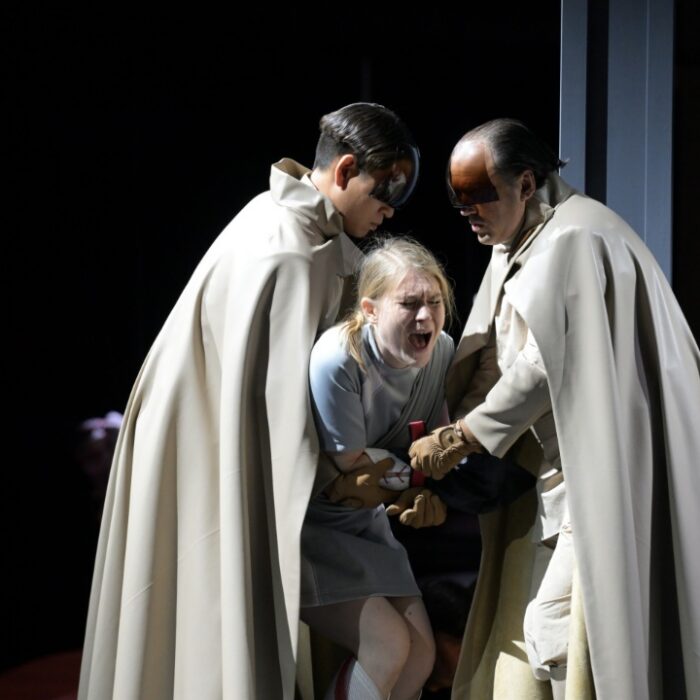
Carlus Padrissa’s 2011 staging for Munich’s Bayerisches Staatsorchester (seen June 30) took the “grand spectacle” crowded approach with mixed results; some of the imagery was indeed stunning, but a lot of it was mere headache-inducing clutter. Prior to the performance, which started almost 15 minutes late, the ushers kept pushing 3-D glasses onto the audience. They gave depth to the busy sets, but also induced migraines. Roland Olbeter’s sets and Chu Uroz’s costumes were a mixed bag of styles, some authentically Chinese and others of various Asian inspirations. The two were apparently inspired after a trip to Shanghai in 2010 and attempted to convey the feel of that city, an odd decision, given that “Turandot” takes place in legendary Beijing a couple of millennia earlier. With a few exceptions, such as the uncluttered “riddle scene,” Padrissa and his production team’s imagery made one yearn for an austere, stripped-down staging. Most unappealing were the hockey players and ice skaters that looked out of place. Another goal of the director and his team was to express the oppression of Imperial China (or was it present day China?). The unimpressive results were sets for a low budget 1980s dystopic science fiction film.
The role of Turandot is a hugely challenging one for any soprano, perhaps the most exigent one in the entire Italian operatic œuvre. It requires a dramatic singer to confront the role’s heavy tessitura, hence the many Wagnerians who have sung the role, including Christel Goltz, Gertrude Grob‑Prandl, Birgit Nilsson and Gwyneth Jones. With the collapse of the Soviet Union, the reservoir of huge‑voiced Russian singers has taken over the role. American soprano Sondra Radvanovsky is one of the rare non-Slavic Turandots today. She has most of the requirements for the role, such as a huge voice and ease in the upper register. However, she is more suited for bel canto roles, such as Donizetti’s Queens, that she has made her own. Her greatest asset is her expressivity, which certainly has its place in Puccini’s toughest role. Her Italian was understandable but diction is not her greatest strength. This is a pity as it could be easily improved and even perfected.
The second act showstopper “In questa reggia” was powerful but monochrome. One would have liked to have heard tenderness and rage when Turandot evoked her ancestor Lo‑u‑Ling, abducted and raped by a foreign invader (and the reason of her eternal vendetta against men). In the third act, there was a hint of the ice princess melting. Indeed, this was her best moment in the opera. Thanks to her great acting, Radvanovsky convinced that she was moved by Liù’s sacrifice and even showed remorse. As Liù gave her last breath and Timur cried in horror, the “Ice Princess” ran to give him succor. Her glance at Calaf also changed, indicating a profound transformation. This was essential for the success of this staging, given that it ended with Liu’s death. One could conclude that Turandot was overcome and that she even succumbed to Calaf’s love. Indeed, the sudden end of the opera at Puccini’s last note was no longer that abrupt.
South Korean tenor Yonghoon Lee has an amazing powerhouse of a voice. I first heard him as Radamès in Teatro Liceu’s production of “Aida.” He then managed the murderous opening aria, “Celeste Aida,” with phenomenal ease and was an altogether astounding dramatic tenor. However, his diction left much to be desired, and describing his acting as wooden would have been a euphemism. Six years later, Lee has much improved on both the diction and the acting fronts. His voice remains as impressive as six years earlier.
Thanks to more nuanced singing, he was able to sing softly and with superb command to express myriad emotions. He also did not fall into the most common pitfall of dramatic tenors with huge voices, singing forte indiscriminately. Needless to say, his Act three “Nessun dorma” brought the house down.
Though endowed with an appealing lyric soprano, South Africa’s Golda Schultz was miscast in the role of Liù. This role requires a lyric soprano with beautiful legato and the ability to produce ravishing pianissimi. Her first aria, “Signore, ascolta” was disappointing, especially for the quasi-absence of the final, subtle pianissimi at the end of the aria. Thankfully her Act three aria, “Tu che del gel sei cinta” was believable, as well as beautifully expressive. Her acting throughout the performance, especially her attraction to Calaf, was convincing.
American bass-baritone Christian Van Horn, endowed with an impressive and powerful voice. was a noble and dignified Timur. As always, his clear diction and stage presence were impressive.
The role of the Emperor Altoum, Turandot’s father, is a minor one that demands a character singer. Hence, it’s often given to older tenors past their prime. However, American tenor Kevin Conners had a potent enough voice to sound properly regal.
Vitor Bispo, Tansel Akzeybek and Samuel Stopford, respectively Ping, Pang and Pong, were delightful. Padrissa dispensed with the commedia dell’arte antics of the three Imperial bureaucrats, despite the fact that Count Carlo Gozzi’s 1762 play (on which the opera is based) is deeply entrenched in that art form. Nonetheless, they were funny enough to serve as a respite from the main story of Calaf and Turandot and the overall visually dizzying production.
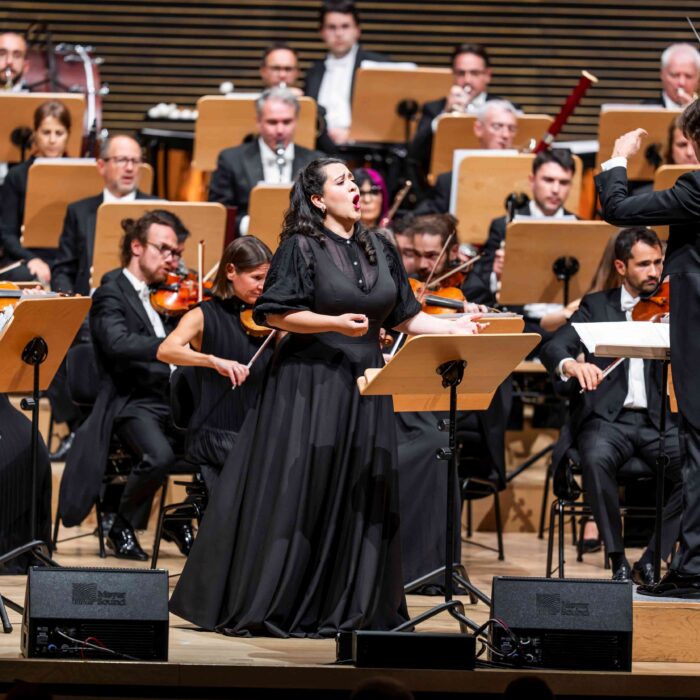
Andrea Battistoni led the performance with ardent conviction, bringing the score’s striking contrasts into sharp relief, from its explosive dramatic climaxes to its ethereal, lyrical reveries. His reading displayed a keen sensitivity to the work’s richly layered orchestral fabric. Yet, for all its dynamism, his conducting never overwhelmed the vocal lines, a balance that is all too easily lost in this demanding opera. Indeed, the Bayerisches Staatsorchester emerged as the production’s greatest asset, delivering the evening’s most distinguished performance.