Blackwater Valley Opera Festival 2026 Review: Don Giovanni
Tom Creed’s No-Frills, No-Risk Production Brings Out the Fun in Mozart’s Masterpiece
By Alan Neilson(Photo: Frances Marshall)
There were very few members of the audience who left the Blackwater Valley Opera Festival performance of Mozart’s “Don Giovanni” without a smile on their faces. And why shouldn’t they have? After all, there was plenty to smile about. For this was a no-frills, simple production that presented the well-known narrative for laughs, nothing more. There was no subtext, no exploration of its underlying themes, and no complex characterizations. The audience was encouraged to sit back and enjoy itself. The opera’s darker aspects of sexual abuse, exploitation and violence that include rape and murder were amusingly sidestepped while Don Giovanni confronted the possibility of spending eternity in Hell by escaping down a fire escape. There was nothing that could possibly upset anyone, and the comedy was very well done.
The stage of the Blackwater Valley Opera Festival is certainly a unique, if not the most versatile, space. Set in an old castle courtyard, surrounded by old farm buildings, it is fairly small in size, although not out of proportion to the seating or the orchestral spaces. Nor does it readily lend itself to elaborate scenic constructions, and the stage access points can make for some awkward entrances and exits by the cast.
A Production Full of Humor & Laughter
The director, Tom Creed, updated the narrative to the present day and located the entire drama in a hotel, or more accurately the hotel corridor in which all the characters were staying. The single set, designed by Aedin Cosgrove, consisted of a series of doors to guests’ rooms, an emergency exit, a storeroom and a few chairs scattered along the corridor, in which Don Giovanni and Leporello spent most of their time, racing between rooms, either trying to escape from Donna Elvira and the rest of the cast or in pursuit of another conquest. What actually went on behind the closed doors was left entirely to the imagination; nothing untoward was explicitly portrayed. Was Donna Anna raped, or was she just annoyed by Don Giovanni’s amorous attentions? Did Leporello actually have a physical relationship with Donna Elvira? Nothing was presented in too serious a manner. Laughter rather than disgust or even admiration was the order of the day! When the Commendatore was killed by Don Giovanni, his body was unceremoniously and amusingly bundled into the cleaners’ store cupboard. It was quite a surprise, however, when in the final scene, he staggered out of the cupboard to torment Don Giovanni; of course, he had not been killed; that would have been far too heavy; he was just a little dazed and in need of a drink.
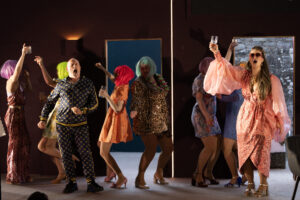
The characters were contemporary in all their aspects; there was nothing noble or refined about any of them; they all wore their emotions loudly and ostentatiously, raging and shouting at each other. While this may well have been expected from the young peasants, Masetto and Zerlina, who, dressed in garish costumes designed by Catherine Fay for their stag and hen parties, just happened to be in town to celebrate their forthcoming nuptials, it was quite surprising to find Don Giovanni dressed in a cheap tracksuit that advertised a thuggish, ill-educated demeanor rather than a charming, upper-class rogue with the air of danger and menace. In truth, Don Giovanni and Leporello came across as a couple of chancers, down on their luck and with little in the way of natural wit to turn the situation around. True, it was a modern representation, but shorn of its 18th-century context and Don Giovanni’s philosophical and behavioral challenges aimed at the ancien regime and the promotion of libertarianism, he came across as nothing more than an unpleasant, thoughtless bore.
Whether or not it was a reading to everyone’s tastes, the slapstick comedy that Creed was able to infuse into every scene was well-orchestrated and could not fail to have even the most cycnical individual laughing along. Likewise, his use of a moderenized text that played up the humor successfully engaged the audience on a lighthearted level, although again at the expense of Don Giovanni’s suave, at times heroic, qualities.
Whelan Oversees A Successful Musical Reading
The musical side of the production was under the direction of Peter Whelan, who oversaw a rhythmically strong and dramatically satisfying performance from the Irish Baroque Orchestra while revealing the beautiful chiaroscuro contrasts of the score.
While there were many accomplished performances from the cast, unfortunately the two pivotal roles of Don Giovanni and Leporello, around which everything revolves, did not fully convince. While this was partly down to their costuming and treatment by the director, the singers themselves had to take the majority of the responsibility.
Baritone Joylon Loy certainly boasted the right athletic and domineering physique, but his interpretation of Don Giovanni lacked the necessary strength of personality; there was nothing magnetic or imposing about his presence. He was not sophisticated or noble. There was no dash or daring and there was certainly no menace or danger attached to his character other than that expected from an anti-social thug. It was an image that was not altered to any meaningful extent by his vocal performance, although he sang correctly and with a pleasing lilt to the voice. There was just no drive and zip that was able to capture the audience’s attention. His recitatives were delivered without the necessary bravado, and his final scene confrontation with the commendatore lacked any sense of terror or dread. Arias were acceptable but emotionally tepid.
Bass-baritone Andrew Murphy was a lively and humorous Leporello, whose natural comic timing had everyone laughing out loud. His recitatives were expertly animated, and he certainly managed to squeeze the full comic potential from the text. He was attentive to Don Giovanni’s mood swings and related with ease to the ridiculous goings-on, and his rising sense of frustration and the need to be free from Don Giovanni was neatly conveyed. On the negative side, however, vocally he was not always secure and often failed to bring the necessary conviction and bite to his interpretation. His rendition of the famous catalogue aria passed by without much of a splash with the audience responding to the projections of the texts rather than his singing. Really the role needed a fresher, younger, more energetic voice to truly convince, but overall Murphy still managed to keep the audience entertained.
Amy Ni Fhearraigh’s Strong Characterization of Donna Anna Catches the Attention
Donna Anna isoften portrayed as a fairly passive individual, especially in comparison with Donna Elvira, and given the multiple traumas that she has experienced at the hands of Don Giovanni, it is hardly surprising. However, it was refreshing to watch soprano Amy Ni Fhearraigh’s very different interpretation. Her Donna Anna was no shrinking violet! On the contrary, she was raging. She was not prepared to hide behind Don Ottavio; she wanted her own personal revenge. And it provedto be a very convincing characterization, one which she supported with a powerful vocal performance. From the opening act, she dominated the interactions with Don Giovanni and Leporello, which had the unfortunate side effect of further undermining Loy’s characterization. The emotion and versatility with which she was able to imbue her singing were truly impressive, nor it was not at the expense of the melodic beauty, which she captured delightfully, notably so in her aria “Non mi dir, bel’idol mio.”
Tenor Gavan Ring was a suitably good-natured, weak, lily-livered Don Ottavio, yet he nevertheless successfully conveyed the genuine passion and love he felt for Donna Anna with a fresh, lively, well-sung performance, full of emotional strength. For his rendition of the aria “Il mio Tesoro,” he pulled out all the stops with a gripping interpretation, for which he received well-deserved applause from a grateful audience. Despite everything, he never went too far. One was always confident that he would receive a good beating if he actually tried to defend Donna Anna physically!
Mezzosoprano Carolyn Holt was, however, not to be outdone as Donna Elvira. Rather than a simple jealous lover, she clearly set out to enjoy herself by maximizing the comic aspect of the role. Her outbursts of faux hysteria were very amusing, allowing her to show off for her excellent comic timing to good effect. Recitatives were very expressive, often neatly molded to blend her very real emotions with a fine dollop of overstatement so that her outrage became a source for laughter. Her singing impressed throughout the evening, displaying ease of movement and the ability to fashion a lively, colorful line.
Bass Valerian Ruminski made a fine impression as the Commendatore. He was authoritative and assertive but also rolled easily with the comedy. He possesses a clear, appealing, secure voice that he used to impose himself. In the first act, he was forceful and serious as he challenged Don Giovanni, but on emerging from the cleaning cupboard in the final scene, he was far more relaxed and more intent on settling down for a drink and a chat.
The two young lovers, Masetto and Zerlina, were imaginatively interpreted by bass-baritone Dominic Veilleux and soprano Aimee Kearney, capturing the typical emotional posturing of young lovers who have not yet sorted out their relationship. Both produced fresh, youthful, enthusiastic performances: while Kearney’s flirtatious Zerlina loved the attentions and adventure of Don Giovanni, Villeux’s Musetto became increasingly aggressive and frustrated.
Kearney sang with a wonderful sense of confidence and freedom. Her attractive tone, sensitively molded phrasing, and versatile, secure upper register allowed her voice to dance lightly across the line, which she showed off with an attractive and moving reading of her aria, “Batti, batti, O bel Masetto”
Veilleux possesses a voice with a strong, animated dramatic presence, which he used expertly to characterize the naive and impulsive Masetto. It was possible to hear the frustrations and anger, despair and jealousy in his voice. On occasions, it is easy to view Masetto with a contemptuous eye; after all, Zerlina and Don Giovanni are constantly outmaneuvering him. However, thanks to his sensitive presentation and comedic abilities, he actually turned Masetto into a wholly sympathetic character.
Overall, this was a safe production that aimed at entertaining rather than challenging its audience. And they did a fine job! Moreover, musically, it had plenty to offer; the best of the singers were excellent, and the orchestra under the musical director Whelan was in splendid form. On a personal level, however, I would have preferred a more ambitious approach. Last summer’s offering of Britten’s “A Midsummer Night’s Dream,” which successfully blended comedy with artistic depth, proved to be more satisfactory.