Musikfestspiele Potsdam Sanssouci 2026 Review: Cefalo e Procride
A Fashion-Show Pastoral Sweats & Shines in the Prussian Court
By Mengguang Huang(Photo: Stefan Gloede)
Musikfestspiele Potsdam Sanssouci has continued staging its flagship new opera production within the unique, historic Orangerieschloss. For seasoned festival-goers, the announcement of Giovanni Battista Bononcini’s “Cefalo e Procride” might initially have left a slight sense of lingering hunger. The scale of this single-act work aligns more closely with a compact serenata than a grand opera seria. Consequently, it sparked a nostalgic longing for the bygone eras when the festival routinely unveiled two or three full-scale new opera productions in a single season. Yet, in an era increasingly defined by tight cultural budgets and financial constraints, the sheer refinement of this production and its exceptional performance quality offered a welcome consolation.
Composed in 1704 for Queen Sophie Charlotte’s Berlin court, this work reshapes Ovid’s myth into a single-act pastoral drama. Spurned by the mortal hunter Cefalo, the dawn goddess Aurora manipulates him into testing his wife Procride’s fidelity while disguised as a shepherd. A tragic web of mistaken identity leads Cefalo to accidentally shoot Procride with a magical arrow. Ultimately, the sun god Titone intervenes, healing Procride and elevating the lovers into divinity.
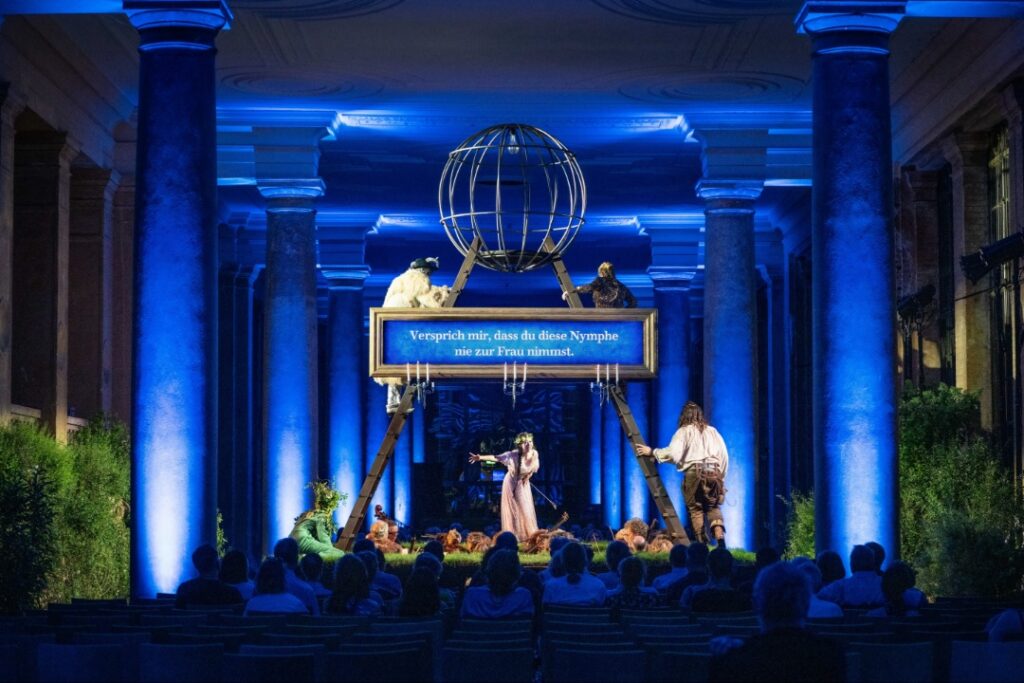
(Photo: Stefan Gloede)
Production Details
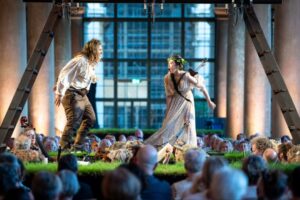
Unlike last year’s production of Agostino Steffani’s work, which merely utilized half of the Orangerie’s linear space, director Michiel Dijkema reimagines the entire venue by adopting a spatial design reminiscent of a modern fashion show. By placing the stage dead center, the production allows the audience to view the unfolding drama from seating blocks arranged on both the east and west sides. At the heart of this setup sits a square enclosure, roughly one meter high and topped with real green turf, which houses the orchestra pit for the dozen or so period-instrument players of the Akademie für Alte Musik Berlin. Towering above this rustic pit is a climbable scaffolding framework, capped by a spherical cage. Suspended from the very top of this cage hangs a prominent lightbulb—a visual nod to this year’s overarching festival theme of “Licht” (Light). Framing the entire space, massive vintage-style LED screens project libretto surtitles to audiences on both sides, while displaying vivid sheep CGI motifs that whimsically complement Bononcini’s instrumental ritornellos between scenes.
This high-fashion spatial layout forces the production to constantly engage both sides of the auditorium. Much like priests delivering sermons from the center of an Italian Renaissance centrally-planned church, the performers have to project their presence omnidirectionally, meticulously balancing their blocking. Dijkema makes full use of the Orangerie’s elongated east-west axis; several crucial scenes begin with singers projecting their voices from the absolute far ends of the gallery, brilliantly capturing the elusive acoustics essential to Cefalo’s story—the rustling of deep woods and the untouchable whispering of the wind. The absolute crown jewel of this spatial choreography arrives near the end of the opera with a beautiful echo duet between the two wind spirits (Zeffiro), a moment where the vast architecture of the Orangerie truly becomes a living musical instrument.
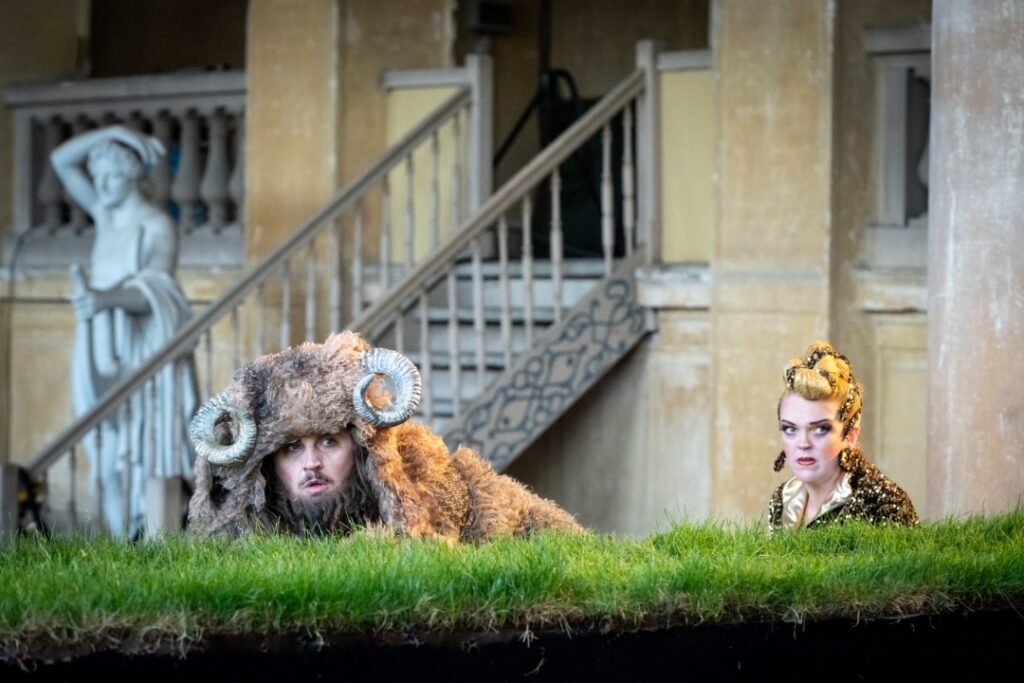
The pervasive sheep motif is naturally designed to cultivate the idyllic, pastoral atmosphere of a traditional serenata. However, with outside temperatures pushing close to 40°C, evoking this rustic innocence demands a monumental sacrifice from the performers. The orchestra members play heroically while wearing heavy sheep hats and scarves. Even more remarkably, the oboists and a few singers remain fully clad from head to toe in thick, suffocating sheep costumes, leaving the audience genuinely anxious for their physical well-being in the unbearable heat.
(Photo: Stefan Gloede)
Illuminating Cast
Countertenor Yuriy Mynenko as Cefalo was undoubtedly the hardest-working performer on stage, sweating profusely in his heavy costume and enduring two very loud slaps from both Procride and Aurora. Musically, his voice remained exquisitely soft and sensitive, yet it was his deep psychological insight that left the strongest impression. While early scenes subtly suggested a man nearly lost under Aurora’s silver-tongued manipulation, any doubt was completely dissolved by his duets with Procride—moments packed with energy, sincerity, and delightfully simple melodies. Yet, this conviction remained fragile; Cefalo’s lingering inability to fully trust the elusive Procride led to reflective soliloquies that added weight to this otherwise youthful drama. Ever the entertaining serenata, Mynenko also delivered brilliant comic relief: his desperate pleas to the wind spirit Zeffiro for a cooling breeze became a perfectly timed nod to the real-world heatwave, prompting a knowing laughter from the audience.
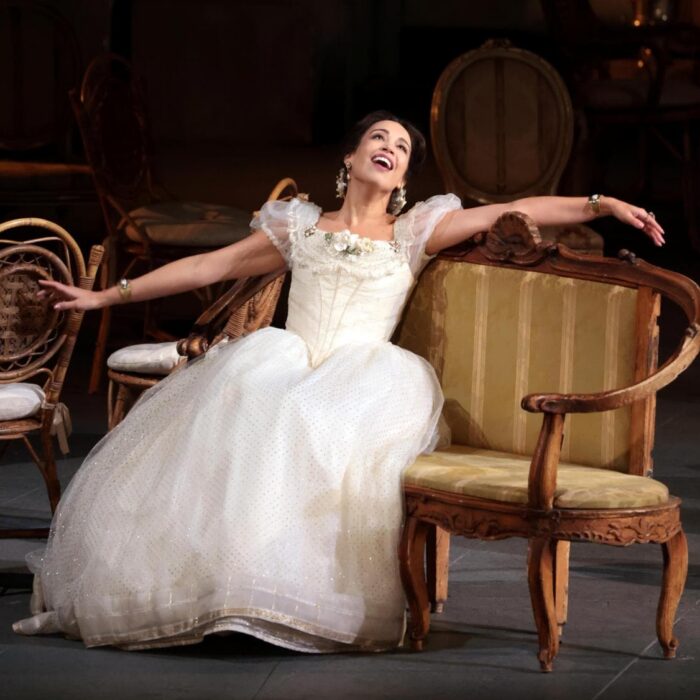
In the role of Procride, soprano Jiayu Jin proved to be an ideal counterpart to Yuriy Mynenko’s Cefalo. Jin’s voice was exceptionally clear, boasting a pristine projection that bordered on flawless, save for a few brief moments of slight over-singing. Her breath control in the high register was particularly impressive. Adorned with a delicate crown of green leaves and a long, classic braid, her stage image exuded pure innocence, beautifully highlighted by a gracefully flowing cream bohemian gown. This visual charm translated into a vividly realized psychological portrait. Jin traced Procride’s emotional arc convincingly: from her tender, pleading expressions of love—supported by a softly swinging cello accompaniment—to the tortuous inner anguish of her misunderstanding with Cefalo, and finally to her heartbreaking farewell after falling victim to a tragic, jealous error. The music and her poignant stage movement spoke entirely for themselves.
Chloë Morgan delivered an equally captivating Aurora, vividly portraying the goddess’s sharp persuasion and her calculating approach to love once she realized Cefalo was truly unattainable. Anita Rosati brought a beautifully radiant tone to the forest nymph Atenice. Her captivating echo duet with Morgan—with both singers stepping into the roles of the two wind spirits (Zeffiro)—stood out as one of the evening’s most magical highlights. This ethereal moment was poetically supported by the orchestra’s rustling instrumental depiction of the breeze.
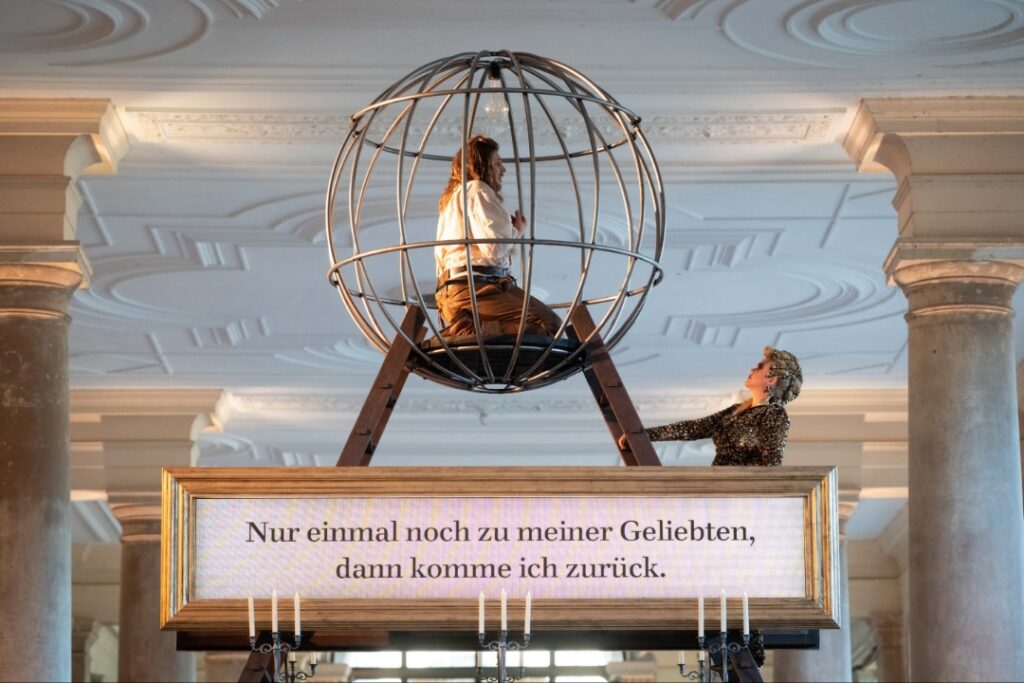
(Photo: Stefan Gloede)
Meanwhile, Jonathan Eyers successfully navigated a dual role as Titone. For most of the opera, his shepherd disguise leaned into a delightfully comic, almost farcical jealousy. Yet, the moment tragedy strikes Procride, Eyers cast off the comedic veil. In revealing his true divine identity, he executed a classic Baroque deus ex machina with an authoritative vocal presence.
As always, the Akademie für Alte Musik Berlin performed at an exceptionally high standard. Crucially, they successfully avoided the overly sharp, aggressive articulation that has occasionally crept into their playing in some recent productions. Under Bernhard Forck’s leading violin, they imbued this Prussian courtly serenata with the exact right measure of aristocratic elegance and precision. The carefully selected instrumental movements by Bononcini seamlessly bridged the scenes as fitting interludes. The two oboists, fully immersed in their sheep costumes, became active participants in the physical drama.
This tight, ninety-minute production kept the audience utterly spellbound from start to finish. The only true disappointment of the evening lay outside the Pflanzenhalle: it is a profound shame that Deutschlandfunk failed to broadcast this rare, complete staging, resulting in a deeply regrettable missed opportunity to document a milestone in early Berlin opera history.