Arena di Verona 2026 Review: Turandot
An Imperial Pageant: Zeffirelli’s Turandot returns to Verona
By Ossama el Naggar(Photo: Arena di Verona)
There are few operatic spectacles more perfectly suited to the Arena di Verona than Franco Zeffirelli’s “Turandot.” Puccini’s final opera demanded, almost from its inception, something larger than life: an imperial court, a condemned prince, a populace intoxicated by bloodlust, an icy princess elevated to quasi-divine status and, above all, the theatrical machinery of fairy tale. A century after its first performance at La Scala, the opera returned to the Arena in the production Zeffirelli devised for this enormous amphitheater in 2010, with Emi Wada’s sumptuous costumes and Maria Grazia Garofoli’s choreography. The result remained visually prodigious, even if the passage of time had made the limitations of the conception increasingly difficult to ignore.
Production Details
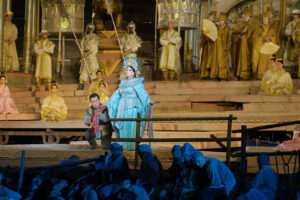
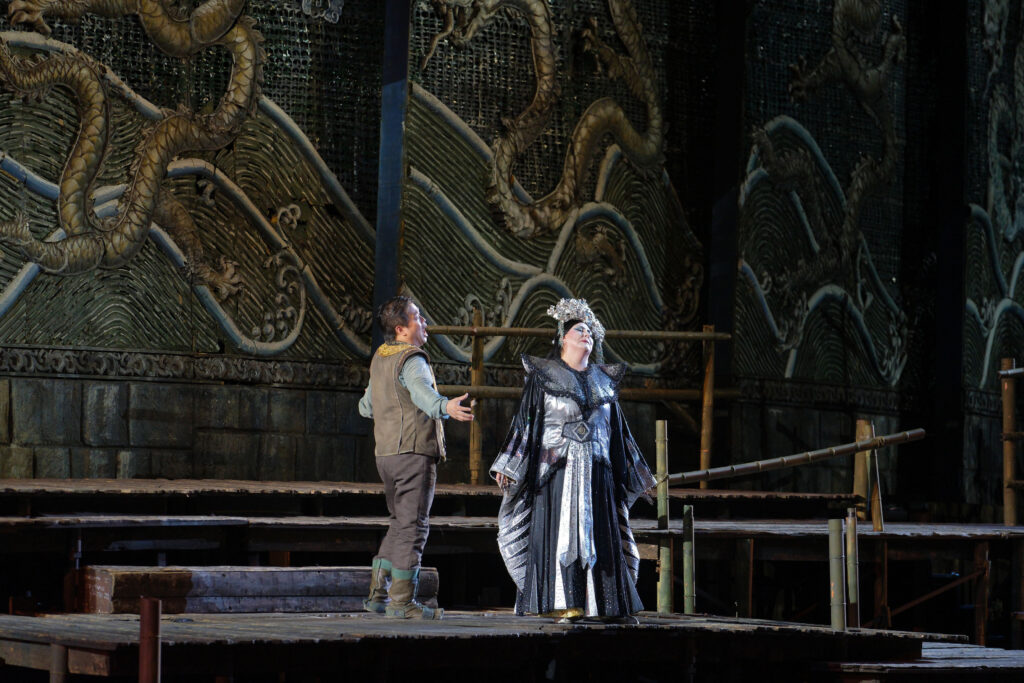
Zeffirelli’s “Turandot” (seen August 7) was, in essence, opera as cinematic colossus. Its visual grammar was one of accumulation: hundreds of bodies, extravagant costumes, gold, crimson, banners, masks, processions, ceremonial gestures and an architectural apparatus apparently designed according to the principle that more was invariably more. Earlier revivals had already noted the production’s almost pathological horror vacui: an inexhaustible profusion of color, gold and human ornament, crowned by the spectacular unveiling of the imperial palace.
The Arena, naturally, rewarded such extravagance. What might have appeared vulgar or merely overstuffed in a conventional theatre acquired a certain grandeur beneath Verona’s night sky. The great division between the impoverished, grey populace and the dazzlingly colored Forbidden City remained one of Zeffirelli’s most effective ideas. The people of Beijing seemed to swarm in perpetual agitation in the foreground, while the imperial world beyond remained almost unnaturally still, crystalline and remote. The image was simple but theatrically potent: political power made visible as color, space and distance.
Yet it was also here that the production’s fundamental weakness became apparent. Zeffirelli had supplied a visual idea rather than a dramaturgy. Once the initial opposition between the masses and the imperial world had been established, there was remarkably little left for the direction to discover. The production remained essentially a sequence of tableaux, each one more lavish than the preceding one, while the singers were expected to provide the psychological movement that the staging itself scarcely articulated.
This was particularly problematic in an opera whose dramatic contradictions are more interesting than its fairy-tale exterior suggests. “Turandot” is not merely a procession of Orientalist splendors and spectacular deaths. It is a disturbing drama about power, misogyny, desire, trauma and the strange moral economy by which Calaf’s obsession with a woman who has ordered the deaths of innumerable suitors is treated as romantic triumph. Turandot’s transformation from executioner to lover is one of the most psychologically precarious transitions in the repertory. Zeffirelli’s production offered little assistance in negotiating it. The princess remained a monumental emblem rather than a woman undergoing an interior crisis.
That problem was exacerbated by the production’s relentless visual saturation. The dancers, extras and courtiers were not merely background decoration; they constituted an entire secondary spectacle. At times the eye was almost overwhelmed by the sheer quantity of things happening on stage. Earlier revivals had already observed that the density of scenery, costumes, extras and choreography could threaten to obscure the principals themselves.
One could hardly complain that Zeffirelli lacked imagination. The more pertinent complaint was that he had too much of it and too little dramaturgical restraint. His “Turandot” was a museum piece from the great age of operatic gigantism, recreated with extraordinary craftsmanship but insufficiently interrogated. It was an artifact of a theatrical philosophy in which visual magnificence was itself presumed to constitute meaning.
Emi Wada’s costumes remained a substantial virtue. Their splendor was inseparable from the production’s aesthetic, and the Oscar-winning designer’s ability to create a coherent visual hierarchy amid such enormous numbers was considerable. Yet even here, admiration was not synonymous with uncritical approval. The costumes belonged unapologetically to Zeffirelli’s imaginary China: a fantasy China filtered through European theatrical conventions, chinoiserie and fairy-tale exoticism. Their beauty was undeniable; their relationship to the cultural reality they purported to evoke was considerably more problematic.
Arena di Verona
Musical & Cast Highlights
The musical performance supplied the necessary corrective to the production’s visual excess. Andrea Battistoni approached Puccini’s score with an awareness of its extraordinary orchestral sophistication. “Turandot” may announce itself with brutal percussion and monumental choral writing, but beneath the bombast lies a score of extraordinary harmonic refinement: shards of melody, grotesque rhythmic cells, Chinese-derived pentatonic material, Wagnerian sonorities and moments of almost chamber-like delicacy. Battistoni gave the score sufficient propulsion and theatrical voltage without reducing it to the kind of sonic assault that can so easily overwhelm an Arena performance.
The evening was crowned by Anna Pirozzi, whose Turandot confirmed why the role has become such a natural extension of her dramatic soprano. Pirozzi possessed the essential amplitude to dominate the Arena, but the achievement lay in the fact that sheer volume was not the whole story. Her voice had the amplitude, incisiveness and upper-register security that the role demands, while her command of phrasing allowed the character’s imperiousness to be differentiated from mere vocal violence. Her recent Turandots at La Scala and the Metropolitan Opera had already demonstrated these qualities: critics had particularly noted the combination of amplitude, formidable high notes and a willingness to shade the character rather than simply thunder through the riddles.
If the production rendered Turandot somewhat monolithic, Pirozzi supplied dimensions that the staging lacked. The princess’s celebrated “In questa reggia” acquired the authority of an act of public proclamation, while the riddles were treated less as vocal hurdles than as the final expression of a woman who had made cruelty into her defense mechanism.
SeokJong Baek, replacing the originally announced Calaf, proved an exceptionally well-matched foil. Baek had already attracted considerable attention for the role at the Royal Opera House, where critics singled out his top notes, musicality and particularly his “Nessun dorma.” At Verona, the tenor’s instrument possessed the kind of ringing upper register indispensable in this amphitheater, but his most welcome quality was that he did not reduce Calaf to the single-note phenomenon that has unfortunately come to define the character in popular culture. His Calaf had something more substantial than the famous aria’s final “Vincerò!” There was youthful ardor and an element of recklessness in his pursuit of Turandot.
The real emotional counterweight to the protagonists was Mariangela Sicilia’s Liù. Sicilia was particularly well placed to return to the Arena production, having previously sung Liù in Zeffirelli’s “Turandot” there. Her earlier performance had been singled out as one of the production’s principal strengths, with critics praising the combination of vocal warmth, delicacy and dramatic sincerity. Her Liù again represented everything that Turandot was not: vulnerability rather than power, affection rather than possession, sacrifice rather than domination.
This contrast was dramatically revealing. Sicilia did not need Zeffirelli’s armies of extras or elaborate choreography. Liù’s tragedy required only a singer capable of making Puccini’s deceptively simple melodic writing sound like an utterance of genuine human necessity. Sicilia did so with an attractive lyricism and an affecting restraint. Her death consequently supplied the evening with the emotional gravity that the grand machinery surrounding it sometimes struggled to provide.
Alexander Vinogradov brought to Timur the dark sonority and authority expected of a Russian bass. His substantial projection and naturally resonant lower register served him well in the role, qualities that have repeatedly proved advantageous in this repertoire. His usually inadequate diction was less obtrusive here—a considerable blessing. The characterization was less fully developed than his vocal means, but the voice itself endowed Timur with the requisite patriarchal gravity and made his grief at Liù’s death appropriately weighty.
The Arena chorus, children’s chorus and massed stage forces were indispensable to the spectacle. “Turandot” is one of those scores in which the collective voice becomes a character in its own right: the mob’s appetite for execution, its fascination with the princess and its sudden submission to imperial authority are fundamental to the opera’s moral architecture. Here the Arena’s enormous forces provided precisely the scale for which Puccini’s score seems almost indecently well designed.
An Imperial Pageant
And yet, after the final pages, one was left with a curious ambivalence. Zeffirelli’s “Turandot” remained breathtaking because it was breathtaking: an extravaganza of theatrical craft that had scarcely any interest in understatement. But the production also illustrated the difference between spectacle and theatre. The former can be preserved almost indefinitely; the latter requires dramatic thought, which inevitably ages.
In its centenary year, “Turandot” therefore offered an intriguing paradox. Puccini’s unfinished final opera, with its unresolved questions about desire, violence and the possibility of emotional transformation, remained one of the most problematic works in the standard repertory. Zeffirelli’s staging, by contrast, presented the work as though its meaning were perfectly settled: a fairy tale of glittering palaces, sinister crowds, heroic tenors and the eventual melting of the Ice Princess. The production’s magnificence was beyond dispute. Its dramatic complacency was harder to forgive.
Fortunately, the musical performance supplied what the staging lacked. Pirozzi gave Turandot formidable vocal and dramatic authority; Baek supplied Calaf with the requisite heroic radiance without reducing him to “Nessun dorma” and nothing else; Sicilia found in Liù the opera’s indispensable humanity; and Vinogradov brought noble gravity to Timur. Battistoni ensured that Puccini’s extraordinary score did not become merely the soundtrack to a pageant.
The Arena had once again offered “Turandot” as spectacle on a monumental scale. But the most affecting moments of the evening were precisely those in which the spectacle receded and Puccini’s human beings emerged from behind it.