Teatro Real opened the 2026-27 season with a new production of Puccini’s juvenile opera “Manon Lescaut” (co-produced with Opera Köln). These are the first stage performances of this title since the theater reopened in 1997, and it has been 102 years since it was last seen at Teatro Real. It delivered a splendid cast with the voices of soprano Sondra Radvanovsky as Manon, tenor Michael Fabiano as Des Grieux, and baritone Lucas Meachem as Lescaut. This core trio were joined by other great artists and singers, such as tenor Alejandro del Cerro and tenor Mikeldi Atxalandabaso.
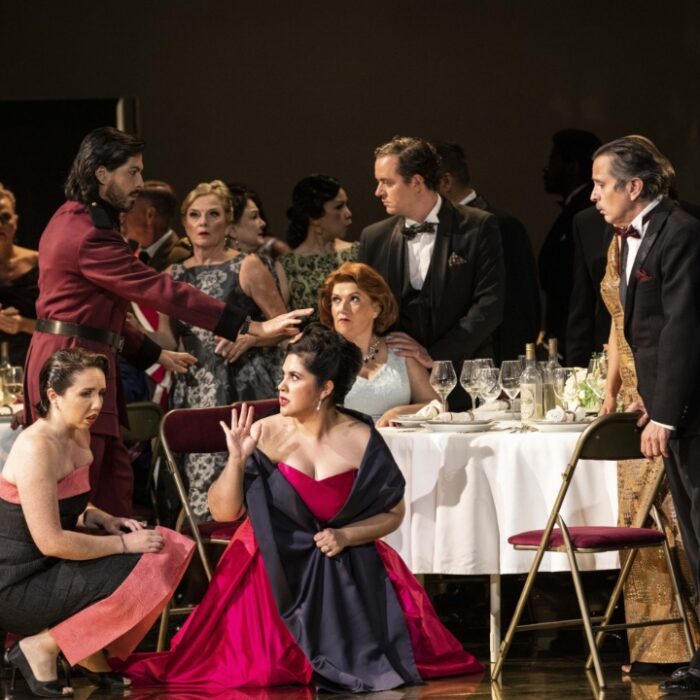
The production was set in modern times. The costumes were not from any specific period, though they could have very well belonged to the 1950s or 1960s. The choir danced rock and roll and the twist at certain points, but they could have hailed from our current age as well. What was especially striking was the mixture of abstract with realism — which one believes did not work out at all. It is very difficult to mingle those two different approaches and obtain a solid result. While the costumes were completely realistic, the sets were completely abstract. The opera was set within a white box, contained on its sides and ceiling by four white panel walls. In the middle there was a revolving turntable set piece that held different elements during each act, resembling a merry-go-round in Act 1 and a prison cell in Act 3. I believe the inclined floor represented the swamps of Louisiana, being made of sand covered in puddles of water, the water was made with a mirror-like material. The sets were pure white, the costumes and props were black, grey, or dark brown, and therefore the bright red horse riding jacket that Manon wore at the end of Act 2 created a big contrast. The last act was emptiness; just the white walls and deserted floor.
The main problem came with the stage direction. While the director, Carlos Wagner, chose a realistic, believable approach for the first three acts, the last act was completely metaphorical. The curtain rose on Manon and Des Grieux walking slowly towards their deaths as actresses died all around them. Every once in a while, someone fell to the floor in agony. As Manon and Des Grieux — who also fell to the floor at one point — sang their final duet center stage, one actress fell and died while another froze with her head against a wall. The rest left the stage walking like zombies. Manon died standing, which was well-portrayed thanks to the great interpretation by Ravdanovsky. But dying standing has been profusely done: it is no longer surprising and it is not original. The final act felt as if it had been staged by a director from another production: it did not make any sense within the rest of the show. Though it was well done, meaningful, and strong, you cannot just present three whole acts with a detailed, truthful, and hyper-realistic approach and then end the opera with abstract, metaphorical movements and characters. It ended up being really shocking. I must add that the movement and choreography of the choir were lively, rhythmical and original.
World-renowned soprano Radvanovsky portrayed the titular role. Once again she offered an intense and believable portrayal of a Puccini dramatic heroine. She began her first short intervention, “Il mio fatto si chiama,” singing shyly and with a sense of naïveté. This role is well written, building up gradually. It begins in the first act with short interventions and a central tessitura. She delivered the first B flat of the night alongside the tenor in the Act 1 duet “Vedete? Io son Fedele,” though here she sings very few lines and Puccini keeps her tessitura mostly inside the stave. But she sings near continuously during the 45 minutes of Act 2. Puccini keeps her central tessitura, writing mostly inside the stave, although she has to rise up to B flat twice on her aria “In quelle trine morbido.” The soprano showed her strong, warm middle register and her astonishing ability to sing mezza voce and pianissimo in moments such as “v’è un silenzio…” Here the soprano sang in a beautiful, soaring whisper. Her high notes were thunderous and sparkling. In her short duet with Lescaut, “Per me tu lotti…” the tessitura began to rise up, navigating between high G and A naturals, and required Radvanovsky to hit the first high C of the evening, “Ah! Vien, resister più non so!” This the soprano sang with determination and incredible volume. Radvanovsky’s instrument is unique. She possesses a dry, metallic timbre that makes her voice incredibly special. She also has a superb high register that reaches up to a high E natural, increasing in volume as she climbs without losing her impressive projection (as one can also hear in “Mercé, dilette amiche,” from her recording as Elena in Verdi’s “I vespri siciliani”). Her high notes ring in your ears as if she were singing right next to you. Her instrument is big, dramatic, yet flexible and agile — qualities that are often considered counterposed — as she has been alternating spinto and dramatic roles with bel canto coloratura. She may be the only soprano in history who has “Aida” and “Tosca” alongside Donizetti’s “Tudor Queens” opera trilogy and “Norma” in her repertoire. She has the incredible ability to sing piannisimi and mezza voce even in her high register. Her high C in “sul mi raconto, Ah!” was clear over the chorus and orchestra in forte. The interpretation of the second act duet “tu, tu amore…” was ardent and intense. Not only is her singing beautiful and technically perfect, she is completely committed to the character and the scene — even when the staging requires the soprano to pole dance, performing wearing just a tight black satin bodysuit and black pantyhose. Not only did she sing well, Radvanovsky showed her stamina and physical fitness.
Manon sings very little during Act 3, mostly spare lines, with the exception of the ensemble moment with several soloists and the choir, where she has to emit another high C in fostissimo. This the soprano sang with power, astonishing volume, and projection. The soprano’s big moment, both vocally and dramatically, came in Act 4. It is very difficult to reach this point in the opera with the voice still fresh and the stamina to reach the emotional climax of her famous and desperate aria “Sola, perduta, abbandonata…” In this Ravdanovsky was splendid. Her high notes remained powerful and incredibly loud, emitting another high C in “Ah sei tu.” She coloured her voice and played with dynamics to give the impression that she was dying, while also sounding desperate and frightened. Her dying scene was extremely sorrowful and moving.
Opera star tenor Michael Fabiano debuted the role of Des Grieux. It is a long role that has at least one aria and a duet in each of the four acts. The tessitura is high with constant ascensions to B flats and B naturals, while the orchestration is dense and heavy. This requires the tenor to sing all night with a strong projected sound and a believable dramatism. Fabiano opened with a light and agile “Tra voi belle…” This is a short arietta that he defended effortlessly, lightening the sound to deal with the high tessitura and the situation of his character — in the first act he is a young and ardent gentleman. He delivered a ringing and secure high A in “Aspetta…” He began his first encounter with Manon— “Cortese damigella…” — with loving fraseo, projecting a top ringing B natural in “Sul vostro destino…” This is not an easy task, as Des Grieux has only been onstage and singing for around ten minutes at this point in the opera, meaning the tenor’s voice may not be sufficiently warmed up while the note is terribly exposed. Fabiano sung his first act aria, “Donna non vidi mai…” with impeccable fraseo and legato singing, alternating his big projected sound with delicate mezza voce and decrescendo, such as in the line “vanno a carezzare.” He delivered two splendid B flats and received the first applause of the evening (though the conductor, Nicola Luisotti, did not stop the music and carried on with the orchestra, cutting down the audience’s applause). He sang the first act duet “Vedete? Io son Fedele…” with beautiful lyricism and legato singing, handling the high tessitura nicely and delivering a strong secure B flat in “Ah! Mio sospir…” alongside the soprano.
Dis Grieux reappears for the Act 2 duet “tu,tu amore…” This Fabiano sang with passion and determination, delivering a secure, sonorous, and exposed top high B flat in the legato line “Le giornate che buie…” that culminates the duet alongside the soprano and orchestra in fortissimo. He sang “Ah! Manon mi tradisce…” with desperation and dramatism, hitting a straight attacked exposed B flat in “ma discendo la scala dell’infamia” and B natural in “Ah! Con te portar…”
Fabiano built a fantastic dramatic arc. From the cheerful young man of Act 1, through the resentful and despised lover in Act 2, to the desperate and extreme man of Acts 3 and 4. This was a desperation that he built in crescendo from his very first lines, “ansia eterna crudel,” to his third act aria “Guardate, pazzo son,” where he delivered several B flats. His soaring, whispering mezza voce in the Act 4 line “Non mi rispondi amore” was hair-raising, and a huge contrast with the desperate and exposed B flat of “Ah! Manon…” He delivered a secure high C alongside the soprano in fortissimo in “O amore, O Manon.” His intention and emotion in “La mia preghiera, un soccorso…un soccorso!” was remarkable. He sang till the end in an uncomfortable, high tessitura, navigating between high G and A natural with astonishing strength and determination, and finished with his voice fresh. Despite his astonishing volume and projection, his timbre has become darker in recent years — he can sometimes sound like a baritone — and consequently he does not have to force the voice, pushing the sound or over-darkening it.
The protagonist couple received a well-deserved standing ovation when they took the first curtain call together.
Lescaut was portrayed by the magnificent baritone Lucas Meachem. He possess a beautiful, round, and projected sound, able to carry over the heavy Puccini orchestration. This is often a very difficult task when Luisotti is in the pit, as he tends to play as loud as possible and not care about the voices onstage. As with so many baritone roles, the part does not have any memorable solos and is relegated to supporting lines requiring a resolved high tessitura, navigating constantly between high and F sharp. Meachem sang his first main intervention, “Ma lo consiglio…” with an impeccable Italian fraseo and effortless singing. He offered a lyrical interpretation of his short arietta, “Una casetta angusta,” at the beginning of Act 2, where he held a strong, ringing high F sharp on the line “per un palazzo aurate…”
Tenor Alejandro del Cerro shone as Edmondo with a ringing and timbrical voice, astonishing vocal projection, and believable acting. It is a small part, but Edmondo sings a lot in the first act and it is this singing that opens the opera. He succeeded in singing in an uncomfortable tessitura, navigating the passagio with constant ascensions to G, G sharps, and A naturals.
Conductor Nicola Luisotti was once again faithful to his modus-operandi: “the louder the better.” That might be great for a symphonic concert but in an opera performance you have to hear the singers. Thanks to the extraordinary trio of protagonists, who all possess extraordinarily big, well-projected voices, we could hear them clearly. The rest of the cast sounded distant and muffled. Luisotti was brilliant in the intermezzo before Act 4, where he extracted all the timbrical colours from instruments of the orchestra, making the piece lyrical and beautiful. The Coro y Orquesta del Teatro Real complied with Luisotti’s demands, sounding powerful and strong.
This new production of Puccini’s rarely-seen “Manon Lescaut” presented a cast to dream for, with Sondra Ravdanovsky, Michael Fabiano, and Lucas Meachem in the lead roles, in a weak but nevertheless decent production.