Teatro Real de Madrid 2026-27 Review: Fire, Guitar, Legend
By Francisco Salazar(Credit: © Chris Lee)
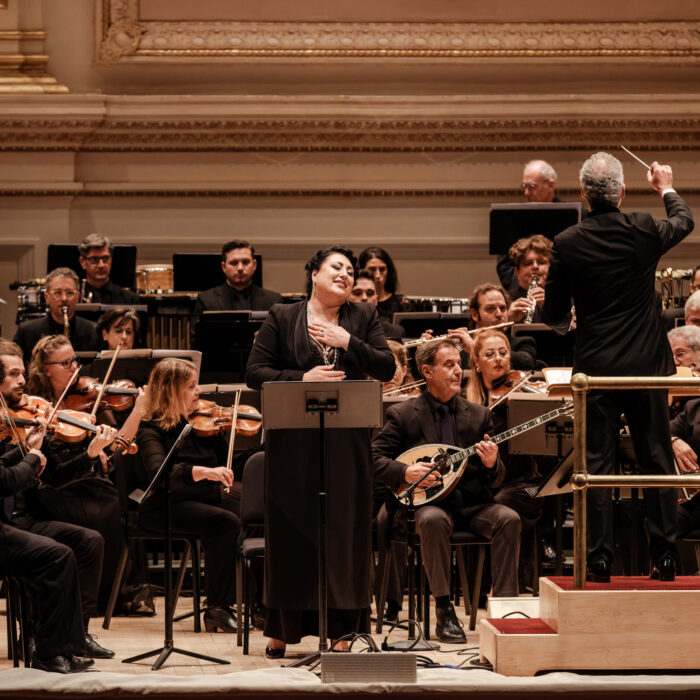
On Oct. 15, the Teatro Real de Madrid returned to New York for its annual gala performance. This time the orchestra and its Music Director Gustavo Gimeno brought a program inspired by Spanish colors and identity titled “Fire, Guitar, Legend.”
The program included music by de Falla, Rodrigo and Rimsky-Korsakov and the result was a solid performance filled with fiery interpretations and passionate music making.
Fire
The program open with a reading of sections of de Falla’s “El Amor Brujo,” which were performed with rhythmic precision, particularly the “Danza ritual del fuego,” which was playful if a times a bit too slow.
The program gained momentum with de Falla’s “Siete canciones populares españolas” featuring Adriana Gonzalez in her New York debut. Gonzalez relished each rhythmic flourish, especially in “El paño moruno,” “Seguidilla murciana,” and “Polo,” emphasizing the triplet flamenco rhythm. Her low chest voice was also on full display bringing out a lush vocal range. In the “Jota” the soprano played with tempi and emphasized each rallentando for as long as she could. But it was in the haunting “Asturiana” and tender “Nana” that Gonzalez excelled, showcasing a gorgeous legato line that was sensitive and flexible.
But the highlight of Gonzalez’s evening was without a doubt the encore “Goizeko eguzki argiak” (Aria de las flores) from “Mirentxu” by Jesús Guridi. Gonzalez brought out her lush and exquisite lyric soprano and sang with delicacy and gorgeous pianissimos, all while holding out extended phrases. It was virtuosic singing like no other and one wished that Gonzalez would have continued throughout the evening as it seemed like she was just getting started. Hopefully the soprano will return very soon to the New York stages.
© Chris Lee
Guitar
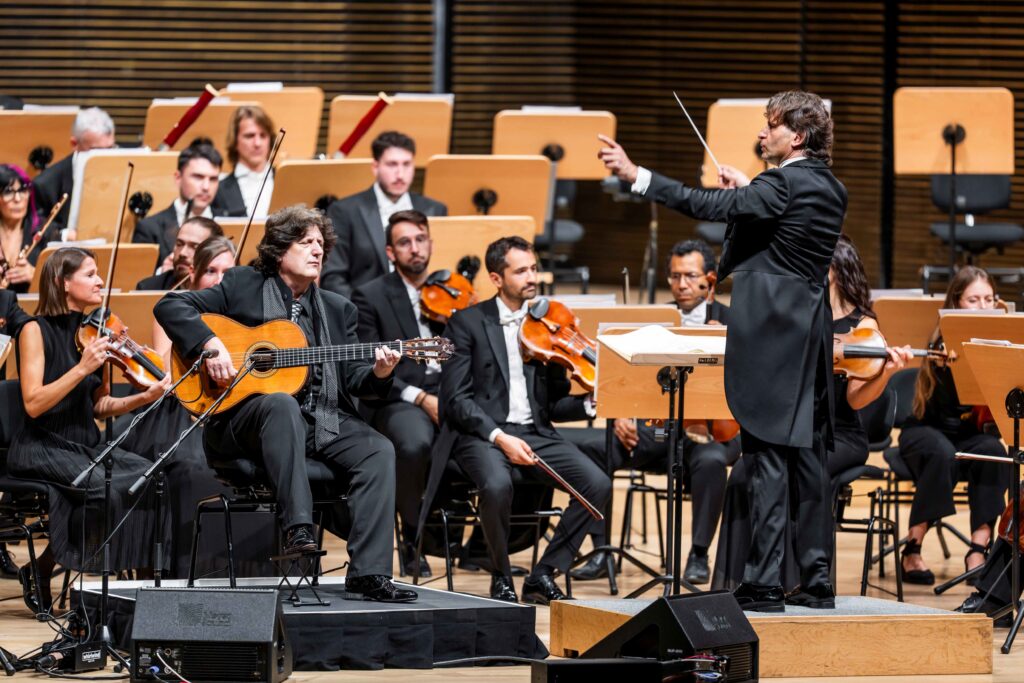
Next on the program was Rodrigo’s famed “Concerto de Aranjuez” performed by Juan Manuel Cañizares. The guitar was surprisingly performed with a mic, which made some sense given the pianissimo sound that Cañizares produced. Cañizares opened the concerto’s “Allegro con spirito” with precise runs, his timbre light and agile. The orchestra under Gimeno accompanied with dynamic flexibility, always keeping the orchestra tempi steady and following the guitarist impressively. The second movement, the famed “Adagio,” opened with a haunting oboe solo that was played with a dark timbre that evoked grief and loss. Cañizares’ followed with a light tone that slowly built with each bar. Cañizares and the oboist also accompanied each other to perfection, each playing the central melody off each other. The movement slowly built with the strings eventually crescendoing to a forte sound in the climactic moment of the piece all while keeping the guitar central to the piece and Cañizares’ passionate playing coming to the fore. The third movement “Allegro gentile” was playful and Cañizares took each solo moment to showcase his flexible runs and shifts, moving around the guitar with ease and extraordinary technique. He received a thunderous applause that led immediately to him performing an encore, “Cádiz” from “Concierto Al-Ándalus” by Cañizares himself. The piece was the definition of fire as Cañizares relished the flamenco and Spanish rhythms and gave us a full guitar sound.
Legend
The final part of the concert was Rimsky-Korsakov’s famed “Scheherazade.” The piece opens with a violin solo that embodies the storyteller. In a way this piece is a showcase for the concertmaster as it requires a mastery of interpretation and on this even Gergana Gergova brought that mastery with a gorgeous timbre, immaculate double stops, and precise runs. More importantly, her interpretation was filled with nostalgia, joy, and passion.
Maestro Gimeno was also precise with his tempi, uniting the first and second movement and the third and fourth without any pause. The first movement, “The Sea and Sinbad’s Ship,” evoked the waves of the sea with the swelling rhythms, the cello’s music slowly building with the violins leading the melody. The second movement, “The Legend of the Kalender Prince,” showcased an inspired wind section, while Gimeno’s third movement “The Young Prince and the Young Princess” was soothing in its tempo, never slowing down, but always allowing the music to breath. The final movement, “Festival at Baghdad,” was played with frenetic energy and slowly built to the climax that eventually recapitulated into the first movement. On this recap, the orchestra was in fortissimo mode, capturing the turbulent final sail of our main character. But it eventually died down to create an ethereal color that slowly descrescendoed to a piano, allowing the solo violin’s music to die down in the hall. In all, Gimeno drew out so many colors in the piece, producing a surprising listen and adventure.
At the end of the concert, the orchestra encored with the “Preludio” from the zarzuela “El bateo” by Federico Chueca. The joyful piece emphasized the Spanish dance and the fiery spirit of the Teatro Real’s orchestra.
In all this was yet another successful evening by the Teatro Real. One however wishes that the company could bring a Spanish opera in a concert reading at some point during one of these tours. It would be a better discovery, especially given the pieces performed on this evening are too frequently heard in the States.