Carnegie Hall 2026-27 Review: Greek National Opera – ‘Nikos Kazantzakis: An Odyssey in Music’
By David Salazar(Photo Credit: G. Antonoglo)
Over the past few years, it has become increasingly common to see major international opera companies come to New York and make their formal debuts, bringing together local communities in a celebration of cultural exchange.
The Teatro Real has done it in recent seasons and the Hungarian State Opera took its turn several years prior.
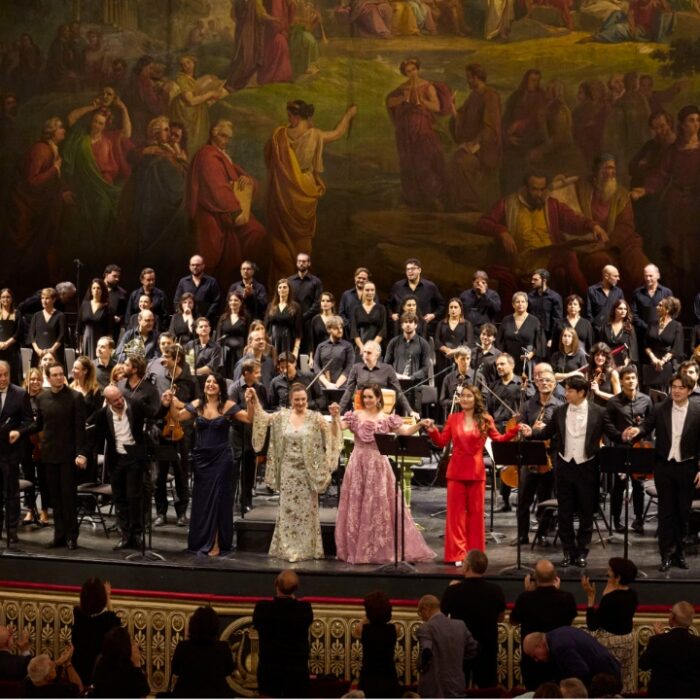
It’s interest that on the same night that the Teatro Real returned to New York, with a performance at David Geffen Hall, the Greek National Opera made its formal New York debut at Carnegie Hall.
The debut was several years in the making with plans already in place as far back as 2019. But the global pandemic forced institutions worldwide to pivot in different directions and years flew by before the Greek National Opera got another opportunity at a Carnegie Hall debut. Moreover, the programming shifted as well, centering Greek composers and legendary author Nikos Kazantzakis.
Kazantzakis (1883-1957) is considered one of the most prominent Greek authors of all time with such works as Zorba the Greek, Captain Michalis, and The Last Temptation of the Christ transcending Greek culture and becoming recognized internationally. Moreover, his work inspired generations of Greek composers and it is this influence that was at the core of the concert on Oct. 15, 2026.
The Orchestra of the Greek National Opera, led by Vassilis Christopoulos, was the forefront of the program’s opening half. The audience was immediately thrown into the “Cretan Feast” by Dimitri Mirtropoulos (the legendary conductor) with an orchestral arrangement by Nikos Skalkottas. This piece, in a more traditional sonata form, was a statement of intent, showing off the orchestra’s muscularity but also its cohesion and unity.
But more importantly, this piece established a strong connective thread throughout the first half. Following the “Cretan Feast” was a dance by Skalkotta (Series I, No. 2 Cretikos) that was similarly potent in its character and execution. From there came the more rambunctious Series I, No. 5 Cretikos “I Enjoy No Other Dance” with its wild contrasts and more improvisatory nature. It shifted from a more euphoric nature to something more relaxed and back again with instrumental solos layered throughout. This dance was a perfect setup for the more relaxed and even pastoral Series II, No. 3 Cretikos “Early at Dawn I Will Rise.”
And the narrative arc was just reaching its apotheosis. With the mood more relaxed in nature, the ensemble concluded the first half with Giorgos Koumendakis’ “Amor Fati.” Despite its busy and dissonant wind writing throughout (which often covered the violin solo in a display of rare sonic imbalance from the ensemble) this piece was meditative in nature, soothing even. You could in a way feel the Mediterranean Sea with its incessant ebbs and flows, the episodic eruptions like crashing waves. The piece’s repetition, its seeming looseness of structure only added to this feeling and association. It did feel a bit long by the end, but the overall cumulative effect was not wondrous.
Intermission was where the vocalists arrived.
G.-Antonoglo
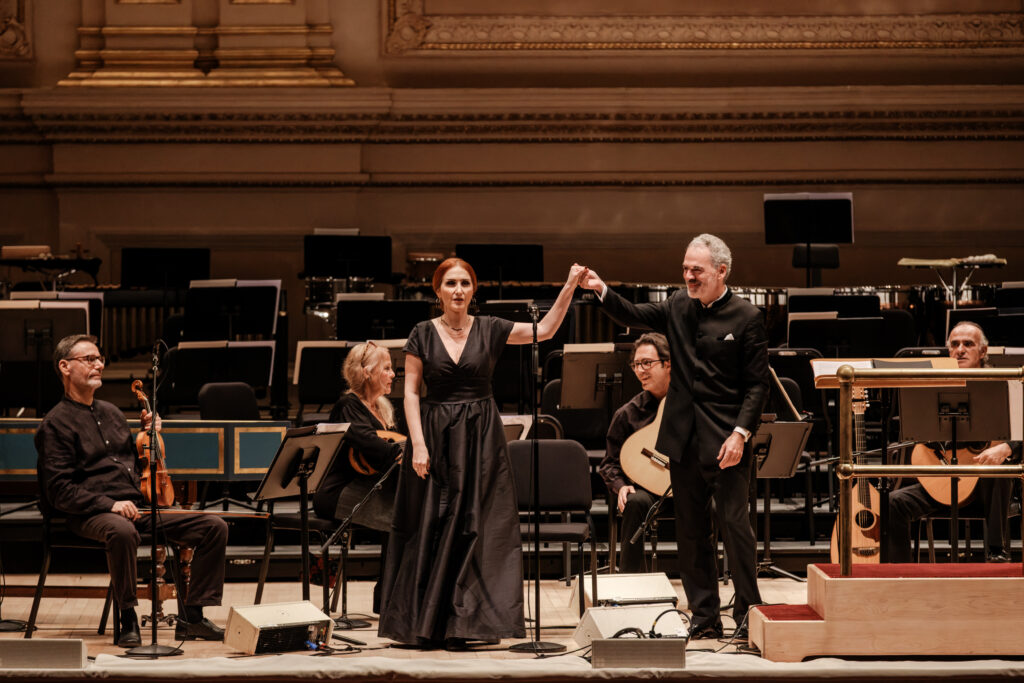
First up was Manos Hadjidakis’ “Captain Michalis,” a suite for small ensemble and vocalist that explores episodes from the famed novel.
(As a side note, the program regrettably did not include much context or the text for the movements of this piece or the final one in the program; fortunately the PR team for the Greek National Opera subsequently provided that information in time for this writing. The fact it slipped the organizers in the first place is unfortunate and certainly detracted from being able to properly contextualize the overall performance for the purposes of this writing.)
Taking the stage was Manos Hadjidakis’ Ensemble alongside soprano Maria Kostraki. Everyone on stage was mic’d for this showcase. Otherworldly is the best way to describe this music. It features harpsichord alongside violin, cello, bass, and several guitars from across different time periods and cultures. And the interplay of all of these combinations of instruments is endlessly creative as the piece develops. At one point guitars and harpsichord played off one another in a reprise that repeated four times. At another the lights dimmed in the hall with only a spotlight focusing two guitarists as engaged in a gentle dialogue. In a latter piece, violin and cello took the lead to a lush and gorgeous effect. Even the double bass was given subtle prominence at other junctures.
At the center of it was the voice and Kostraki delivered a gorgeous impassioned reading. Her first appearance, in the second number, “Where is God” was a soaring melody. The style of the piece called for not only more gentle delivery, hence the mic, but the placement throughout the piece was surprisingly low for a soprano. And yet, Kostraki sculpted every phrase with elegance and assuredness. In some of her numbers, “The Evening The Night is Heavy,” were far more rhythmic in nature, and her articulation was pristine. In a more dramatic piece later on, she expressed yearning and desperation through more accented phrasing.
The audience went wild for this segment.
Then came the low point of the performance as the technical team did its utmost to take apart the ensemble and remove the harpsichord to then remount the entire orchestra. It cut the momentum of the performance tremendously and left one wondering if there was not a more optimal way to have managed this transition. On one hand, it may have been a more natural fit to put the Hadjidakis at the end of the first half and leave the actual intermission for replacing the set, likely having to move “Amor Fati” to the second half. However, that would have wrecked the emotional cohesion of that first half.
Nonetheless, the program would come to an end with selections from “Zorbas” by Mikis Theodorakis. The opening number is a military march, the orchestra pounding into the space with great vigor. The second number maintained a similar quality before giving way to the third movement where mezzo-soprano Anita Rachvelishvili made her appearance on a New York stage for the first time since her much publicized vocal challenges. As with Kostraki’s challenge in the Hadjidakis, the music calls for a more gentle vocal approach. But the difference here is the massive orchestra and the lack of a microphone. For her first number “Odysseas Elytis,” Rachvelishvili was gentle in her phrasing, the line residing in her lower voice. Her legato was solid throughout and Christopoulos was attentive to giving her space. They worked together even better in the ensuing “With the Morning Star,” which called for even more extremes of piano singing, Rachvelishvili bringing her voice down to a whisper at times. The singing pulled you in. But the big number came at the close. “Make Your Bed for Two” is a raucous dance. Here the mezzo allowed her voice to blossom into the space, a smile across her face throughout. Once her vocal section came to a close, she was charged with signaling to the audience to clap along with the dance, a duty that it duly attended to. This happened several times throughout this prolonged finale to the point that at several junctures you could see the very same ushers walk down the aisle to tell people to put away their cell phones. On one return trip, I caught the usher with a smile on her face at the disbelief of having to talk to the same cellphone culprit.
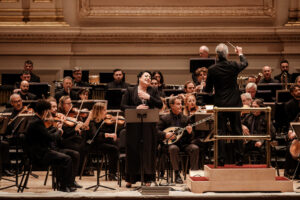
Christopoulos proved a brilliant master of ceremonies, the conductor standing firm and confident atop the podium. While many conductors gesture about to make sure their presence is felt, the Greek maestro proved more minimalist in his approach, allowing the musicians themselves to take more of a centerstage. At times, he put down his arms to let the musicians lead the way, the ultimate sign of trust. And the ensemble responded in kind with overall cohesion. There were a few moments where balance was questionable (the solo violin in “Amor Fati” likely has more to do with the composition itself because the violin solo was clearly heard in the many other such moments scattered across the other pieces).
At the end of the day, the performance, while a bit long and its pacing brought into question by the lengthy stage change (not to mention the slim program notes and lack of text for the vocal movements), proved a wonderful immersion in Greek culture and music.