Teatro alla Scala 2025-2026 Review: La Traviata (Cast A)
By Bernardo GaitanOn the evening of April 21, 1990, the curtain rose at Teatro alla Scala for what could have been yet another “La Traviata” in Italy, an event destined to go largely unnoticed. Instead, it was the then-new production by Liliana Cavani. More than 35 years have passed since that evening, and this now-historic production continues to sell out within the first few minutes after tickets go on sale, regardless of the number of performances scheduled each season.
In fact, it is a well-established formula: a title that fills the house on its own thanks to its status as a Verdi masterpiece, a dream production and, normally, at least at La Scala, an international first-rate cast. The result could hardly be otherwise.
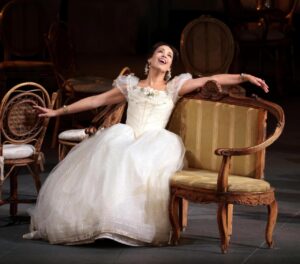
As musicologist and presenter Fabio Sartorelli puts it: “As soon as the curtain rises on Cavani’s production, you see a party… but what a party! Nothing is spared; it is a real party, like the ones they used to have in the mid-1800s.” And this naturally anticipates not only a traditional production, but one of the highest quality. This is why, in a couple of days, the production will reach its 100th performance at the theatre and, with it, the 300th performance of “La Traviata” in the history of La Scala will be celebrated.
At the age of 93, Liliana Cavani still attends every revival of her production to give the singers acting details, while for this revival Marina Bianchi has overseen a version more focused on the technical aspects. Dante Ferretti’s sets are majestic, with sumptuous and meticulously detailed spaces portraying a Paris that is elegant and, at the same time, already decadent. Its luxurious, opulent interiors add a powerful visual and theatrical dimension to the production. Gabriella Pescucci, meanwhile, created costumes of exceptional elegance and sophistication, with opulent dresses, crinolines and luxurious fabrics. Her work helps define both the period and the social status of the characters. Andrea Giretti’s lighting design uses warm, suggestive light to enhance the sets and pastel colors, creating a soft atmosphere.
In the pit, Michele Gamba’s conducting stood out for its great sensitivity and close attention to the relationship between the music and what happened on stage. The Teatro alla Scala Orchestra responded with precision and quality, with the strings and winds standing out in particular. Gamba’s tempi and dynamics were carefully shaped to maintain the theatrical tension and accompany the different moments of the work: from the energy and lightness of the Act one party to the melancholy of the end of the Act two duet; the striking contrast in “Pura siccome un angelo” and “Dite alla giovine” and, above all, the dramatic intensity of “Addio del passato,” whose introduction, as Violetta reads the letter, sends shivers down the spine. The Milanese conductor adjusted the pace, making it considerably slower and creating an extremely powerful dramatic tension. He also introduced dramatic pauses that heightened the impact and character of the music in each situation. His conducting was characterized by continuity, always maintaining the thread of the performance while paying close attention to his singers.