Andria 2026 Review: Farinelli – The Voice That Remains
Bafunno & Balducci Combine To Create A Complex Portrait Of Farinelli
By Alan Neilson(Photo: Luca del Pia)
Arguably the most famous opera singer of the 18th century and one of the most famous singers in the history of opera was the castrato soprano Carlo Maria Michelangelo Nicola Broschi, more commonly known as Farinelli. Showered with honors, jewels, and other riches during his lifetime, he was fated by the rich and powerful across Europe, appearing on the stages of the continent’s greatest opera houses and in the courts of dukes, princes, kings, and emperors. He was, in effect, an 18th-century superstar. His life was one of glamor and glitz, spectacle and fame, money and influence. It is a story fit for the stage and indeed has been the subject of a number of operas and plays, although none have appeared to have stood the test of time.
He was born in the small city of Andria in the province of Puglia, situated on Italy’s Adriatic coast, which each year is host to an annual arts festival, the Festival Internazionale Castel dei Mondi di Andria, which this year included two performances of a new work entitled “Farinelli: The Voice That Remains,” written and directed by MariaLuisa Bafunno, who herself also happens to be a native of the city, and performed by a major star of baroque opera, the male soprano Nicolò Balducci, who also happened to be from a nearby village.
Bafunno’s Powerful Text Captures the Suffering Behind Farinelli’s Art
Although the work defies a neat definition, it certainly fits into the overall category of music theater, with Balducci singing arias associated with the great singer, separated by passages of spoken text penned by Bafunno. Certainly, it is more than a simple recital. The text is not a filler, aimed at providing a background for the music; far from it! Rather, it is an integral part of the performance, used to reveal what lies behind the excitement, the success, the splendor and the stage persona of the man with a voice that still holds a place in our imaginations.
If the audience is encouraged to marvel at the musical brilliance of Balducci and therefore Farinelli, Bafunno’s text drags them into a darker world, one characterized by a profound sadness and emptiness resulting from a life without meaning and purpose outside of his art. Farinelli’s artistic greatness, his voice and his fame are a product of a horrific act of brutality carried out on him as a child, which meant that he was never to have a child or raise a family of his own and was always seen as an outsider, different from other men. Bafunno, however, never mentions the word castration; there is no need; everyone in the audience already understood. It was as if by speaking the word, the spell would be broken, and the ugly reality would have to be confronted. After all, the voice was all that mattered!
Bafunno, however, had no intention of allowing the audience to escape so easily. The word itself may not have been uttered, but she did not stint in conveying the desolation and pain that Farinelli had to bear as a result of his parents’ callous decision, made when he was too young to understand its consequences. Through a number of short, powerful anecdotes that could not but move even the hardest of hearts, she brought the depth of his suffering brilliantly alive. There is the Neapolitan flower girl he met every morning on his way to Maestro Porpora’s. He was 17 at the time. When she lovingly took him by the hand, he pulled it back, lamenting privately, “Other men go on, and I… I stop… I knew I had to stop, I already knew.” She didn’t understand why. In an angry outburst, he confronts his mother, asking her, “Do you know what it means… when a married woman smiles at you in front of her husband, and the husband smiles too?”
The performance took place in the Palazzo Ducale in the center of the city, a place Farinelli knew well. As the audience queued up outside the main gate, they were given candles and greeted by the hapsichordist, posing as one of Farinelli’s servants, who gave a brief poetical introduction, informing us that the candles should be kept lit, as “he sings only by candlelight. He says still light gets things wrong, while a flame breathes, just like he does.” He also asked the audience to applaud him whenever they wished, as he is used to it, but “do not use your mobile phones… as they would distract him,” and with that we entered the building.
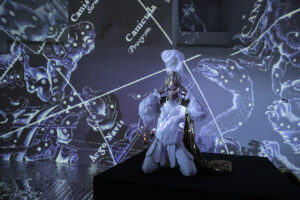
The performance space was an oblong room, seating around 150 people in three rows, with the musicians, comprising a cello, violin, and harpsichord, seated at one end. A large space, running the entire length of the room about three meters deep, with a number of small podiums, among which were scattered chandeliers upon the floor, was reserved for Farinelli. On to the walls to the side and behind were projected various video mapping images, designed by Luca Attilli, which immersed the audience in a myriad of shifting shapes and colors and videos of the young Farinelli. It provided a brilliant backdrop for the performance. Farinelli arrived from the back of the room dressed in a traditional baroque costume, designed by Donato Didonna. Attired entirely in a white military-style uniform that hinted at the classical world with a helmet adorned with a flamboyant feather, the costume absorded and reflected Gianni Bertoli’s colorful lighting designs to create spectacular stage pictures with a quasi-baroque aesthetic. It was a cleverly designed staging; it might not have been the actual Farinelli who walked out onto the stage, and the use of video mapping was very 21st century, but it generated the atmosphere of a lavish spectacle that allowed Balducci to successfully wear the mantle of the great singer.
Balducci’s Stunning Presentation Wows the Audience
Ultimately, the success of “Farinelli: The Voice That Remains” relied heavily on Balducci. It was down to him to provide a singing performance that not only had to be high quality but also had to supply the spectacular vocal effects that would allow the audience to believe that it was Farinelli himself who stood before them. A solid, well-sung performance would not suffice. It had to be something very special. And Balducci delivered!
The opening two arias, “Qual guerriero in campo armato” and “Son qual nave,” written by Farinelli’s brother, the composer Riccardo Broschi, were chosen as vehicles to illustrate his vocal brilliance and impressive technique. Balducci pulled out all the stops with two flamboyant performances, incorporating impressive vocal coloratura displays, audacious leaps, fabulous passages of complex ornamentations, and delightful trills, which he delivered with confidence as he pushed the voice to its limits while bounding around the stage from podium to podium. It was a breathtaking display, yet it was never at the expense of the text.
Having thus established Farinelli’s vocal brilliance, which he set alongside his spoken reminiscences of his childhood in Andria and of descriptions of his life as Europe’s most famous singer, Balducci changed the mood with a broken rendition of Hasse’s aria “Pallido il sole,” taken from his opera “Artaserse” (1730), in which he coated his voice with anger and bitterness to reveal the deep sadness that lay behind the spectacle as he broke down and wept. He then expanded upon these feelings with unsettling interpretations of Giacomelli’s aria “Sposa non mi conosci” from his opera La Merope” (1734) and Egidio Duni’s aria, “Prudente mi chiedi,” from his opera “Demofoonte” (1738). In both cases, Balducci captured the heartrendering intensity of Farinelli’s distress and anger. In the following spoken monologue, he even turned upon his mother and questioned her role and motivations in his mutilation. Not a sound could be heard from the audience, which had been completely entranced by Balducci’s magical interpretation. His identification with the great singer was total. Farinelli’s pain became his pain!
The penultimate aria, “Alto Giove,” taken from Nicolo Antonio Porpora’s opera “Polifemo” (1735), was a further reflection on the gift that had been bestowed upon him, but that had brought him so much pain. Balducci once again brilliantly conveyed the intensity of the great castrato’s deep suffering, as he once again infused his voice with deep suffering. Bafunno’s imaginative staging of the scene, in which she had Balducci lay out his warrior’s costume on a podium so that it appeared as a desiccated corpse, reinforced the image of the hollowed-out shell that was Farinelli. It was a beautifully crafted piece of theater, one that Balducci turned into a delicate meditation on Farinelli’s life. Pointedly, he expressed his hope that future audiences would one day carry candles in memory of him.
The musicians, Il Baskerville on harpsichord, Ninni Visaggi on violin, and and Federico Del Gaudio on cello, produced a well-co-ordinated, energetic performance with a sound that filled the space. Even more impressive, however, was the dramatic depth and textural variety that they were able to achieve.
The concert was brought to a conclusion with a splendid reading of Händel’s famous aria “Lascia chi’io pianga,” and it proved to be a perfect choice. It allowed Balducci to show off the delicacy of his phrasing along with his artistic sensitivities while bringing to the fore the beauty and the pain that defined the life of the great castrato Farinelli, a boy named Carlo Broschi who grew up to charm Europe with his beautiful voice but destined never to experience the fullness of life
“Farinelli: The Voice That Remains” is a brilliant piece of theater, and although it was not presented as such, it had everything one could expect of an opera, albeit a pastiche with a substantial amount of dialogue. It is certainly a work deserving of further productions and is particularly suited to smaller venues, although with the proviso that it requires a singer of Balducci’s quality in the role of Farinelli if the drama and music are to be brought fully alive.
The show lasted approximately 75 minutes.