Teatro Grande di Brescia 2026-27 Review: Death in Venice
By Bernardo Gaitan(Photo: ©Teatro Grande di Brescia – Umberto Favretto)
Homosexuality, unfortunately, remains a taboo subject. It is less noticeable in large cities, but in small towns it is still very much in evidence. The love affair between composer Benjamin Britten and tenor Peter Pears, on the other hand, was no secret. They treated their relationship with such naturalness that Britten practically reserved his finest musical ideas for the tenor voice, naturally thinking of his life partner as the one who would perform them.
It was equally revolutionary and controversial that Britten incorporated sexual themes into some of his works. One need only think of the coded or subtly suggested incest in “Peter Grimes,” the extraordinary admiration for the beauty of the young sailor “Billy Budd” in the opera of the same name, and, needless to say, the explicit rape scene in “The Rape of Lucretia.”
Yet in “Death in Venice,” premiered in 1973, there are no scenes of violence or sex, and, curiously, it makes audiences more uncomfortable because of its subject matter: the homosexual attraction of a mature intellectual toward a pure and virginal adolescent.
Illuminating Production
Based on Thomas Mann’s novel: Der Tod in Venedig (Death in Venice), the opera tells the introspective story of Gustav von Aschenbach, a writer who travels to Venice, where he undergoes a profound transformation in his relationship with beauty, desire, and artistic creation itself. The masculinity of the protagonists or the youth of the ephebe Tadzio is beside the point; what matters is the psychological struggle of an artist at the end of his life. Among the drafts of the work, Britten even considered having Aschenbach consummate his relationship physically with Tadzio, an idea he ultimately abandoned, undoubtedly increasing the dramatic tension.
It is equally evident how much Britten saw of himself in Aschenbach, since this was the last opera he composed. In this kind of artistic testament, Britten found an unmistakable parallel between his own personal circumstances, marked by increasingly fragile health, and Aschenbach’s fate. Even more personal was the fact that the role was written for tenor Peter Pears and specifically for his deteriorating voice. It is important to stress that, until 1967, British law regarded Britten as a criminal, since homosexuality was a crime; therefore, it would be somewhat naïve to pretend that this fact had no impact on his work. Britten’s commitment to this opera was such that he postponed an essential heart operation until he had completed the score in March 1973. Complications from the procedure and his lengthy recovery prevented him from attending the premiere.
A standing ovation is due to whoever decided to open the Teatro Grande di Brescia’s 2026–27 Opera and Ballet season with “Death in Venice,” which reaches the Brescia stage for the first time in a production co-produced by the OperaLombardia association and some theaters in Emilia-Romagna. An even louder ovation is due to whoever assembled the creative team and chose the cast, which was literally perfect.
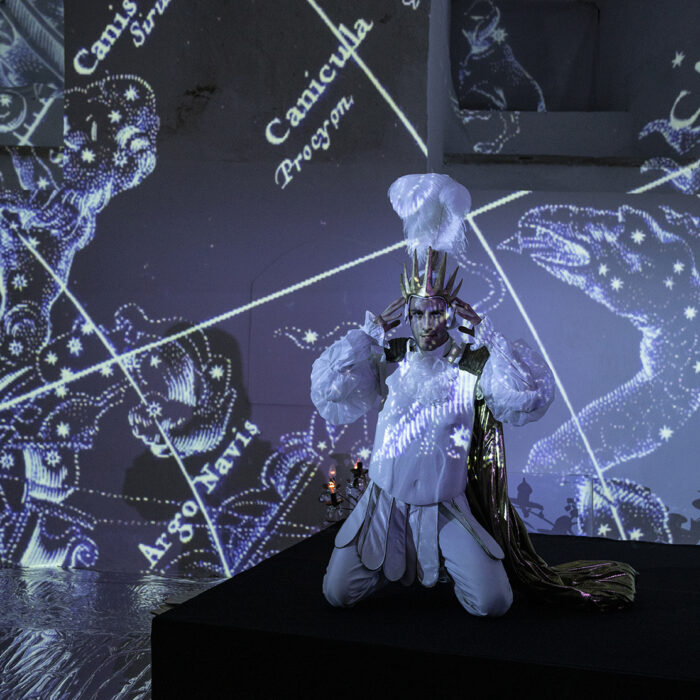
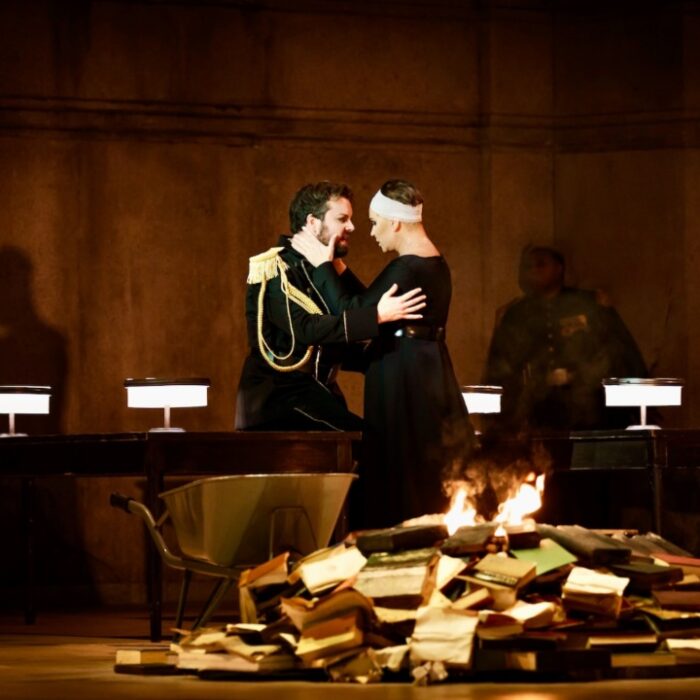
The production signed by Rodula Gaitanou is extraordinary. Working with a modest budget, she manages to demonstrate that budget is irrelevant when every available resource is used effectively and, above all, when art, interpretation, and the performers’ talent are given priority. The Greek stage director entrusted Takis with the set and costume design. The visual concept is as simple as it is brilliant: a dark and gloomy stage, exactly like Mann’s Venice. A handful of elements: a chair, clocks, a barber’s chair, an office desk, or a few gondola oars; reinforce the visual impact and place the action precisely where it needs to be. Every element is visually striking and meaningful, not least the costumes, inspired by the way people dressed at the beginning of the last century. Particularly effective are the gentlemen’s and Aschenbach’s suits, as well as the boys’ bathing suits on the beach.
As is customary in contemporary stage productions, video projections were used, and the images designed by Dick Straker were particularly striking. Special mention must be made of Fiammetta Baldiserri’s highly intelligent lighting design, which focused attention on Tadzio through discreet lighting that set him apart from the other young people surrounding him, just as Aschenbach sees him: singled out from the rest. The sense of teamwork is evident throughout. For example, the production team created the visual impression of Venice’s canals with white smoke across the floor which, aided by the lighting, produced a chiaroscuro effect, while the projections behind it made the canals appear to move. It is a brilliant example of collaborative stagecraft, producing a masterful result. It is clear that Gaitanou worked extensively on the singers’ acting, since every movement and every glance was fully justified and revealed something essential to the drama.
Musical Highlights
From the podium, the expert baton of Daniel Smith stood out, demonstrating an exceptional knowledge of the score. His reading was clear and precise, expository, melancholic, and analytical in character. Incredibly familiar with Britten’s musical language, his conducting was clear, objective, and rigorous, with particular attention to nuances and tempi. The Australian conductor’s performance came close to perfection, made possible by the outstanding contribution of the I Pomeriggi Musicali Orchestra, whose musicians, focused and attentive to Smith’s requirements, offered a decisive, dynamic, and moving account. Particular mention should go to the percussion section, which helped create the gloomy Venetian atmosphere. The OperaLombardia Chorus, prepared by Diego Maccagnola, performed with the utmost discipline.
The demanding role of Aschenbach—since the opera is almost a monologue with interactions involving the other characters—was masterfully performed by Toby Spence. His voice, perfectly projected, was supple, pleasing to the ear, and possessed a color ideally suited to the role. The British tenor had complete command of Britten’s style and displayed impeccable pronunciation and articulation. His interpretation was perfectly calibrated and full of nuance; he was poised and energetic, an ideal interpreter for the protagonist. He created an elegant and humane Aschenbach, outstanding both vocally and dramatically.
Equally convincing was Dominic Sedgwick in the complex and demanding task of taking on the seven roles assigned to him, from the gondolier to the barber, as well as the hotel manager and the Voice of Dionysus. His resonant, appealing, velvety voice was matched by the British baritone’s impressive stage presence, as well as by the incisiveness of his singing and his ability to differentiate all seven characters, each one distinct from the others. The physical characterization further reinforced their individuality, making them truly unmistakable.
Although his emission was somewhat unsettled and at times slightly flat, countertenor Danilo Pastore gave a satisfactory performance as the Voice of Apollo. Endowed with a generously powerful instrument, his incisive, clear voice was complemented by a beautiful golden-toned characterization, as though he were a sculpture made of gold.
Although he does not sing, the role of Tadzio is crucial and is always entrusted to a young dancer. Filippo Polli’s work as the young Pole was commendable, and together with the other dancers he gave an outstanding dance performance. The other dancers’ movements, always elegant and innocent, found in Mattia Agatiello’s choreography an elegance that captures Tadzio’s elusive beauty as seen through Aschenbach’s eyes.
More Cast Details
The numerous performers entrusted with the smaller roles also deserve mention. Far from being merely functional, their presence contributes to shaping the production’s complex human mosaic. Xin Zhang as the Hotel Porter, and Eugenio Maria Degiacomi in the roles of the Guide and English Clerk, handled their interventions with assurance and naturalness. Serena Pulpito as the Strawberry Seller and Danish Lady, brought freshness, while Dario Battaglia performed confidently in his three roles: Lido Boatman, Polish Father, and Restaurant Waiter. Chiara La Porta as Lace Seller and Russian Mother, and Ilaria Molinari as Russian Nanny and Beggar Woman, offered precise and expressive characterizations. Fabio Sabadini in the roles of Glass Maker and Strolling Player Boy, and Federica Cassetti as French Girl and Strolling Player Girl, likewise demonstrated ease on stage. Chiara Torosani as Newspaper Seller and French Mother, stood out for the clarity of her interventions, while Marcello Zinzani as Russian Father and Gondolier 2, and Renato Cadel as Priest in St. Mark’s and German Father, brought presence and consistency to the stage ensemble. Marco Tomasoni in the roles of Ship’s Steward and Hotel Waiter, performed effectively, as did Davide Cucchetti and Jacopo Grenti in their respective roles as American 2/Gondolier 1 and American 1/Gondolier 3. Completing the cast were Letizia Egaddi as English Lady and Isabella Di Pietro as German Mother.
At the end of the performance, a great ovation greeted all the performers, naturally warmer for Spence and Sedgwick, as well as for Smith and his orchestra. Without a doubt, this is OperaLombardia’s finest production, at least of the past five years. There is nothing left but to wish it great success and a warm reception at the upcoming performances, which will continue in Como, Pavia and Cremona.