Staatsoper Berlin 2026–27 Review: La Vestale
Lydia Steier Turns Spontini’s Roman Drama Into a Chilling Study of Totalitarian Power
By Zenaida des Aubris(Photo: Stephan Rabold)
Gaspare Spontini’s “La Vestale” occupies a curious position in operatic history: once enormously successful and today rarely performed. Premiered at the Paris Opéra in 1807, to a French libretto by Étienne de Jouy, the three-act tragédie lyrique became Spontini’s international breakthrough. Dedicated to Empress Joséphine, it emerged directly from Napoleonic France, and its combination of monumental choral writing, orchestral color, ceremonial spectacle and private passion points forward toward Berlioz, Wagner and French grand opera.
That history matters considerably in Lydia Steier’s production, which opened the Staatsoper Unter den Linden’s 2026–27 season on September 26. Rather than reconstruct its original setting in ancient Rome, Steier places the action in an ominously recognizable totalitarian state in which religion, military power and political ambition have become virtually indistinguishable.
The story itself is simple. The Roman general Licinius returns victorious from war only to discover that his beloved, Julia, has been forced by her family to become a Vestal Virgin, bound by a vow of chastity and charged with tending Vesta’s sacred flame. The lovers meet secretly in the temple; the flame goes out and Julia, refusing to identify Licinius, is condemned to be buried alive. At the moment of execution, lightning miraculously reignites the sacred fire. The gods have apparently spoken: Julia is pardoned and allowed to be reunited with Licinius.
Steier has little interest in that comforting conclusion.
(Photo: Stephan Rabold)
The Architecture of Power
Indeed, the production’s argument is already present during the overture. While Spontini’s music surges with public grandeur, we see Licinius returning from battle not as an uncomplicated conquering hero but as a man hollowed out by victory. He has conquered for the state and lost what mattered to him personally. The opposition between public triumph and private devastation becomes one of the evening’s central tensions.
Over everything hangs the repeated Latin maxim Talis est ordo deorum: “Such is the order of the gods.” It is less an article of faith than an instrument of control. Steier’s mortals invoke divine order while relentlessly pursuing their own interests. The gods become an alibi for the mortals’ power.
Etienne Pluss’ imposing set makes that power architectural. A vast institutional hall, maybe modeled on the amphitheater of the Sorbonne, mutates from assembly chamber to temple. Its monumental proportions carry unmistakable echoes of Fascist architecture: buildings conceived not to accommodate human beings but to make them aware of their own insignificance.
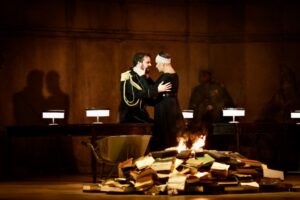
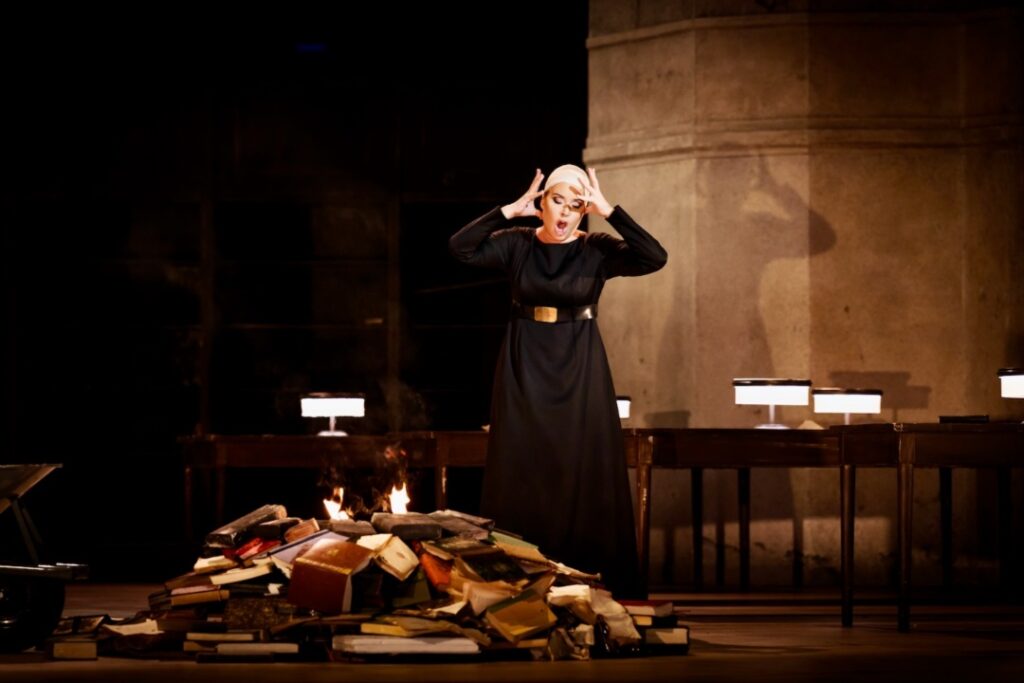
Most chillingly, the eternal flame is fed with books. Knowledge is eliminated, becoming fuel for the regime. This image has particular resonance in Berlin: the Nazi burning of over thirty thousand books on May 10, 1933, took place a few hundred yards away, immediately adjacent to the Staatsoper.
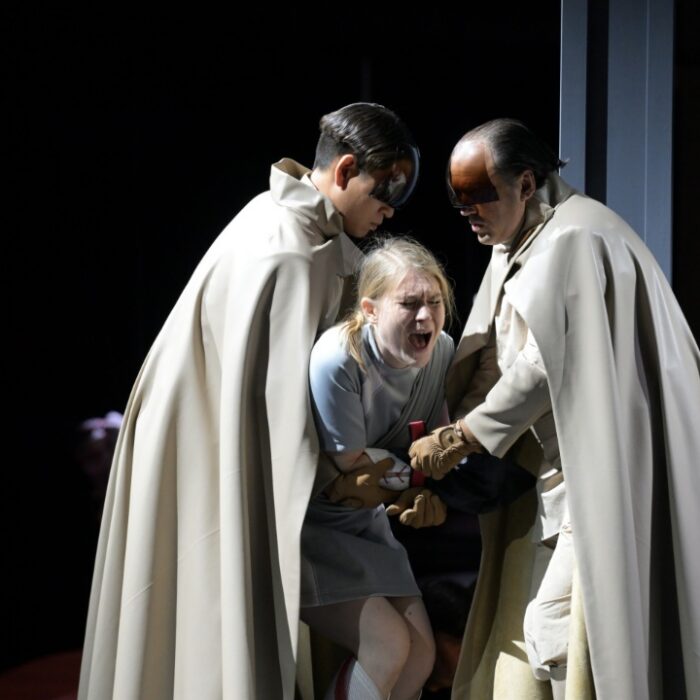
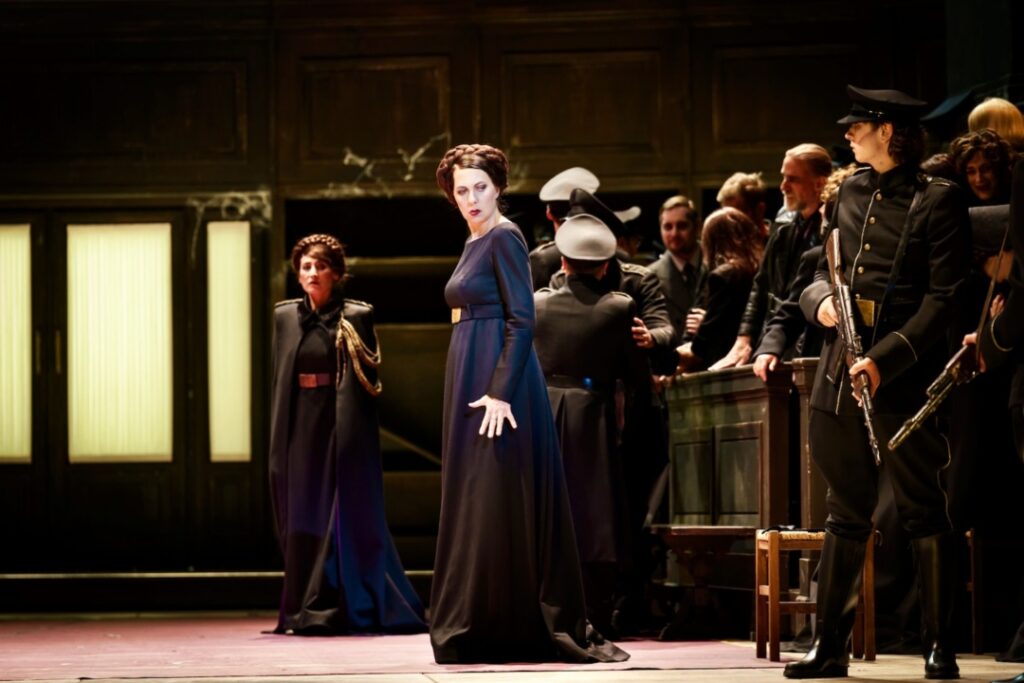
Katharina Schlipf’s costumes complete the picture. Dark uniforms, sweeping capes, gold braid and epaulettes recall authoritarian pageantry, while the Vestals—with their severe ritualized appearance and rigidly controlled female community—bring Margaret Atwood’s “The Handmaid’s Tale” insistently to mind. The women ostensibly guard the sacred order; in reality, they are among its most tightly controlled possessions.
(Photo: Stephan Rabold)
Human Passion vs. State Control
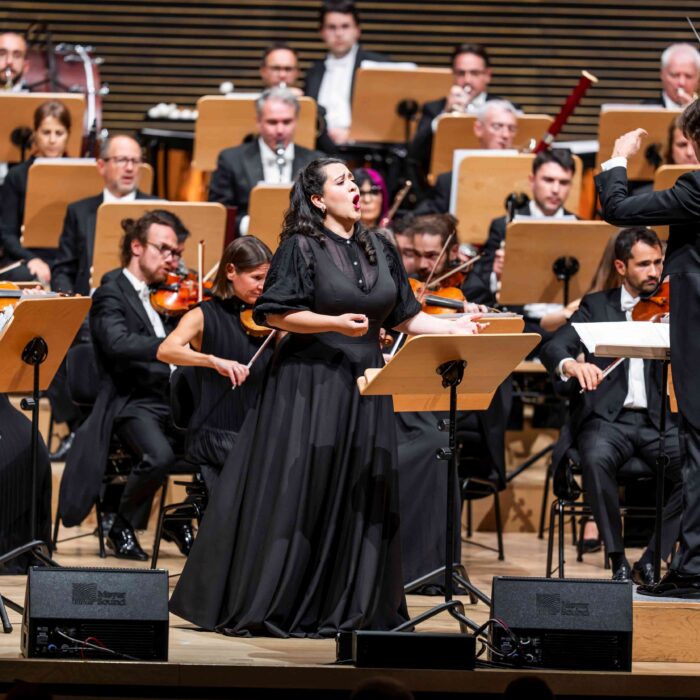
At the center stands Sonya Yoncheva as Julia. She embodied the character with genuine passion and the dramatic vocal weight the role demands. Julia’s conflict between religious obligation, fear and erotic longing can easily become an abstraction; Yoncheva made it personal. Her voice carried both the breadth required by Spontini’s grand ceremonial writing and the emotional urgency of a woman driven to choosing her own life.
David Butt Philip’s well-carried, full-bodied tenor gave Licinius considerable vocal presence, but this was no triumphant hero returning from battle. From his first appearance, he was a broken man, forced to confront—and ultimately succumb to—the seemingly immutable order of the gods. His singing captured that tension between the military hero the state expects him to be and the desperate lover he has become.
Marina Prudenskaya’s Grande Vestale was the system made flesh: severe, commanding and ruling her brood of temple keepers with an iron hand. Yet Steier allows no one permanent possession of power. Once she has served her purpose, the Grande Vestale herself is displaced by a younger and politically more useful Virgin.
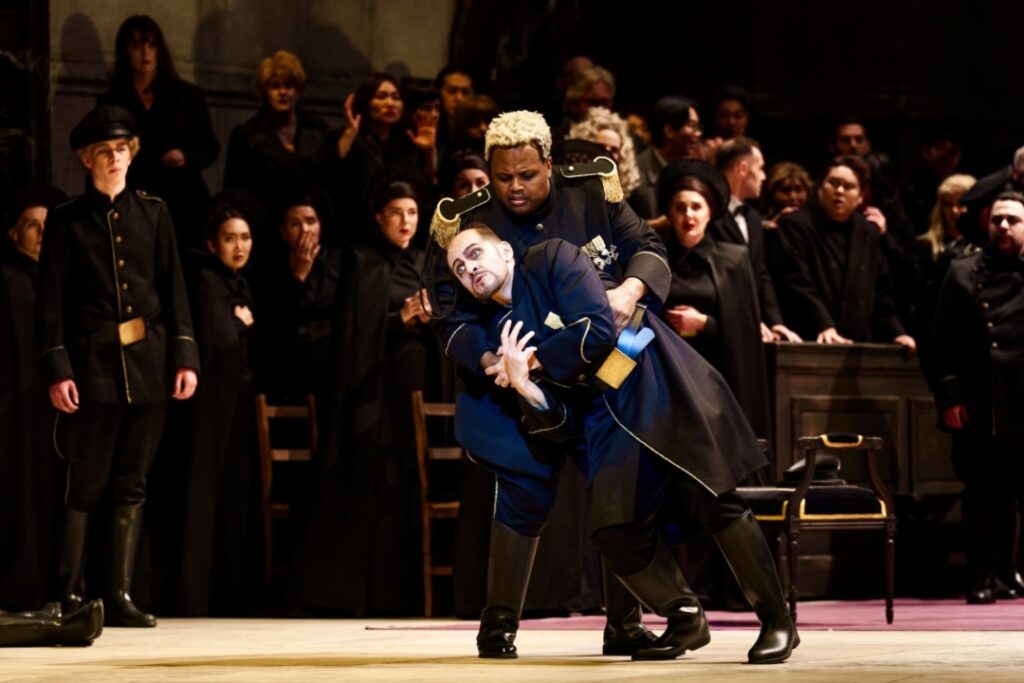
Siyabonga Maqungo brought to Cinna an exceptionally focused tenor, musical yet cutting in timbre. More importantly, Steier radically alters our perception of Licinius’ erstwhile friend. Cinna gradually emerges as the political opportunist of the evening, turning betrayal and upheaval to his own advantage.
The culmination is totally cynical. Cinna crowns himself supreme ruler, unmistakably invoking Napoleon’s self-coronation. The historical allusion is particularly pointed because the most important painter of the early 19th century, Jacques-Louis David, originally conceived “The Coronation of Napoleon” with Napoleon placing the crown upon his own head before changing the composition to the famous image of the Emperor crowning Joséphine. Spontini’s opera premiered barely three years after the actual coronation. The distance between ancient Rome, Napoleonic Paris and mid-20th century history suddenly collapses.
The Staatsopernchor, prepared by Dani Juris, once again demonstrated why it is one of the house’s most formidable musical and dramatic assets. The chorus did not merely sing with precision and weight; it functioned as crowd, congregation and political organism, showing how readily collective ritual can turn into collective intimidation.
(Photo: Stephan Rabold)
Rizzi Finds Spontini’s Italianità
Carlo Rizzi resisted any temptation to make Spontini sound like proto-Wagner. Instead, he emphasized the score’s italianità: its rhythmic propulsion, long vocal lines and instinct for theatrical momentum, even though the opera was written to a French text.
The ever-adaptable Staatskapelle Berlin responded with warmth and flexibility, allowing this transitional score—Classical in some of its architecture, already Romantic in its emotional temperature—to reveal its distinctive identity.
And then comes the supposed happy ending.
Julia and Licinius are reunited. The doors open. Light pours in. The couple walks through it. For a moment, “La Vestale” appears ready to fulfill the promise of its original dénouement: love has defeated fanaticism and the gods themselves have sanctioned human freedom.
Then machine-gun fire erupts.
Steier leaves us with a devastating qualification. Individuals may escape a regime; the mechanisms that created it remain. Cinna assumes supreme power. Talis est ordo deorum has ceased to describe divine order at all. It describes the order men construct—and then attribute to the gods when they need an excuse to preserve it.
Spontini provided a miracle. Steier answers with gunfire.