Metropolitan Opera 2026-27 Review: Così Fan Tutte
By Jennifer E. Pyron(Photo: Marty Sohl © Met Opera)
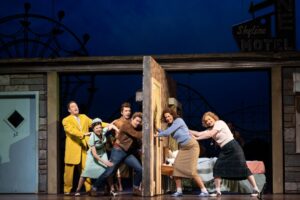
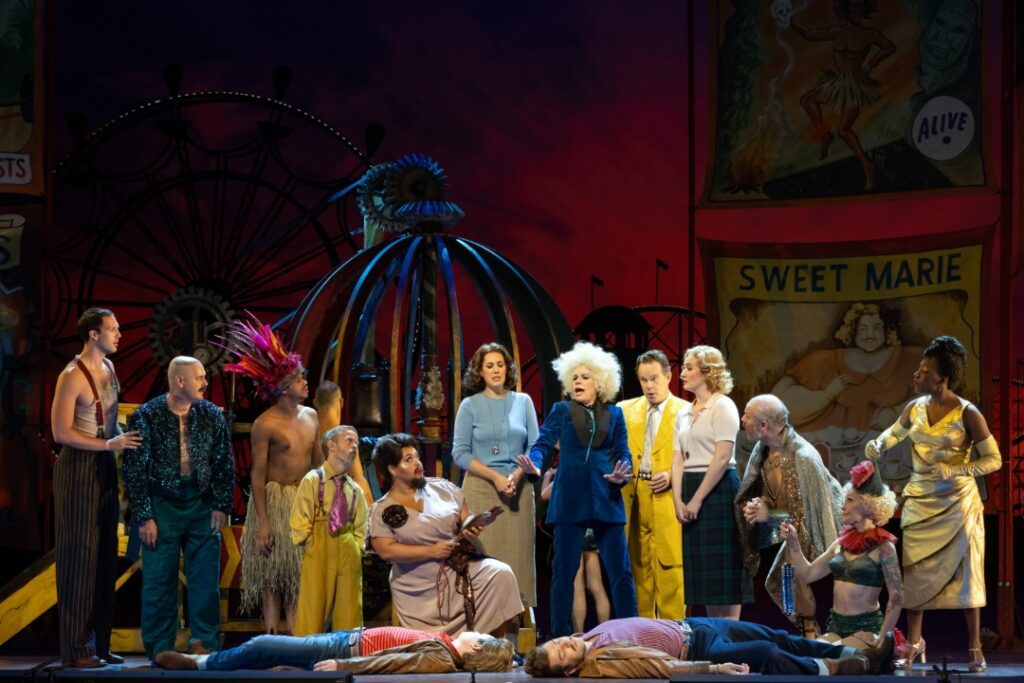
Phelim McDermott’s vibrant production of Mozart’s “Così fan tutte” gives a striking contemporary interpretation of love’s ups-and-downs over a series of balmy summer nights inspired by NYC’s famous Coney Island boardwalk in the 1950s for Metropolitan Opera’s 2026-27 season.
OperaWire first reviewed this production in 2020, detailing the libretto’s intertwining dramatic highlights and comedic exchanges. As a result, this season’s revival review will focus mainly on the documentation of musical and vocal performances lead by conductor Nimrod David Pfeffer.
(Photo: Marty Sohl © Met Opera)
The School for Lovers
“Così fan tutte” received pushback in the 19th and early 20th centuries, prompting Goethe to write about his personal distaste and Beethoven to compose his “Fidelio” in response. It is an overly simplistic two-act comic opera in which Da Ponte’s libretto documents a tit-for-tat unraveling of two young couples, while Mozart’s composition mirrors only the surface level, leaving nowhere for anyone insufficient in their performance to hide—its secret weapon.
The first eight bars of its Overture, followed by the opening trio (Ferrando/Guglielmo/Don Alfonso) and duet (Fiordiligi/Dorabella) determine the course of the night’s musical proficiency. Simply put, at whatever level of standard the opera begins, it surely will end.
Mozart’s music also has a way of getting stuck inside of one’s head. Its gestures are banal and yet this is what makes it unforgettable—whether one likes it or not. Can the same be said about pop music today? Maybe. Maybe not.
Realistically as an audience member one is under the impression that this opera is designed to entertain, and this it does to a certain degree. Behind the scenes as a performer this opera can make or break someone, especially if one misjudges their own musical proficiency or worse yet, their intention to perform as a collaborator. There is no one left behind in this opera either—everyone must be totally in, totally together and totally delusional enough to pull it off.
(Photo: Marty Sohl © Met Opera)
Women Are Like That
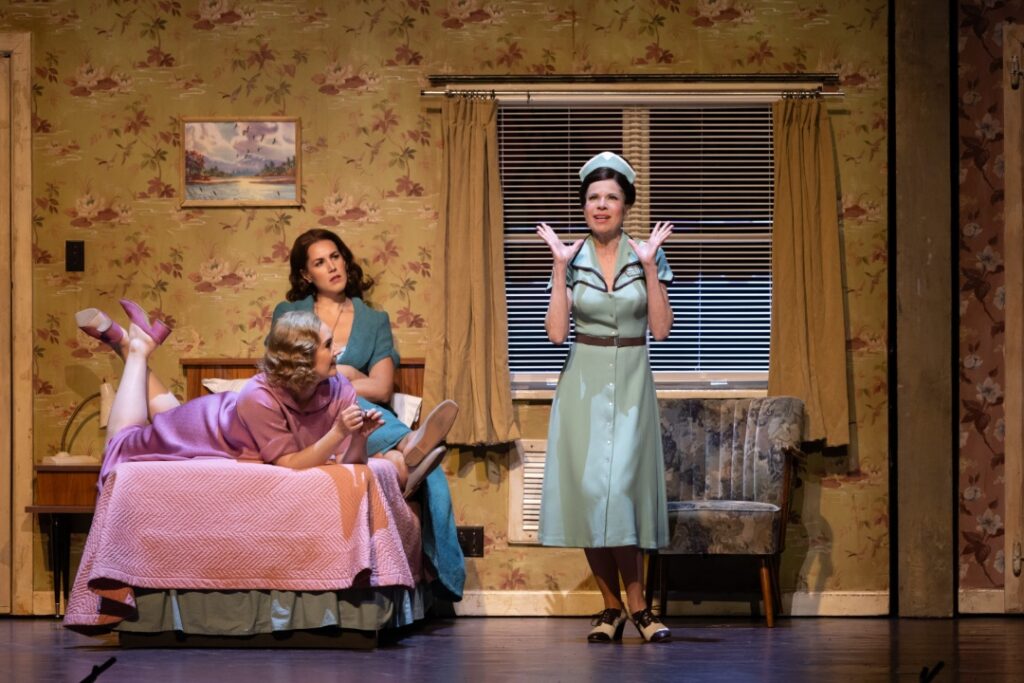
Soprano Federica Lombardi as Fiordiligi and Samantha Hankey as Dorabella were the backbone in which the body of the night’s performances and direction stemmed from entirely. Their Act one duet, “Ah! guarda sorella,” was breathtaking. The tonal nuances of their voices together were so inspiring and refreshing.
Lombardi was on another plane of vocal exquisiteness, even for her. Her rich and sumptuous vowels created a portal for which her vocal timbre resonated without any obstructions, leaving listeners stunned and wanting more.
Hankey was right there with her too. Her mezzo-soprano grounded the brightness of Lombardi’s tone with its warm and intricately complex sound. Hankey made the role of Dorabella a litmus test of vocal technique, exemplifying what it is that makes Dorabella’s less obvious role the most vital one of all.
Her interpretation of “Ah! scostati” and “Smanie implacabili che m’agitate” made Mozart’s composition into something of her own, interweaving emotions without getting stuck in their energetic wastefulness or giving away too much. Here, Hankey showed Dorabella’s vulnerabilities as the stream in which the plot of this opera feeds and festers.
“Come scoglio immoto resta” was another moment during Act one when Lombardi’s soprano left a lasting impression. Her phrasing during “Come scoglio immoto resta, contro i venti e la tempesta” featured her vocal range’s infinite bliss. The depths in which her chest voice plummeted followed by the heights of her falsetto were absolutely thrilling to experience live.
Soprano Ana María Martínez as Despina took the reigns of the opera with her performance of “Una donna a quindici anni,” especially when she sang “Che innamorano gli amanti, Finger riso, finger pianti.” Her tight spinning vibrato made this phrase soar into the Met’s hall and her vocal agility was unmatched. Her role’s physicality and fast paced tempo further played into her vocal prowess with aplomb.
(Photo: Marty Sohl © Met Opera)
Oh What Folly
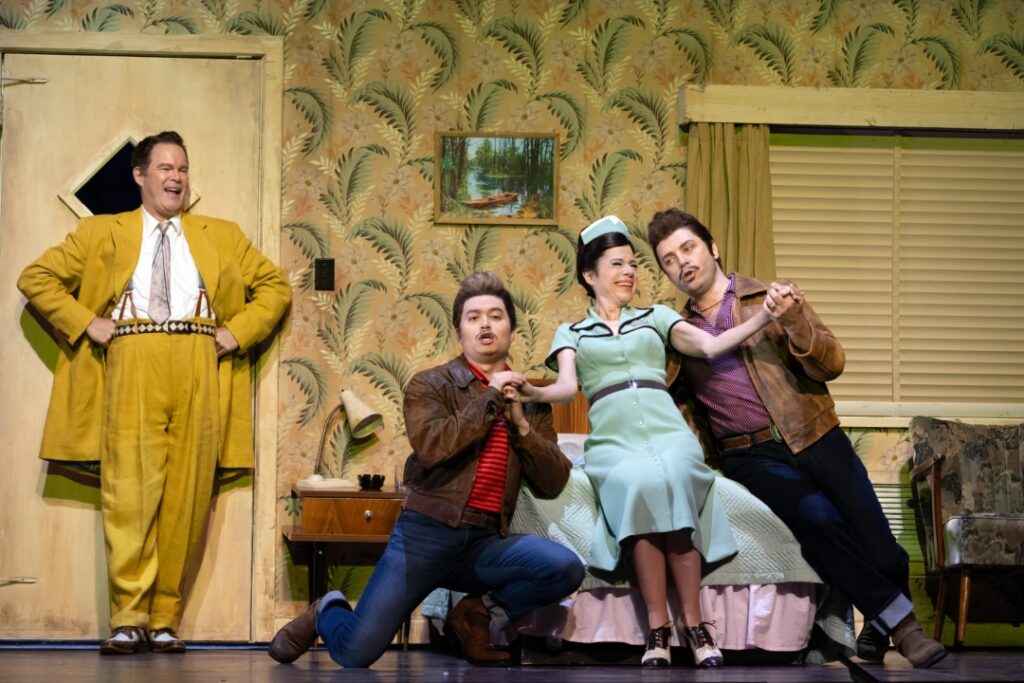
Tenor Duke Kim as Ferrando, baritone Andrey Zhilikhovsky as Guglielmo and bass-baritone Gerald Finley as Don Alfonso were a trifecta of derided masculinity. Da Ponte’s libretto leans into the follies of men and in so doing, Mozart riffs in this direction using melodic maneuvers to “keep the excitement in play.” All in all, here was a group of men proving yet again just how right they know themselves to be.
Kim, Zhilikhovsky, and Finley were excellent as they sang their opening trio, “La mia Dorabella.” One could immediately recognize the character description of each role just by listening to the timbres of their voices. Kim’s naiveté paired with Zhilikhovsky’s sleazy behaviors were the perfect match for Finley’s narcissistic theories about women and how far one could push them until they bend their will.
Finley’s intelligent performance, as is the case for any role he interprets, stripped this opera’s blatant chauvinism, making his role a tool to weld dark comedy relief. Even the best of comics spend their entire careers looking for a way to hit this mark of interpretation, whereas Finley just gets it and gives it.
His aria, “Vorrei dir e cor non ho,” was hilarious as he gave short bursts of emphasized exaggeration when he sang, “Ho di voi, di lor pietà.” Finley’s performance during the trio with Fiordiligi and Dorabella, “Soave sia il vento,” added dimensionality and extraordinary grace. His voice aligned with Lombardi’s and Hankey’s in divine union. This was the most unassuming highlight of the night for me.
Kim and Zhilikhovsky’s duet, “Al fato dan legge,” was seamless in its delivery. The pair laid down a thick coat of “sweetness” to keep their partners oppressed under a veil of ulterior motives. Zhilikhovsky’s vocal performance of “Non siate ritrosi” illuminated Mozart’s simple approach to making this opera’s comedy easy to digest, no matter the level of taste.
Kim’s interpretation of “Un’aura amorosa” was another highlight of the night. His vocal timbre navigated the aria with masterful intonation and feeling. His pianissimo was excellent.
Act two’s trio, “Sani e salvi agli,” was an obvious end to a blatantly obvious plot, however it was still refreshing to listen to Kim and Zhilikhovsky and Finley sing together before the end. Had it not been for Finley’s very clear direction in his role and outstanding performance, this would not have been the case. Finley absolutely made this “showmanship” worth it.
(Photo: Marty Sohl © Met Opera)
Happy Is the Man Who Looks At Everything on the Right Side
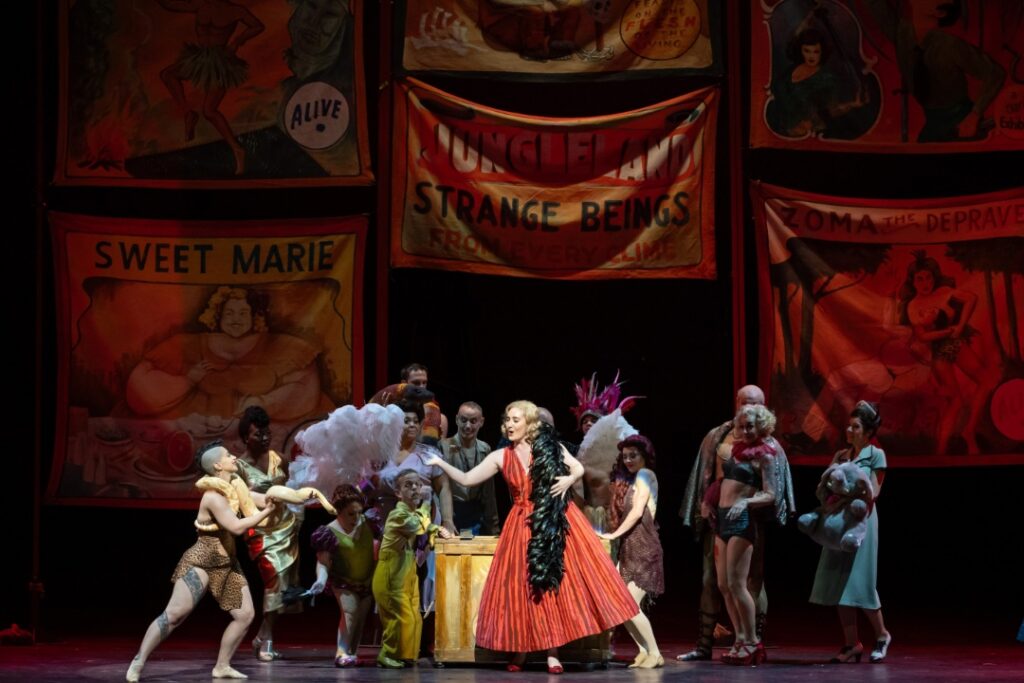
McDermott’s revival genius lies in the quick wittedness of his set’s mechanical and symbolic nature. The addictive pop of 1950s culture met with Coney Island’s dreamland is a hard to beat combination, but what made it fit this opera undeniably well is due to its well executed timing. The music and libretto remained the sole focus of this production while McDermott merely amplified the imaginative landscape, ushering it into modern day on a gentle breeze of well-planned role play.
The characters were essentially stuck in their scenes just as they were stuck in their ways, thus making the set design’s rotating doors and at times very fast paced physical maneuvering justifiable in its madness. The ferris wheel was my favorite part (in addition to the large albino boa constrictor that popped in and out of scenes—opera snake anyone? Genius.)
With this revival, and conductor Nimrod David Pfeffer’s excellent attention to musical details, the Met Opera played it smart and showcased a stellar cast that kept you on the edge of your seat.