Q&A: Azrieli Commission for Jewish Music Laureate Dalit Hadass Warshaw on ‘Letter From Across the River’
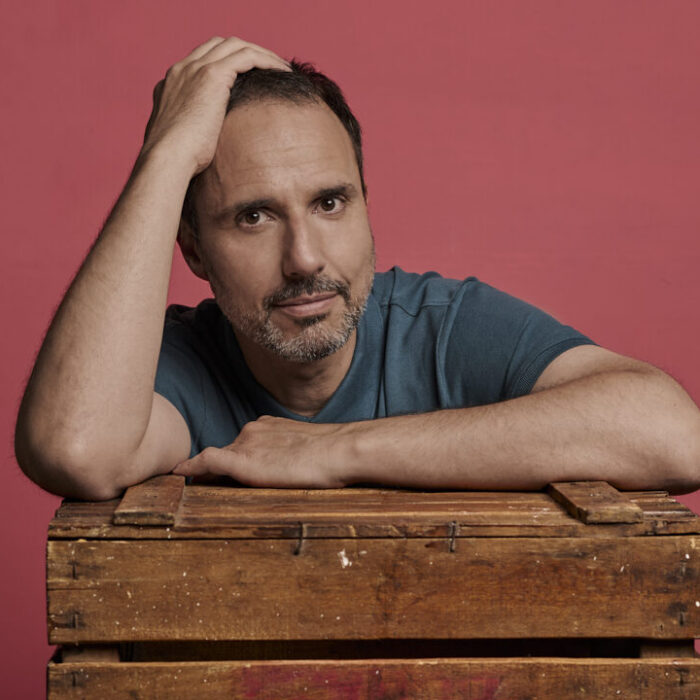
By David Salazar(Credit: Chris Lee)
In 1939, after the Nazi invasion of Poland, a scholar and teacher swam across the River Bug into Ukraine to mail a farewell letter to his three sons, who had emigrated to safety. On the far bank, in Soviet territory, he could have stayed and lived. He swam back instead, to his family and his community in Dubienka, with no illusions about what awaited them. In May 1942, the entire Jewish community of Dubienka was transported to the Sobibor death camp and murdered. The letter did not survive.
That story, passed down through the family, is the basis of “Letter From Across the River,” the 2026 Azrieli Commission for Jewish Music work by Dalit Hadass Warshaw, the scholar’s great granddaughter. Written for chorus, orchestra and soloists, the 18 minute piece sets texts in English, Hebrew and Yiddish and is performed by the Orchestre symphonique de Montréal and the OSM Chorus.
Warshaw is an American composer, pianist and thereminist whose works have been performed by the New York Philharmonic, the Israel Philharmonic Orchestra and the Boston Symphony Orchestra. A Guggenheim Fellow, she released her debut orchestral album, “Sirens,” on BMOP/sound in 2025. She spoke with OperaWire about recreating a lost letter, writing across three languages and what it means to choose love over freedom.
OperaWire: What inspired “Letter From Across the River?”
Dalit Hadass Warshaw: “Letter From Across the River” is inspired by an act of tremendous courage and self-sacrifice undertaken by my great-grandfather in war-torn Poland. A beloved scholar and teacher, upon the Nazi invasion in 1939 he swam across the River Bug to Ukraine in order to mail a farewell letter to his three sons, who had emigrated to safety. Once on the other side, my great-grandfather could have chosen life by remaining on Soviet territory; instead, he opted to swim back across the river to his family and community in Poland, having no illusions as to the fate that awaited them. In May 1942, the entire Jewish community of Dubienka was transported to the Sobibor death camp and murdered.
This story of my great-grandfather’s letter, of his monumental feat of stamina and strength of will in both reaching his ultimate decision and implementing it, was one of family lore, passed down through my grandfather and great-uncles (his surviving sons). In the absence of the letter itself, what tantalized me were the following questions: What would such a letter convey? What emotional and spiritual process would one have to undergo to write such a letter, and to arrive at such a choice? Ultimately, this is what the music explores, as we watch my great-grandfather face his inner struggle over the course of his perilous journey.
OW: Describe the musical language of the piece and how you arrived at it.
DHW: The language of every creative work I undertake is organic, dictated by the needs of the music itself. I see my role as that of a storyteller and enabler, pulling the listener into the protagonist’s experience, as the musical language itself is pulled into transformation at the service of the story. Because of this, I utilize a wide spectrum of vocabularies, although the general sound world can best be described as inhabiting an undeniably fin-de-siecle harmo
OW: What inspires your creative process?
DHW: Initial inspiration comes from the most fundamental need to convey story. Regardless of idiom, I explore the narrative structure of the piece through writing, description, outline, before even approaching the staff paper. When compiling smaller texts at the service of a greater musical form, whose role it is to unfold the drama (as opposed to setting an autonomously structured text, as one would a libretto), the first stage of my process is to spend a good amount of time researching and assembling them within a larger musical construct. In this particular work, the placement of English, Hebrew and Yiddish texts carried especial meaning, along with how they were partitioned within the chorus and between the soloists, to obtain maximum significance and effect.
OW: What were some challenges you experienced while creating this work?
DHW: Fortunately, due to the extraordinary versatility of the soloists, the Orchestre symphonique de Montréal and the OSM Chorus, the potential hurdles that may have otherwise come up — questions of balance between soloists, chorus and orchestra, for example, or the challenge of maneuvering between three different languages — really haven’t been issues. Truly a testament to the virtuosity for all performers involved! For myself, the most fundamental challenge was how to recreate the letter in a way that was factually accurate and emotionally true, when the actual document did not survive. Another challenge was how to tell this story in 18 minutes! Other challenges were more on the practical end: how best to phonetically notate the Hebrew and Yiddish texts, and how to convey an effective translation of text, when two or three languages are converging simultaneously, in a way most comfortable for the reader.
OW: What do you hope audiences take away from the experience of “Letter From Across the River?”
DHW: My hope is for the listener to arrive at an internal place where they can contemplate and comprehend the protagonist’s ordeal, even (or perhaps, especially) if it is far away from their own reality. Aside from the need to convey, and bear witness to, my great-grandfather’s story, my intention was to communicate the universality of such scenarios, and the relatability across cultures and histories. The details may be specific to time, place and language, and it is important that such individual experiences — beyond the posthumous, abstract scrim of historical tragedy — not be erased; what is as powerful, though, is the ability of such stories to resonate within all of us beyond the details, ultimately bringing us together as we realize our shared humanity.
OW: On a personal note, what inspired you to become a composer?
DHW: From the get-go, my first ventures were based on, quite simply, the need to tell stories through music, always the most natural form of expression for me since childhood. This imperative evolved over time, most significantly to provide voice to the unexpressed, often bringing to light figures prematurely stifled by the cultural expectations of their time, or who were erased or misunderstood by history. As both composer and performer, I prefer to view my role as that of a conduit, channeling personalities, intents and applicable musical languages, be it a general allusion to style, or the more literal engagement with quotation.
OW: Who are some of the composers that inspire you?
DHW: There are so many composers who have inspired me for different reasons: kindred spirits of the past (notably Schumann, Brahms, Mahler and Ravel, to name but a few), mentors who were crucial at various points (Jacob Druckman, David Del Tredici, Samuel Adler, Victoria Bond, Yehezkel Braun, Tsvi Avni), and many other teachers and colleagues whose names I risk overlooking by attempting to list them all!

Stories you may also like…
Q & A: Soprano Lucía Iglesias on Her Teatro Real Debut, Social Media & the Future of Opera
Q & A: Jorge de León on ‘Manon Lescaut,’ the Canary Islands & Opera’s Human Values