Q & A: Soprano Lucía Iglesias on Her Teatro Real Debut, Social Media & the Future of Opera
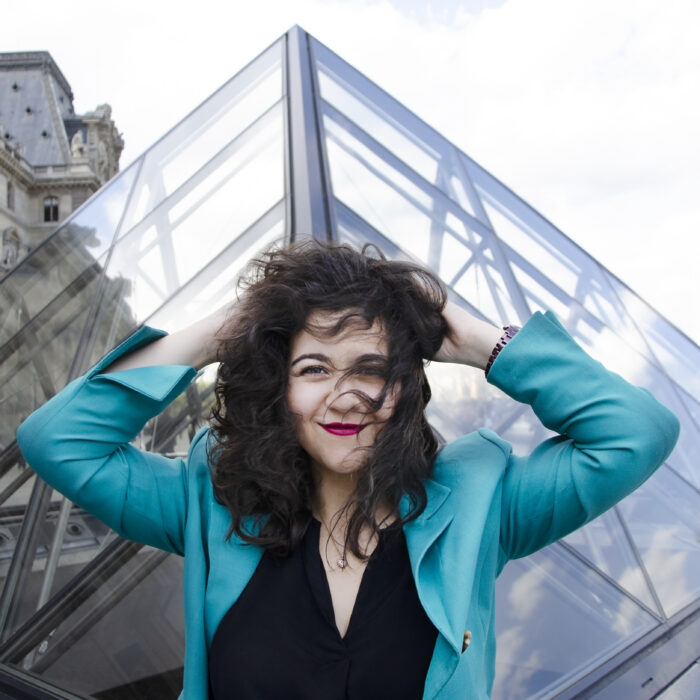
By Galina AltmanAt 26, Galician soprano Lucía Iglesias is entering a defining period in her young career. A member of the Teatro Real’s Young Artists program, she begins the 2026–27 season with a series of major debuts, including Barbarina in Mozart’s “Le nozze di Figaro” at Teatro Real and Papagena in “Die Zauberflöte” at the Gran Teatre del Liceu.
Mozart is at the center of her season, with five different roles across Spain, alongside her debut at Ópera de Tenerife as Mrs. Coyle in Britten’s “Owen Wingrave.” Her recent work has already taken her beyond Spain, including her Latin American debut in Lima in “La púrpura de la rosa,” the first opera written and premiered in the Americas more than three centuries ago.
Iglesias is also developing an artistic identity that extends beyond the stage. She is pursuing doctoral research in music focused on the literary world surrounding “La bohème,” while her interests in cinema, fashion, historical aesthetics, and literature inform the way she thinks about performance. She also collects out-of-print 19th-century novels associated with the tradition of Realism.
Her international trajectory has already brought her to New York through the Teatro Real’s Young Artists program, where she took part in a concert and activities connected with the Metropolitan Opera’s young artists. As she moves into a season of major debuts, Iglesias is building a career that combines a growing operatic repertoire with a distinctly individual curiosity about the worlds surrounding the stage.
OperaWire recently spoke about her Teatro Real debut, Mozart, acting, literature, cinema, social media, and the future of opera.
OperaWire: Lucía, you are a highly sought-after soprano, and you have several debuts this season. Let’s talk about your early success. You’re only 26, right?
Lucía Iglesias: Yes, I’m 26 at the moment.
OW: I’m sure making your debut at the Teatro Real is a significant step for you. Isn’t it frightening to put your youth and still-developing voice under the bright spotlights of such a famous stage? How do you feel about that?
LI: Sure, it’s a huge step for me. Of course, there is some nervousness. But I wouldn’t say I’m afraid. Thanks to the Crescendo program, I have already performed on this stage three or four times. Naturally, I feel a sense of responsibility because I’ve been given such a great opportunity. When you’re young, you’re always eager for opportunities to show what you can do, when not many people know you yet.
This season I’m making my debuts at the Teatro Real and the Gran Teatre del Liceu, two of Spain’s leading opera houses. So yes, it’s a huge responsibility, but I’m very happy. Finding out that I had the opportunity to sing at these venues felt like a dream. Yes, I had already performed at the Teatro Real, but this is my first time taking part in a full-scale production there. And it is also an important co-production between the Teatro Real and the Metropolitan Opera.
I know that you shouldn’t overwork your voice at the very beginning of your career, but I consider my debuts this season safe for me as a young singer. I’m singing Barbarina in “The Marriage of Figaro” and Papagena in “The Magic Flute.” This isn’t a debut in “La traviata” or another demanding role for a dramatic soprano. I’m in my comfort zone, and I’m confident I’ll do well. I would never accept a role I wasn’t ready for. At 26, I’m very careful and thorough when choosing roles: I study the score, look at where the difficulties lie, and only then give my answer. So my debut is happening at exactly the right moment and in the right roles. It’s OK.
OW: That’s fantastic! I can’t wait to see you onstage.
LI: Thank you.
OW: Speaking of major milestones, you are in New York right now, connecting with young talents at the Metropolitan Opera thanks to the Teatro Real. How does it feel to have your career take off on such an international scale at this stage?
LI: It feels like an absolute dream come true. Rehearsing at the Met has been my dream since childhood, and I’m incredibly grateful to the Teatro Real Young Artists Program for these opportunities. I also have two engagements coming up in Miami, a performance at the historic Freedom Tower, and a meeting with students at Dade University. It’s my first season on such a large scale!
OW: Returning to your debut at the Teatro Real, Barbarina is usually seen as such a simple, light character, but Mozart gave her this wonderful aria about a lost pin, written in F minor.
LI: Yes, the only minor-key aria in the entire opera.
OW: What is she really crying about? Is it simply the “lost pin,” or is it her first frightening step into the adult world?
LI: There are many theories about Barbarina’s aria. It anticipates the Romantic sound world, the whole palette of Romanticism. It’s a wonderful aria for a debut: short, but technically quite challenging. As for its meaning, some people believe she is crying because of the pin; others think she is crying over the innocence she has lost with the Count. Or perhaps she really is crossing into the adult world. It all depends on the director’s interpretation.
OW: In Robert Carsen’s production, will you have the freedom to shape the character according to how you feel her?
LI: I don’t know for certain yet because rehearsals haven’t started. The first rehearsal is scheduled for Oct. 1, but I’ll join on the second because I’ll be returning from concerts in New York and Miami. I like to think through different concepts in advance. I’m sure it will be deeper than simply a story about a lost pin. It’s a question of interpretation, and that depends not only on the singers, but also on the director, the costumes, and the overall atmosphere, whether it will be modern or classical.
OW: Does it depend on the singer’s status? For example, can a major star tell a director, “I’ll do it this way, but I won’t do it that way,” like Anna Netrebko?
LI: There always has to be a dialogue between the singer and the director. The artist’s feelings are important, although the director’s concept plays a key role. The production has to work as a whole. At the beginning of rehearsals, you’re always a little lost; you don’t fully understand the overall idea yet. So it’s important for a singer to be flexible and not become fixated on one particular approach.
OW: Yes, versatility is important.
LI: Flexibility and versatility really are extremely important.
OW: Do you watch recordings of other productions before working on a new role?
LI: Yes. I’ve watched both modern and classical productions, for example, Giorgio Strehler’s production. I like watching recordings to get ideas. This is especially true of recitatives: in “The Marriage of Figaro,” they are the very heart of the opera. The music is beautiful, but it is in the recitatives that the characters really reveal themselves. I like observing how other singers perform them, what cuts they make, and what accents they use. I like some things and I don’t like others, but when I see the finished scene come together with my colleagues, I understand: “Yes, there was a reason for that.”
OW: In June this year, Liceu presented a wonderful, colorful production by Marta Pazos, very beautiful and very “Instagrammable.” You belong to the TikTok and Instagram Reels generation, where everything is instantaneous, while opera requires hours of silence and concentration.
Do you feel a divide between your public life on social media and the solitude you need to prepare a role?
LI: Nobody forces me to be on social media, and no one has ever told me that my Instagram is “not right.” I don’t feel any pressure in that respect. I simply try to show my work; it’s something I genuinely want to do. For example, I spent the entire month of August working through my roles for the season and barely posted anything. I think you should share things when you have the time or when you have something finished to show. When I’m in the middle of studying, I don’t feel comfortable filming videos. I’d rather concentrate on my work.
As for my personal life and privacy, everyone has to decide for themselves how much of their life they are willing to put on display. Some colleagues show where they’ve been and who they spend their time with. I’m not one of them. Sometimes I might post something neutral. For example, when I sang Despina in “Così fan tutte” in Italy, I took my dog Julieta with me, walked with her by the sea, and posted some photos. But I don’t put my private life on display. I’m more comfortable sharing my work, especially since it takes up most of my time.
OW: For an artist, that really is your whole life. Does your entire everyday existence revolve around the role?
LI: Of course. The important thing is to be sincere and authentic. That’s what attracts people on social media.
OW: Do you have TikTok?
LI: I don’t have TikTok. I’m afraid I’d spend too much time there, and I also want to live in the real world.
OW: So what do you most enjoy talking about on Instagram? What is the main message of your page?
LI: I share my passion for the opera world. I talk about how I started and how my parents supported me. I often talk about this in interviews. I don’t consider it too personal because it is connected to my profession. For example, my father grew up in Geneva and speaks French, so I heard French at home from childhood. That connects my personal life with my professional life.
OW: So you’re showing that it is possible to pursue what you love and be successful. That’s a very important message for young people who are wondering whether they should build their lives around the arts.
You were born in Galicia, a region with a mystical Celtic energy. The great Montserrat Caballé always said that her roots helped her onstage. Do you feel that Galicia can be heard in your sound? Does that cultural background help you?
LI: I was very lucky to grow up in A Coruña, where there is an opera season, because many other cities in Galicia don’t have one. In Lugo, where my whole family is from, opera is extremely rare. I became connected with music precisely because I had the opportunity to attend concerts, go to the opera, and take part in productions.
I entered that world as an extra in a production of “Werther,” and I saw opera from the inside. I sang in the chorus of the Galicia Symphony Orchestra from the age of nine. Almost every weekend I was performing on the stage of the opera house in A Coruña, and that instilled in me an enormous love of the arts.
Opera was always playing at home, especially Baroque music. It was beautiful, but as a child I didn’t understand what was happening behind the scenes. And when I opened that door onto the stage for myself, I was fascinated. I always loved performing: I sang, danced, and acted out little scenes at home. Opera brought together everything I loved. I heard beautiful harmonies and cried because of the profound connection I felt with them.
OW: With the feeling that the music is inside you?
LI: Music touches the deepest strings of the soul; it brings tears or love. It really is something divine.
OW: When you’re sad, you can always put on opera or classical music and immediately feel energized, right? By the way, I know you’re also a pianist.
LI: Yes, I played the piano for 17 years.
OW: Does it help you in your work?
LI: Very much. Although when I was at the conservatory, playing Bach’s “The Well-Tempered Clavier,” I used to think, “God, the piano is not for me.” I understood how beautiful it was when I listened to Glenn Gould, but playing it myself was difficult. Singing is difficult too, but I didn’t have the same passion for the piano. Besides, the voice develops later, once you understand your own timbre.
Music gives you an incredible inner impulse. I passionately love opera, and I consider it the highest form of art! I never had those feelings with the piano. Now I love the instrument; it helps me learn my roles, but I never saw myself as a pianist.
OW: Do you still play for yourself, for pleasure?
LI: Yes, much more often than I used to. Now I play freely, without thinking about strict technique or my teachers’ instructions. But in order to enjoy it, you first have to go through rigorous training.
OW: What do you play for yourself?
LI: I adore Khatia Buniatishvili! You have no idea how many times I’ve tried to imitate and feel her approach at the piano. She is incredibly magnetic onstage, she puts on a whole show – she’s a true actress!
OW: Yes, she’s extremely theatrical. In the male-dominated world of pianists, a woman has to be something special to break through – one moment you’re “too serious,” the next there’s “not enough movement.” And as for discussions about stage dresses, let’s not even go there.
LI: Absolutely. Khatia plays a lot of song arrangements, for example, Schubert’s songs arranged by Liszt, such as “The Serenade,” and I love playing those melodies and singing along. It’s great!
OW: Speaking of acting and theatricality, opera today has become cinematic and psychological. I know you love film. Which acting school is closest to you? The Stanislavski system, or something else? Who inspires you?
LI: I studied the Stanislavski system and even earned a master’s degree in theater arts. I spent years at the conservatory, but opera is 50 percent music and 50 percent theater. I decided to strengthen my acting skills and studied privately with theater and film actors, which helped me enormously.
The Stanislavski system can sometimes be too emotional. An opera singer cannot completely immerse themselves in emotion because when you cry or experience intense emotion, your vocal folds constrict, and that can be damaging to the voice. For a dramatic actor, that can be useful, but an opera singer needs balance. Emotion should change the color of the voice without destroying the technique; otherwise, the voice will start to break and become hoarse. So the Stanislavski method is excellent as long as you control the level of emotional intensity. It’s ideal for film, but opera requires a more physical, perhaps, system of expression.
OW: Like the Michael Chekhov method, which is popular in the United States and which Meryl Streep likes, when you seem to put on a mask and then take it off, but you are still yourself?
LI: Exactly. In theater, you have to project a gesture and an emotion all the way to the last row of the audience, projecting emotion not only through your voice but through your body. It isn’t transformation; it’s projection.
OW: Today opera directors have enormous power, and the theater has become director-driven. Sometimes their ideas can be physically uncomfortable for singers. Have you ever experienced a situation where a director’s concept made it difficult to sing? Is it hard for a young artist to stand up for their own comfort and vocal health?
LI: There should always be a respectful dialogue between the director and the singer. And you need to know how to establish your boundaries. But you shouldn’t say “no” without trying first. Perhaps the idea will work and won’t interfere with your singing, unless it involves an extremely demanding aria like “Sempre libera” from “La traviata.” I’ve been lucky with directors; they have always listened to how I was feeling physically. The important thing is to try it and see the result.
OW: And which productions are closer to you, modern ones or classical productions with elaborate costumes?
LI: For me, it isn’t about style. What matters is whether the production respects the essence of the story, the libretto, and the music. Every opera has many layers of meaning. A director might emphasize the theme of fading youth in “La bohème,” or the relationship between Marcello and Musetta. If it feels truthful and resonates, it doesn’t matter whether the production is modern or traditional. Classical productions are aesthetically beautiful. We all love elaborate costumes, but opera doesn’t always have to be “pretty.” When Tosca kills Scarpia, there is nothing elegant about it, just as there is nothing elegant about the tragedy and death of Violetta or Katerina Izmailova.
OW: “The Marriage of Figaro” is often considered a light comedy, although Mozart seems to have written a profound drama about betrayal and forgiveness. Why is this story relevant today, in 2026?
LI: It is about the abuse of power, about how powerful people use their privileges. That is an incredibly contemporary subject. It is also an opera about female solidarity, about feminism, for example, when Susanna and the Countess join forces to expose the Count. That’s why classics are timeless: they speak about an unchanging human nature. Instead of the Count, today you might have a boss, a president, or a company CEO.
OW: Absolutely! Opera gives us food for thought about our own archetypes and our own lives.
LI: Exactly.
OW: I wish you a wonderful trip and all the best in making your American dream come true!
LI: Thank you! I have two concerts coming up in Miami, a performance at the historic Freedom Tower, and a meeting with students at Drake University. And then there is the new production of “The Marriage of Figaro” with Robert Carsen, an outstanding Mozart specialist. It is a co-production with the Met, a real dream come true! I’ll also be singing the role of Blonde in “The Abduction from the Seraglio” and giving a solo recital in Madrid. It’s my first season on such a large scale!