Q & A: Composer Paola Prestini on ‘Sensorium Ex’ & VisionIntoArt’s ‘Make Make Innovation Festival’
By Jennifer E. PyronImagine being trapped inside your own head for 22 years, listening to mental loops playing on repeat all day, without the ability to use your own voice. In composer Paola Prestini and librettist Brenda Shaughnessy’s opera “Sensorium Ex,” Jakob Jordan plays Kitsune, the central character who, with the help of custom-designed AI tools developed with NYU’s Ability Lab, is able to use his own voice – and perform the lead role – for the first time.
“Sensorium Ex” features a predominantly disabled cast and a libretto that presents a dystopian reality – one not so far removed from our own – while examining the complex nature of a mother-son relationship set against the backdrop of an inhumane corporation seeking to siphon the essence of life. The overarching question posed in this production is: Whose voice will change this trajectory?
OperaWire spoke with Prestini and learned more, reflecting on how this deeply impactful work is actively making a positive difference right now.
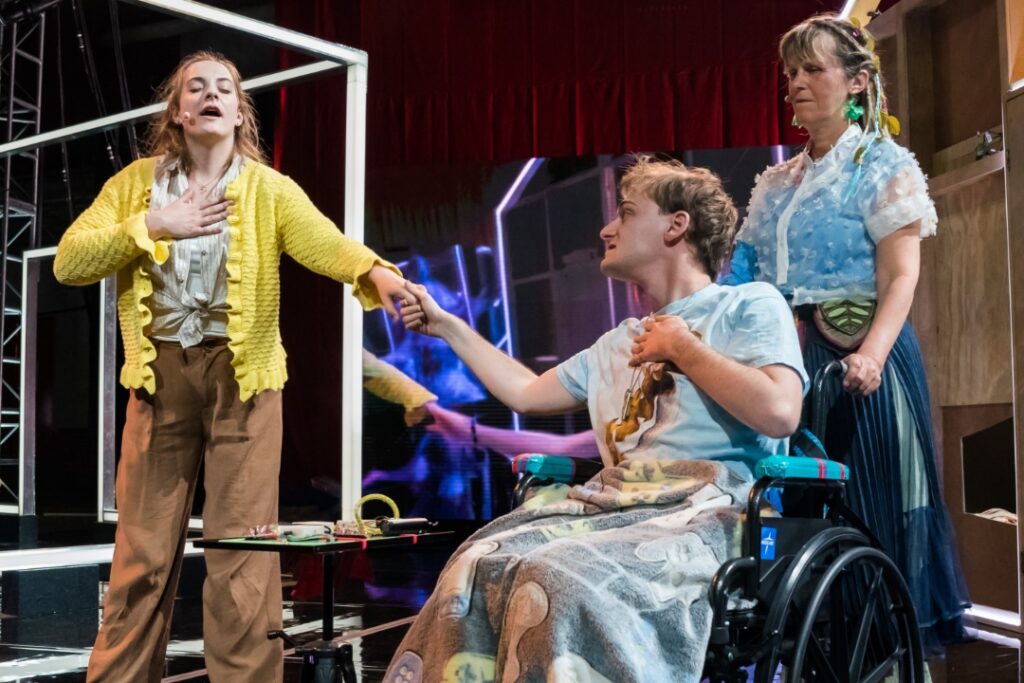
(Photo: © VisionIntoArt Sensorium Ex at Sapp Fieldhouse)
OperaWire: This production has gained a lot of traction since we last spoke in 2024, just before its 2025 debut at the Common Senses Festival in Omaha. How was your experience at the festival?
Paola Prestini: The Common Senses Festival was the perfect place to debut the piece. It is a disability-focused festival and the founder and director, Kate Weitz, is super passionate about access. She really created the perfect framework for the opera to premiere. It was also so much learning. It definitely felt like a first. And I think there was a feeling of success, but also of things that we wish we had known and we could do better. And I think that’s the whole point of this type of work. It’s all incremental learning and it’s complex.
There was a mix of daytime and evening performances so that caretakers and children could come… I remember watching one performance and thinking how wonderful it is to see kids actually seeing themselves onstage, which was the whole point of the performance: how much representation matters. And so I think there are ways in which, as presenters, we really have a lot to learn. There was also a quiet space so that if people felt overstimulated, they could leave the performance and go and enjoy this beautiful space that was created by our accessibility team. There was an accessibility team, a production team, caretakers, and families. So you’re really talking about quite a large group. And even with that, we still felt like there was not enough team if you were to really honor the needs of everybody involved… That’s what I’m saying with this kind of work. You can look at it glass half empty and [talk about] what you didn’t do, or you can look at it and see it and face it and say these are all the things that we could do better next time. But the only way you improve it is by doing it. You can only theorize so much, but then you never do it. And so I feel very strongly that with this kind of work, you have to do it and commit to building upon one’s learning.
I will say that one of the things that gave me a lot of hope was looking at mezzo-soprano Hailey McAvoy and what a star she is and knowing that, while the experience wasn’t perfect for her, she was incredible in the process. Soprano Gerlinde Sämann had her first starring role in an opera. I remember when I was looking for a blind mezzo-soprano and Laurie Rubin, who’s on our advisory board, told me she could not do the premiere. I was googling “blind mezzo-soprano.” There was no database for this specific type of voice and so, finally, I found Gerlinde through her website in Germany. She had never been in an opera and she was astounding. And, for her, this was an extraordinary experience. Looking at Jakob’s responses and seeing all the joy we experienced together gives me hope to continue to create opportunities for this work to be seen a lot more. We are gearing up for a New York performance sometime next season, [which] I’m really excited about.
OW: What were some of the learning points you had to figure out?
PP: There is a real intersectional approach to disability in “Sensorium Ex.” We have people who are minimally verbal, who have apraxia, who have autism, and one character that’s played by two different actors. You’ve got folks who are blind onstage, who have cerebral palsy. Everyone has different needs, and this mixed also with the parents of the disability community, [whose] own feelings and reactions and real life needs are things that require a lot of [support] and knowledge. And we were doing this for the first time. My hope for this is that by writing down everything we learn and creating an open source codex – and we had Gregory Moomjy as our impact fellow there, writing down everything he saw that we could do better – that we will be able to continue to do a better job.
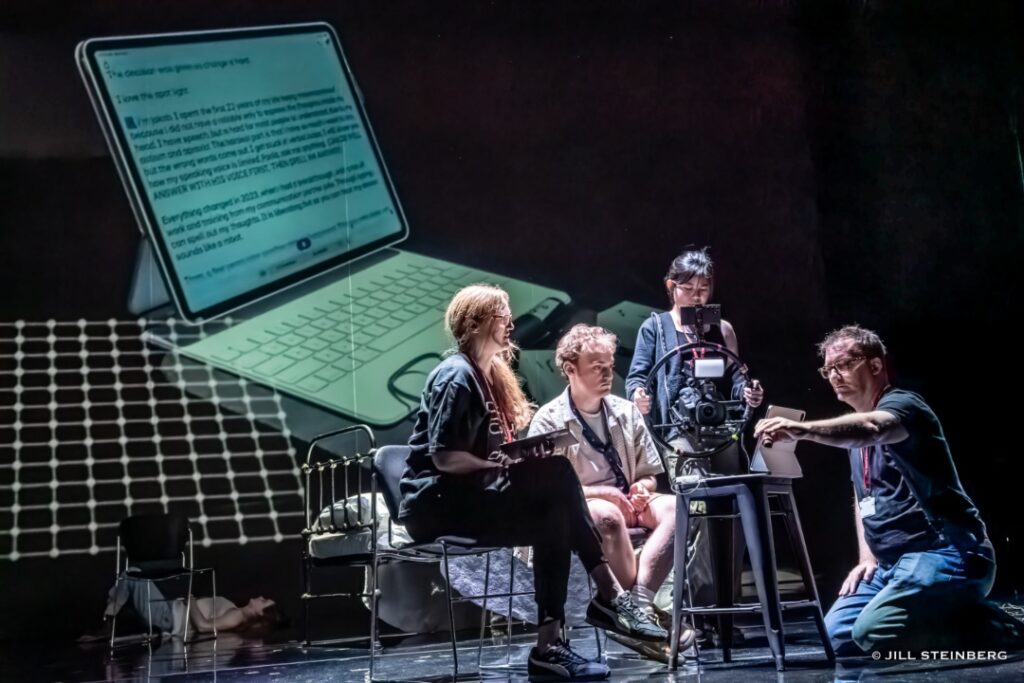
(Photo: © VisionIntoArt Sensorium Ex at RBO)
OW: The most recent production took place at Covent Garden this summer for the inaugural RBO/SHIFT Festival. What did this venue and experience make possible for “Sensorium Ex” that hadn’t been explored before?
PP: What was really interesting about this festival is that its focus was on AI. I think that for us there is a deep optimism in tech-optimism, in the way that we are able to use technology and artificial intelligence in the role — and creation — of Kitsune. What we did for that version is we [performed] a couple scenes for about 30 minutes and then opened up the technology. What I think we’re going to be doing going forwards is that the technologists will actually be onstage. What’s really cool about seeing Luke DuBois and all the different technologies working is that you get the sense that what they’re doing is actually part of the corporation. And so the character of CORP, who is played by Lucia Lucas, is in a way amplified by the technologists and the kind of transparency of seeing them onstage. I think that’s one of the things that we’ll be carrying forward as we do this again. I also want to be able to be there with people like George Lewis and Jennifer Walsh, who are doing incredible work in artificial intelligence. To see what everyone’s thinking about it… How people are using it positively… Examining the big, ethical questions… That was a really interesting framework to be involved in.
OW: “Sensorium Ex” incorporates AI-driven voice and communication tools developed with NYU’s Ability Project. How has that technology changed what is possible for performers with atypical speech patterns, both in rehearsal and onstage?
PP: For folks like Jakob Jordan — who was one of the actors who portrayed Kitsune — it really allowed him to hear the timbre of his actual voice. To do so in a timed environment, which is what the staging requires — this is something that can be taken into everyday life… Being able to hear yourself with the voice that is actually yours! This is something really special and I think that both characters had really different approaches. The way I looked at creating the opera was that, essentially, I had two roles that required improvisation. When you’re working with two kinds of improvisatory roles there are frameworks. But you really want to highlight the specific identity and voice of that particular performer. For one of the two performers, Kader Zioueche, he generally spoke as a zookeeper — animals represent his everyday joy — so we associated lines in the libretto with the sounds he assigned to “yes,” “no,” “maybe,” which could be bird sounds, roars, etc. That’s really what he identified with, and so I created a map, after spending a lot of time with him, between what were simple answers to questions that would be “yes,” “no,” and “maybe.” These were put into the libretto as suggestions. Then I mapped those to the sounds that he made. Then we programmed those into the actual technology. Essentially, what it allows for is a certain ability to time responses for minimally verbal performers. Then, of course, [they can] also hear themselves in their own voice. That’s something that Luke DuBois worked really hard for, in terms of figuring out the phonemes of the voice and creating parameters around that. The sensors that we have… right now are still quite rough and we’re still working on them. What’s really cool about the sensors is they allow for any… level of spasticity to be able to trigger those pre-recorded responses that are in the voice of those two characters. Our hope with this technology is to evolve it and to continue evolving it. That’s the idea over the next year.
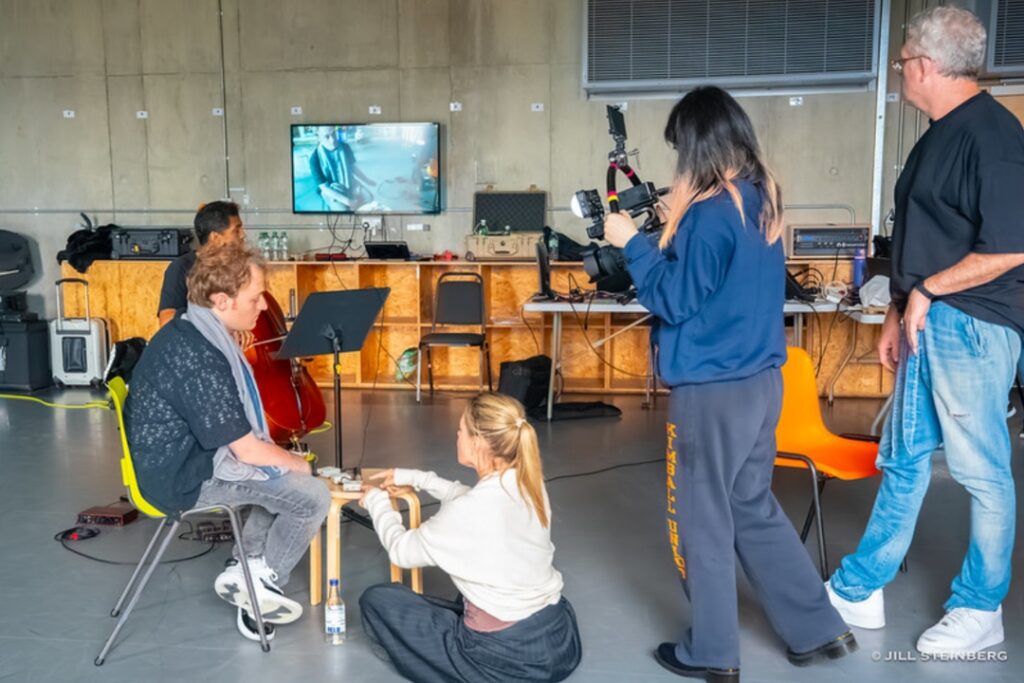
(Photo: © VisionIntoArt Sensorium Ex)
OW: I really loved watching the PBS News special and hearing Jakob’s voice.
PP: It’s so incredible. Jakob was really trapped for 20-plus years in loops. For him to be the star of a show and to hear the voice that he was born with, I think it was a huge step forward for him. It brought him a lot of joy.
OW: Hearing the essence of his voice, instead of a programmed synthesized version, really moved me.
PP: It is incredible and we are so lucky to work with both Jakob and Kader. What they bring to the role is magnificent. I remember when I started this project seven years ago. It was such a question, because I realized that I had some skill in terms of working with improvisers, but I knew I was going to learn so much in terms of working with a character who has a caretaker — who has a family. The involvement of this entire community for this one character is a beautiful experience.
OW: You developed this project around a predominantly disabled cast from the ground up over the course of seven years. What has this changed about your own process as a composer? And how has it changed the way you think about the human voice in opera?
PP: I think the reason I do this kind of work is to constantly remind myself of how much I have yet to learn. I think this kind of humility allows us to be the very best kind of person, not just to be the best artist. I think a process like this, that taught me so much about what I didn’t know, also taught me so much about creating accessible futures. I can only continue to bring that into the work going forward because, of course, if I had only done this for “Sensorium Ex,” then that would mean that I didn’t really understand what this piece can mean for the future. In that sense, I feel like the festival that we’re launching here at National Sawdust this year will speak to that and then continue to create an ecosystem around the work. In the upcoming festival, Hailey McAvoy has a work that we’re supporting, Gregory Moomjy has a work that we’re supporting, and we will continue to create more opportunities because I saw how hard it was to bring this work into the world.
In terms of the voice and what opera means, I’ve always had this feeling that opera is this extraordinary container for work that glorifies the human voice and the human experience. It tells the reality of life and that it can be done in the most complex ways. In this question of “who gets a voice,” the answer is “everybody,” right? My job was to say, okay, what are the ways in which I can create opportunities for this character written in this libretto, which is written in this way, and how do I honor that? It was my job to then make sure it became real.
OW: Congratulations to Brenda Shaughnessy on the release of her “Sensorium Ex” book and audiobook this year with Knopf. How has working with Shaughnessy influenced the way you think about the relationship between language and music?
PP: It’s interesting. You know, Brenda and I had the gift of extra time because of the pandemic. We really had this amazing opportunity to dive deep into every choice, and so every iteration of the way of making this brought us a step closer to where we needed to go. I’ll say that with Brenda, the complexity of her language and the way she structures text and the way she structures overlap and counterpoint is already there in the poetry. This forces me to think in really interesting and complex ways musically. An example of that is the whole section of the corporation played by Lucia Lucas where she essentially tells you what’s going to happen to this child. And we hadn’t really written the choral part yet but it was all there because the choir was essentially just the people who believe in these corporations. And so she was really open to this kind of exploration of that whole character which became the chorus and ended up amplifying the human emotion. There were ways in which Brenda was so open. She put so much into the text for me to uncover and to explore. And then, of course, there is the profound lived experience that she has as a mother with a child who’s nonverbal and non ambulatory. She was that expert and I could ask her and I could meet Cal, her son. And I could record Cal and make sure that he had a part in the opera because he’s in the electronics. It was honestly the opportunity of a lifetime that she gave me to be part of her world and to invite me in and to trust me.
OW: I’m excited about your upcoming VisionIntoArt “Make Make Innovation Festival” taking place at National Sawdust from November 17-19, 2026. How will the festival create more opportunities for people interested in “Sensorium Ex” to learn more about the project and participate?
PP: Yes, the whole festival spins out from the ecosystem of “Sensorium Ex.” We are debuting an incredible musical by Hailey McAvoy and a new piece by Opera Praktikos, which is the only disabled opera company and led by Gregory Moomjy. We are also premiering short films by SOUL(SIGNS), which is an ASL troupe led by Kevin Newbury and Brandon Kazen-Maddox along with producer Jecca Barry. We are also doing all-night disability focused raves. It’s going to be a really amazing festival. I also want to shout out my team members because our executive producer Ras Dia has really poured his heart into this. And we have a new artistic leader here at National Sawdust, Siobahn Sung, who’s really bringing nightlife and responding to the nightlife community through this festival as well. I’m excited for folks to see both of their artistry come in this festival.
The “Sensorium Ex” recording is also out and available now on all platforms to listen to and get to know. We are excited to continue this journey!
Stories you may also like…
Q & A: Azrieli Commission for Canadian Music Laureate Nicholas Denton Protsack on Creating Ecologically-Minded Music
Q & A: Sharon Carty on her Position as Artistic Director of the Sligo Baroque Festival & her Role as Mary in Irish National Opera’s Production of “Testament”