Q & A: Composer Hana Ajiashvili on Her Azrieli Award-Winning ‘Riddle,’ Finding Inspiration in Color & Music’s Omnipresence in Her Life
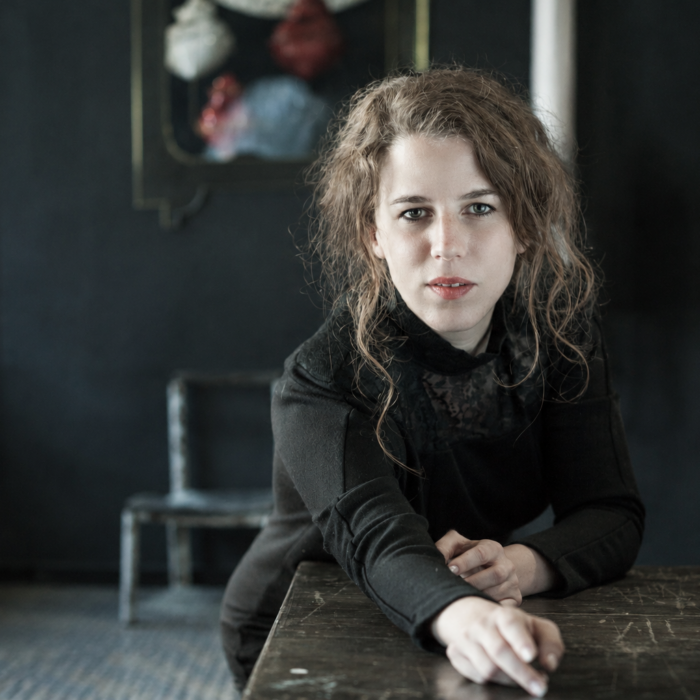
By David Salazar(Photo Credit: Michael-Pavia)
“Color is one of the strongest impulses in my creative process. I often think about orchestration and instrumental techniques almost visually — as layers, densities, contrasts, surfaces, and transformations of color,” says composer Hana Ajiashvili, 2026 Laureate of the Azrieli Prize for Jewish Music (give for an existing but undiscovered work of Jewish music), regarding what inspires her creative process most.
Ajiashvili is a Georgian-Israeli composer whose works have been performed internationally by ensembles including the Meitar Ensemble, Musica Nova, Ensemble XXI Century, Continuum, The Jerusalem Symphony Orchestra, Momenta Quartet, Mivos Quartet, Reconsil, defunensemble, Riot Ensemble, and Trio Catch. Her music has featured at festivals such as Heroines of Sound, ISCM World New Music Days, the Asian Composers League Festival, Moscow Autumn, and Alternativa.
She has won the Israel Contemporary Players’ Young Israeli Composers Prize (2004), the Prime Minister’s Award for Composers (2008, 2021), the Acum Award (2017), and first prizes at Contempus – University of Macedonia (2022) and the Luxembourg International Composition Competition (2025). She studied in Tbilisi and Moscow, earning her doctorate at Bar-Ilan University, and now directs the Or Yehuda Conservatory.
OperaWire spoke to Ajiashvili about her award-winning composition, her process, and why she decided to become a composer.
OperaWire: What inspired “Riddle?”
Hana Ajiashvili: I composed it in 2022 for large choir and symphonic orchestra, originally for the Hallelujah Festival and the Jerusalem Symphony Orchestra.
When I began working on the piece, I was searching for an ancient Hebrew text and discovered a short riddle by the great medieval Jewish poet Yehuda Halevi. What immediately struck me was how contemporary the text felt, despite having been written in the 12th century. It is extremely concise, mysterious, and abstract — almost like a piece of contemporary poetry.
The riddle describes something delicate and silent, yet capable of killing without making a sound. Halevi left no answer to this particular riddle, although he provided answers to many of his others. According to some rabbinical interpretations, the answer may be the quill — something light and almost weightless that could nevertheless be used to sign a decree determining life or death.
I was fascinated by this paradox: fragility and brutality, silence and enormous power existing within the same image. It became the emotional and philosophical starting point of “Riddle.”
OW: Describe the musical language of your piece and how you arrived at it.
HA: The musical language of “Riddle” grows from several elements that gradually transform throughout the piece.
It begins with a short, resonant chord — almost a percussive impact. This gesture returns in different forms and becomes one of the structural markers of the work. Another important element is a series of chromatic unison lines in the choir and orchestra. They move upward and downward, sometimes through glissandi, creating a feeling of instability and constant transformation.
For a long time, there is no melody in the conventional sense. A more recognizable melodic line appears only later, first through solo voices. For me, its delayed arrival is important: it is almost as though an individual human voice gradually crystallizes out of a much denser and more unstable sonic environment.
Toward the end, a heterophonic chorale emerges. I think of this moment not as a climax, but as a catharsis — a transformation and release of everything that has accumulated before it. Earlier unison lines and melodic ideas are reconfigured into something collective, but never completely unified.
In a way, the whole piece unfolds as a process — from impact, to motion, to the emergence of voice, and finally to a kind of fractured collective unity.
The score also uses extended instrumental and vocal techniques, multiphonics, divisi, glissandi, and different kinds of articulation and timbral transformation. In the choir, I even use the historical trillo technique associated with Monteverdi. But I never think of these techniques as effects for their own sake. They are simply part of my musical vocabulary — part of how I hear and express the inner world of the piece.
OW: What inspires your creative process?
HA: Color is one of the strongest impulses in my creative process. I often think about orchestration and instrumental techniques almost visually — as layers, densities, contrasts, surfaces, and transformations of color.
Performers are another major source of inspiration. Working closely with musicians has allowed me to discover sounds and instrumental possibilities that I might never have imagined in isolation. I am especially interested in the point where an unusual technique stops being an “effect” and becomes an organic part of musical expression.
I am also inspired by things outside music — visual art, literature, poetry, history, and sometimes simply by a particular sound or image. Very often, a piece begins for me with something quite small: a color, a gesture, a sonority, a word. Then I begin to explore what kind of musical world can grow from it.
I don’t begin with the idea of fitting the music into a particular style or school. I try to listen to what the material itself needs and allow the musical language of each piece to develop from there.
OW: What were some challenges you experienced while creating this work?
HA: Writing for a large choir and symphonic orchestra creates a particular challenge: you have an enormous palette available, but that abundance can easily become density without clarity.
I wanted the choir and orchestra to function as equal partners. At times, the voices reinforce or double the orchestra; elsewhere, the choir behaves almost like another orchestral instrument, with long, independent or asynchronous lines and extensive divisi. Maintaining transparency within this complexity was one of the main compositional challenges.
Another challenge was the dramatic pacing of the piece. I deliberately postponed the appearance of a clearly recognizable melody and, later, the heterophonic chorale. When an important musical element appears only after a long process, the entire structure has to prepare for that moment without revealing it too early. Finding the right proportions — allowing the music to accumulate tension while still feeling alive and constantly changing — required a great deal of attention.
At the same time, these challenges were also what made writing “Riddle” so exciting. A large choir and orchestra gave me the possibility to work with musical color, spatial depth, polyphony, and physical intensity on a scale that would not be possible with a smaller ensemble.
OW: What do you hope audiences take away from the experience of your piece?
HA: I don’t want to prescribe a single interpretation. Halevi himself leaves us with a riddle without an answer, and I like the idea that the music also leaves a certain space unresolved.
But I hope the audience feels the central contradiction of the piece: the coexistence of fragility and violence, beauty and danger, the individual and the collective.
There is one moment toward the end that is especially important to me. A solo soprano sings the Hebrew word adam — “human.” At times I separate the word into “a-dam,” so that dam, the Hebrew word for “blood,” becomes increasingly audible. The transformation happens through sound itself: the human and blood are contained within the same word.
I composed “Riddle” in 2022, before October 7. The work was already connected to Jewish history and to the experience of persecution when I wrote it. I could not have imagined what would happen afterward, and it is painful for me that some of the questions in the piece have acquired an even more immediate resonance.
At the same time, I don’t see “Riddle” simply as a historical or political statement. I hope listeners experience it first as music and are then left with questions — about the power of a seemingly small gesture, about memory, vulnerability, violence, and about what it means to remain human.
OW: What inspired you to become a composer?
HA: Music was present in my life before I could think of it as a profession. I grew up in Georgia, where singing is deeply embedded in the culture. I have been singing for as long as I can remember — even as a child, when I encountered a text, my instinct was often to sing it rather than simply read it. Georgian polyphony was part of the sonic environment around me, as were the musical traditions of Georgia’s ancient Jewish community.
Later, studying at the Moscow Conservatory completely changed my understanding of what music could be. My teacher, Vladimir Tarnopolsky, introduced me to an enormous world of 20th-century and contemporary music. Through his Studio for New Music, festivals, masterclasses, and encounters with composers and performers, I was exposed to some of the most important musical ideas of our time. Those years were enormously formative for me.
I have lived in Israel since 2001, and Israel has had an equally profound influence on who I am as a composer. What fascinates me here is the extraordinary mixture of cultures. It is an incredibly colorful environment, where East and West, ancient traditions and contemporary art, and completely different musical languages exist side by side. Israeli composers themselves come from remarkably diverse cultural backgrounds and represent very different directions in contemporary music. Somehow, all these different voices coexist within one relatively small country.
My doctoral studies at Bar-Ilan University were another important stage in my development. My research focused on the dialogue between contemporary painting and contemporary music, and it deepened something that had already been central to my musical thinking: my fascination with color. I began to think even more consciously about timbre, texture, density, and musical space — not as decoration, but as elements that can shape the structure of a composition.
So, in a sense, my musical identity has been formed through several very different environments: the polyphonic and vocal culture of Georgia, the intense encounter with the European contemporary-music tradition in Moscow, and the extraordinary cultural diversity of Israel. I don’t consciously try to combine these influences when I compose. After so many years, they simply coexist inside me and have become part of the way I hear music.
OW: Who are some of the composers that inspire you?
HA: I am inspired by composers from very different periods and aesthetics. Jean-Philippe Rameau and Domenico Scarlatti fascinate me through their extraordinary sense of musical character, gesture, and color. Stravinsky has always been important to me for his rhythm, clarity, theatricality, and his ability to continually reinvent his musical language.
I also have a particular love for spectral music, especially the music of Gérard Grisey. The idea of approaching sound from within — exploring its spectrum, resonance, timbre, and gradual transformation — is very close to the way I experience music myself. Color for me is never something decorative; it can become part of the structure and dramaturgy of a piece.
Among more recent composers, I am also deeply drawn to the sonic worlds of Salvatore Sciarrino, Beat Furrer, and Fausto Romitelli.
These composers are very different from one another, and perhaps that is precisely what attracts me. I am not interested in belonging to one school or following one aesthetic model. What inspires me is a composer with a recognizable inner world — someone whose musical language feels inevitable and personal.
That is ultimately what I search for in my own music as well: a language in which technique, color, form, and expression become inseparable, and which feels genuinely my own.