Musikfest Bremen 2026 Review: Schicksalslied & Lobgesang
By Mengguang Huang(Photo: Nikolai Wolff)
The European tour of The Constellation Choir & Orchestra leading up to this Bremen stop was originally framed around Sir John Eliot Gardiner. However, ever since the Leipzig incident occurred earlier this year, this specific concert had been shrouded in deep uncertainty, with clear answers only emerging barely two weeks before showtime, when his assistant conductor Finan Jones officially stepped up to lead tonight’s performance. At Die Glocke in Bremen, the visual evidence of this turbulent lead-up was undeniable: the hall was less than half full. Yet, those who stayed were fortunate to witness an evening driven by incredible focus and high-energy music-making.
Brahms: Schicksalslied, Op. 54
The concert opened with Brahms’s setting of Friedrich Hölderlin’s poem “Schicksalslied,” presented with a clear sense of structure and emotional balance. Clearly, here Jones showed a thoughtful, broad vision for the piece. The opening stately presentation set a noble tone, with The Constellation Choir singing with a transparent and refined quality.
The orchestra began with a steady, grounded approach. After a slightly muddy woodwind transition, Jones began to introduce more flexible rubato and longer musical lines. This gradual accumulation of energy culminated in a powerful outburst in the middle section. Here, the vocal dynamic range was vast, creating a profound backdrop before returning to a more mature restatement of the initial theme. The music was guided with a strong sense of certainty and clarity, letting Brahms’s tragic architecture unfold naturally toward its quiet conclusion.
Mendelssohn: Symphony No. 2, Op. 52 (Lobgesang)
If the Brahms was measured and deeply analytical, Mendelssohn’s “Lobgesang” was pure muscle, spirit, and exuberant power.
The extended Sinfonia served as a prime showcase for The Constellation Orchestra. The opening Maestoso sounded confident and full-bodied. In the polyphonic sections that followed, the musical lines overlapped with remarkable clarity and depth, creating a vivid three-dimensional soundscape. The subsequent Allegretto shifted into a delicate, serenade-like style. String and woodwind sections engaged in an elegant, light-footed dialogue. To introduce the third movement—an Adagio—the brass delivered a clear restatement of the symphony’s main motto. Here, the string players used a flexible bowing technique that gave the music a dignified, noble atmosphere.
The Vocal Arc
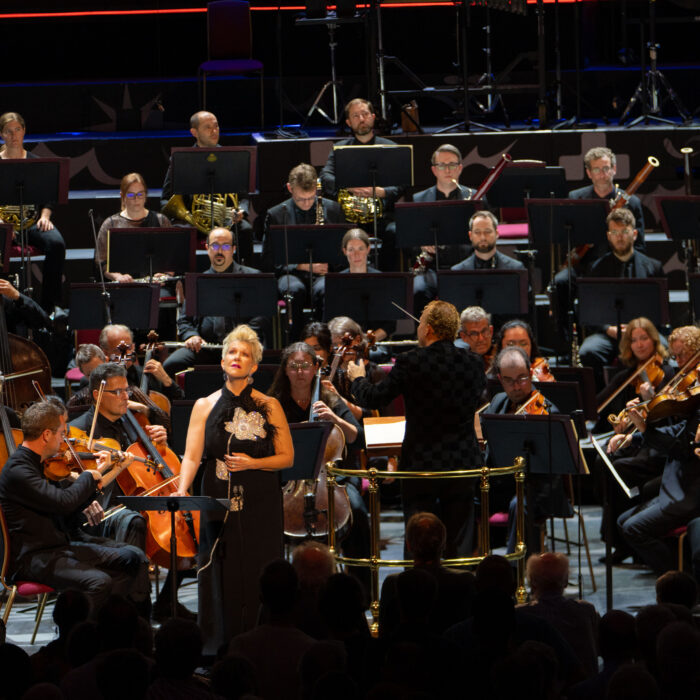
Joining the opening chorus who made an immediate impact with a penetrating, large-scale timbre, soprano Hilary Cronin made her first entrance and instantly captivated the audience. Her voice possessed a bright, golden, and exceptionally pure quality—full, smooth across her entire register. Together, the vocalists projected their message of praise to God with powerful clarity and conviction.
Tenor Jonathan Hanley led the next section, “Saget es, die ihr erlöst seid durch den Herrn.” His voice sounded solid and warm, delivering the recitative-like statements with expression before expanding naturally into the more lyrical, aria-like phrases that followed.
In “Ich harrete des Herrn,” soprano Sam Cobb joined Cronin. The two voices blended harmoniously, moving together with precision and grace. Behind them, the choir slowly built up the emotional intensity, driving the section to a soaring peak.
The dramatic highlight of the symphony came during the night/watchman sequence, “Stricke des Todes hatten uns umfangen.” Hanley painted a stark, inward-looking picture of darkness, successfully conveying a genuine psychological feeling of nighttime helplessness and tension. As he sang “Wir riefen in der Finsternis,” he vividly expressed that sense of disorientation, and intense longing through a genuine, speech-like delivery, before the trembling strings came to an abrupt pause, pushing the dramatic suspense to its limit.
Then came the turning point: like the first golden beam of dawn piercing a pitch-black horizon, a single soprano voice from the choir suddenly cut through the heavy nocturnal blanket to announce the end of the night. In a single stroke, the music burst out of its cramped, suffocating darkness and flooded the hall with a massive, radiant sonic landscape, instantly recalling the awe-inspiring burst of light in Haydn’s “Die Schöpfung.”
Following this release, without instrumental accompaniment, the choir sang a devotional chorale a cappella with deep solemnity. The orchestra’s strings re-entered with a solid, reassuring tone, leading into Hanley and Cronin’s prayerful duet, “Drum sing ich mit meinem Liede.” The sense of heartfelt gratitude toward God was unmistakable, radiating through phrases with palpable devotion.
The final choral section was equally exceptional—crisp, energetic, and completely focused. While the string playing was occasionally a bit rough around the edges, the choir delivered even the densest, most complex fugal passages with clear line contours and absolute precision. The entire symphony came to a magnificent close as the brass section stood up to deliver the final restatement of the main motif, bringing the evening to a triumphant climax. Congratulations to the ensemble for their meticulous preparation under such uncertainty, delivering a resolute performance.