Musikfest Bremen 2026 Review: L’isola disabitata
By Mengguang Huang(Photo: Nikolai Wolff)
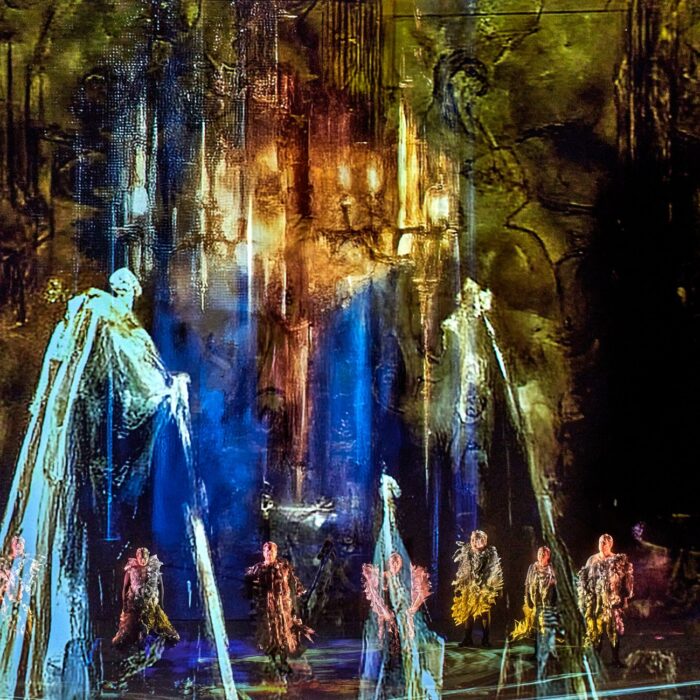
Franz Joseph Haydn’s “L’isola disabitata” (1779) runs for just eighty minutes, making it a uniquely compact chamber opera. The Orchestra of the Eighteenth Century production at Oldenburg State Theater fully embraced this inherent brevity by adopting a minimal stage design. During the overture, a simple grey backdrop was manually raised, coming alive as lighting cues cast shifting hues across its textured fabric. Visually, the canvas evoked the turbulent sea landscapes of J. M. W. Turner.
The orchestra was positioned directly at the center of the stage, leaving the singers to perform primarily downstage, very close to the audience. Two artificial rocks were placed on the far left and right sides of the stage to suggest the desolate shoreline and to provide a physical surface for Costanza’s painstakingly carved inscription.
Illuminating Cast
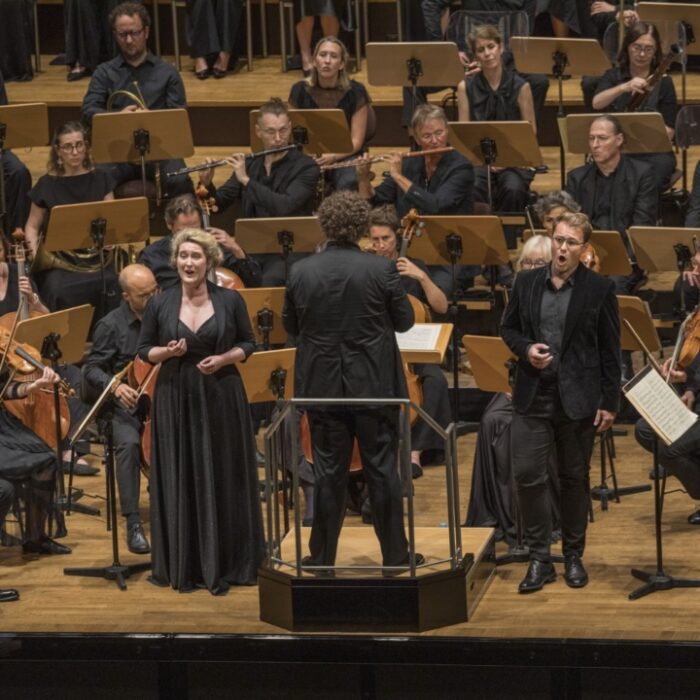
In the lead role, soprano Hannah Gries portrayed a deeply troubled Costanza. Opening the performance in a tattered crinoline skirt and draped in worn canvas stamped with the word “abbandonata,” she presented an image of profound sorrow. Her hesitant steps and weary vocal production directly mirrored a woman who had spent years crushed under despair, conveying the character’s internal anguish. Yet, this intense dramatic commitment also exposed some vocal vulnerabilities under scrutiny. Her tone needed a bit more support to fill the space, and her upper register occasionally leaned toward a slight strain.
However, the stage direction provided a refreshing beat during one of Costanza’s most crucial moments. In the original libretto, she is supposed to faint dramatically upon catching sight of her long-lost husband. In this production, she was directed to freeze entirely in place like a statue. This sudden physical paralysis left Gernando and Enrico staring at her in complete confusion, inserting a Haydn-esque humor directly into what is normally a standard dramatic cliché.
In vibrant contrast to her sister’s heavy gloom, coloratura soprano Sharon Tadmor brought a bright wave of youthful energy to the role of Silvia. Stepping onto the stage in a vivid red swimsuit, she immediately projected a sense of boundless, untamed freedom. She delivered a delightfully fresh perspective on her solitary island life, remaining genuinely bewildered by Costanza’s constant melancholy. Later, when she unexpectedly encountered the two newly arrived men on the shore, Tadmor as a youthful singer rendered her character’s mix of unvarnished curiosity and nervous tension with a fearless exuberance.
Her awakening to first love upon meeting Enrico proved to be one of the musical highlights of the evening. Supported by crisp, lively playing from the ensemble, she captured the awkward jitteriness of a young heart discovering unfamiliar emotions for the very first time. Tadmor’s timbre sounded joyfully pure, natural, and unpretentious, yet it retained an impressive agility during her coloratura passages. She succeeded in portraying a young girl who is entirely unversed in the ways of the world. Additionally her performance could have achieved an even higher level had she chosen more seamless moments for breath control during the aria “Come il vapor s’accende,” and had she avoided deliberately slowing down her tempo significantly during a few unusually low vocal lines for a soprano.
Tenor Peter O’Reilly as Gernando and bass-baritone Michał Karski as Enrico made an immediate impression upon striding onto the island dressed in holiday clothing wearing sunglasses. They established a believable chemistry that marked them clearly as devoted friends. Karski’s vocal production was solid, confident, and inherently masculine. He maintained a calm, steady presence throughout, offering a stage persona that convincingly served as Gernando’s vital emotional anchor during his worst moments of crisis.
The character of Gernando is more complex in the drama, but O’Reilly handled his journey with sincerity. He credibly charted the character’s progression from unwavering loyalty, to sheer horror upon reading Costanza’s carved message, and finally to overwhelming jubilation when the two lovers were at last reconciled.
Musical Highlights
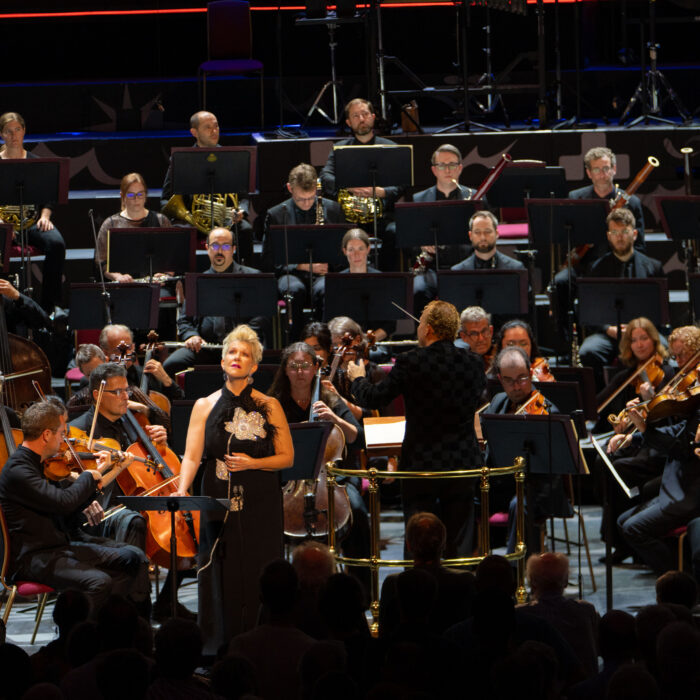
The Orchestra of the Eighteenth Century, directed by Benjamin Perry Wenzelberg, delivered a commendable performance, striving to maintain the refined elegance and relaxed intimacy essential for this chamber opera. Most sections contributed enjoyable musicianship. However, the musical performance overall would have gained more momentum had the tempi been kept slightly tighter. The transitions between the recitatives and the arias needed to be bridged more seamlessly, and the string section could have offered cleaner phrasing to sharpen the musical contours and elevate the dramatic tension.
Finally, a minor dramaturgical issue deserves mention regarding the pacing of the opening. For an opera that lasts only eighty minutes in total, the seven-minute opening Sinfonia feels somewhat disproportional in the composition. Apart from the manual raising of the background curtain, the staging offered no other action during this extended orchestral intro, rendering the beginning a bit uninspired. Throughout the performance, although the lighting created an effective atmosphere, the seascape curtain picture often felt a bit too static for its own good.
All things considered, however, this remains a lighthearted, visually clean, and emotionally sincere production. It treats Haydn’s compact score with affection, making for a joyful evening at the Oldenburg State Theater.